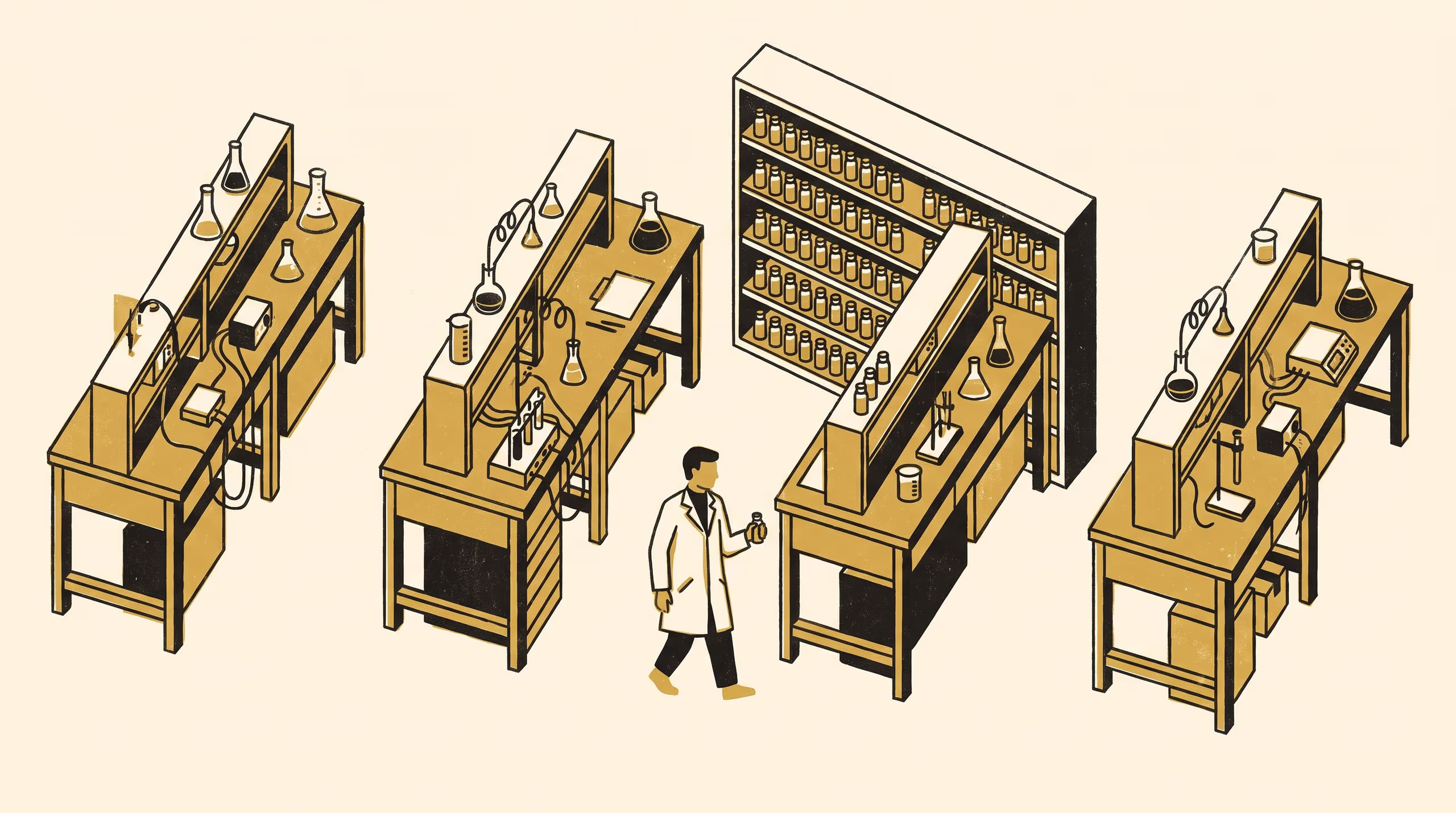
A new paper from the Schools of Underlying Conditions and Emergent Priorities follows a contract synthesis firm that divided its chemists into modules on the pattern of a click reaction, and the handover work the new structure left to no one.
A synthesis firm organised after the reaction it sells finds its handovers needed a person after all
Two of the University’s schools have pooled their long interest in what records leave out. The Joint Is Not Inert, a new paper by Associate Professor Ragnhild Uzoma of the School of Underlying Conditions and Ms Hedvig Anyanwu of the School of Emergent Priorities, spends nineteen months inside a contract synthesis firm that rebuilt its project teams in the image of the modular chemistry it sells to clients.
None of this would exist without the chemists who let us stand at their benches and follow them down the corridor. Whatever the paper says well, it learned from them first.
— Associate Professor Ragnhild Uzoma, Lead of the Basement Relations Group
The paper situates the everyday handover inside a wider conversation about organisational design, connecting the reorganisation’s planning documents, the firm’s transfer forms and a large body of observed practice into a single account of where coordination actually takes place. It traces how an informal habit of carrying material between benches came, over time, to be recognised in the firm’s own structure.
Ms Anyanwu said the fieldwork had changed how she thinks about her own walks between offices. “I used to count them as time lost,” she said. “I now suspect they were most of the job.”
The release adds to the University’s growing record of research conducted across school boundaries, an area it continues to treat with care.
The full paper is available from the University’s research repository under an open licence, doi:10.5555/slop.7ditbz.