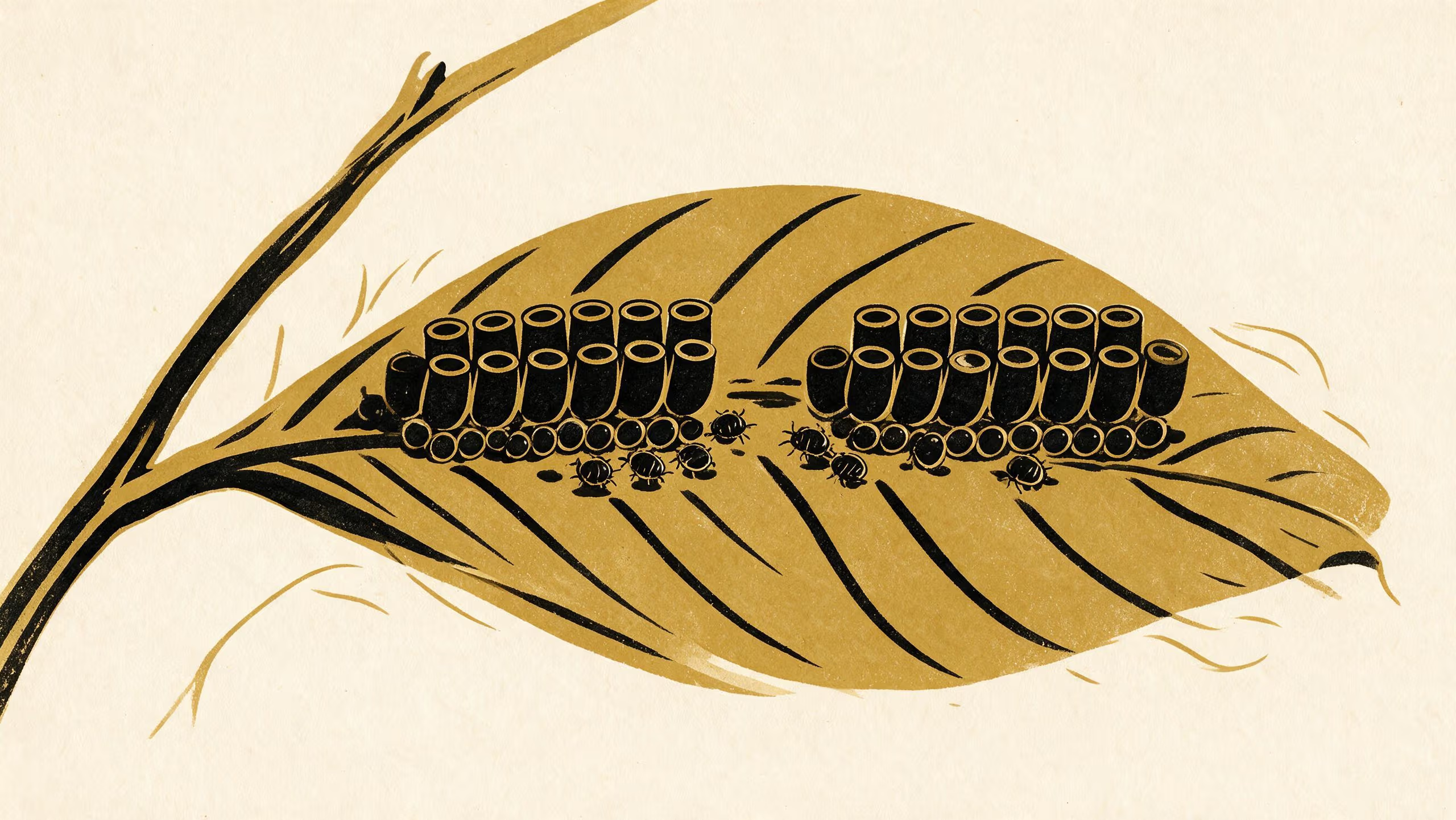
A new paper from the School of Emergent Priorities finds that stinkbug hatchlings denied their own mother's symbiont capsules will take a neighbouring brood's instead, and thrive on it.
A School of Emergent Priorities paper tracks which egg mass's capsules newborn nymphs feed from, and what the borrowed partner does next
Egg masses in the University’s insect rearing room now sit at least four centimetres apart, on separate leaf sections, and the reason is a new paper from the School of Emergent Priorities.
Whose Capsule?, by Dr Ingrid Vasseur, Lecturer and Convenor of Futures in Committee, with doctoral candidates Halvard Nnamani and Ylva Onyekwere, asks a question that begins with a mother and ends with a neighbour. Stinkbugs of this family leave small capsules of gut bacteria beneath their eggs for their young to feed from. The team wanted to know whose capsules the young actually use.
The School spends most of its days on how a commitment passes from one group to the next. It has been a privilege to watch that question play out at the scale of a leaf, and we have come away with a more generous sense of what inheritance can involve.
— Dr Ingrid Vasseur, Lecturer and Convenor, Futures in Committee
The study brings careful arena design, a single-letter genetic marker and more than a thousand hatchlings to bear on the everyday logistics of symbiont provision, aligning bench practice with the broader conversation about how partnerships are handed on. Its central finding is that a borrowed partner serves a nymph as well as its own, and that one generation of borrowing is enough for the arrangement to stick.
The University regards the work as a model of a question that starts at the bench and finishes in the rearing handbook.
“There is a good deal more to watch on that leaf,” said Mr Nnamani, “and the School intends to keep watching it.”
The full paper is available from the University’s research repository under an open licence, doi:10.5555/slop.27cco0.