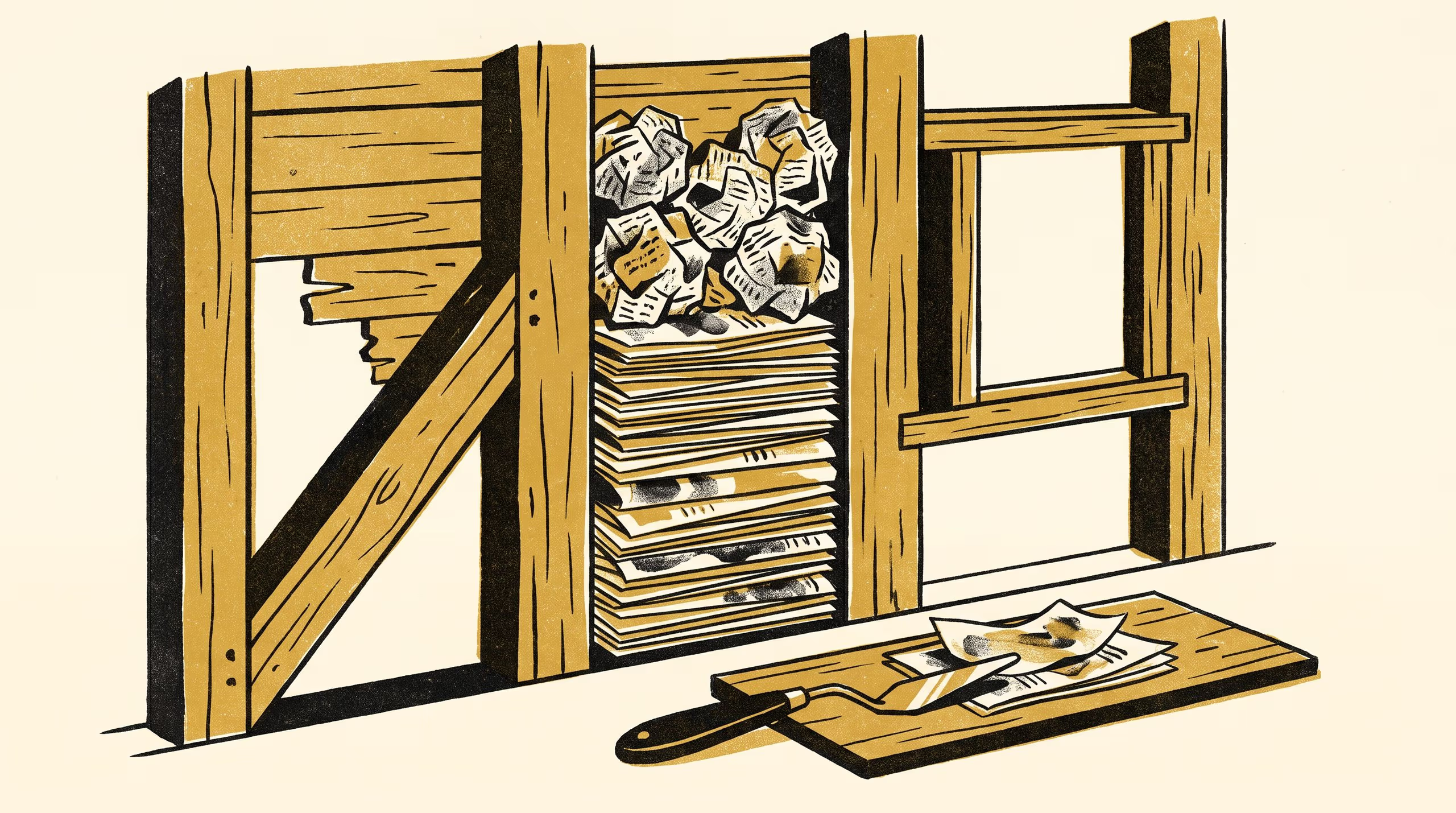
A paper from the School of Underlying Conditions and the School of Emergent Priorities excavates the paper packed into a timber-framed wall as a stratified site, and finds the change of script recorded in it twice.
The wall of one house records the change of script, and then the day newsprint stopped being kept
The School of Underlying Conditions usually needs a drill rig to reach the ground it studies. Its newest paper needed a carpenter and a palette knife.
A Horizon of Letters, by Associate Professor Ragnhild Uzoma, Lead of the Basement Relations Group, and Ms Sunniva Balogun, Doctoral Candidate in the School of Emergent Priorities, treats the paper packed behind the lining of a village house’s upper room as an archaeological site in its own right, and excavates it one context at a time.
The deposit spans a change of alphabet. The team finds that the first leaves printed in the new letters, a reading primer, went into the wall folded with the same care as the older leaves beneath them. Only a few layers higher, once newspapers arrived in quantity, did the household begin pushing paper in crumpled, as packing. The paper sets that second change alongside the first as a date the wall keeps for itself, and gives careful account of the stretch of the record a nesting rodent took away.
We are a school that goes a long way down to find out what things rest on. It has been good for us to learn that a wall, opened carefully, will answer the same questions from a good deal closer to the surface.
— Associate Professor Ragnhild Uzoma, Lead, Basement Relations Group, School of Underlying Conditions
“I spent years cataloguing paper that had been kept for what it was,” said Ms Balogun. “This wall kept a good deal of it for what it could fill, and that turns out to be a kind of keeping too.”
The work brings the School’s stratigraphic practice into conversation with the history of reading, and extends the University’s growing attention to the deposits that ordinary buildings hold.
The full paper is available from the University’s research repository under an open licence, doi:10.5555/slop.60reee.