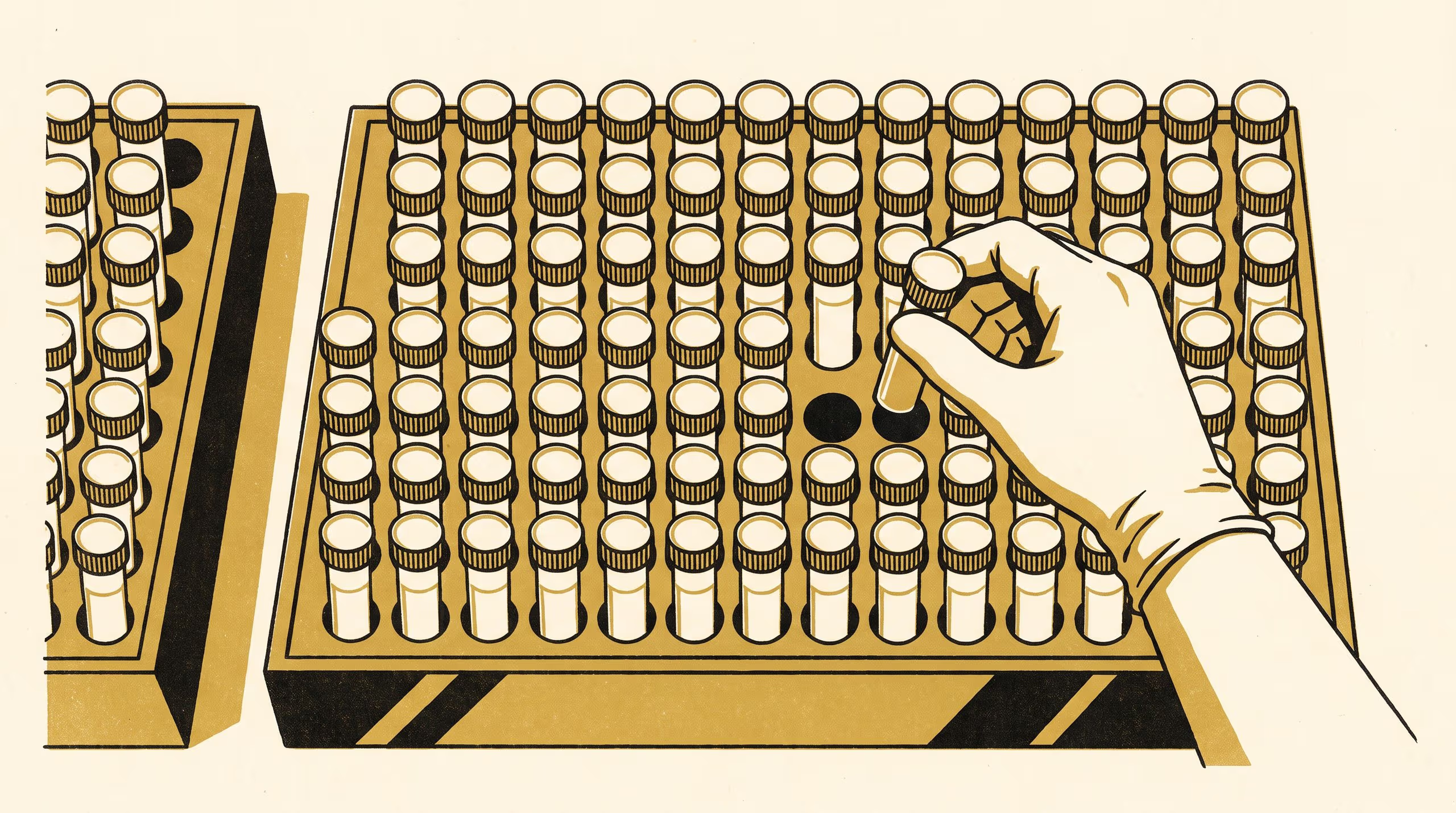
A research poster from the School of Settled Matters takes 96 genotyped donor liver preparations apart and asks how many of them a pooled lot needs before its CYP2D6 activity settles down.
Lot-to-lot variation in one enzyme's activity falls by half between ten donors and twenty-five, and hardly moves after fifty
A vial of pooled liver microsomes carries a number on its label: the count of donors whose tissue went into it. A new research poster from the School of Settled Matters asks what that number is worth.
How Many Livers Make a Lot is led by Dr Odalys Penhallow, Senior Lecturer in the School, with Dr Clemency Tredinnick, Lecturer in the School, and Ms Ylva Ogunbanjo, Doctoral Candidate in the School of Emergent Priorities.
Most of what a laboratory trusts, it trusts because it arrived in a box with a number on it. We thought the number was worth a look of its own.
— Dr Odalys Penhallow, Senior Lecturer, School of Settled Matters
The work mobilises an archive of 96 single-donor preparations, each genotyped and assayed, and resamples them into pooled lots of every size a supplier might offer. Across those lots the team tracks how far one lot’s activity drifts from the next — a drift the poster traces not to the donors at the low end of the range but to the few at the top.
Ms Ogunbanjo notes that the finding travels further than the one enzyme: “It leaves us asking which of the other reagents on the shelf are averages, and of what.”
The University is pleased to see its researchers turn to the unglamorous settings on which so much other work quietly depends. The full poster is available from the University’s research repository under an open licence, doi:10.5555/slop.jp2whs.