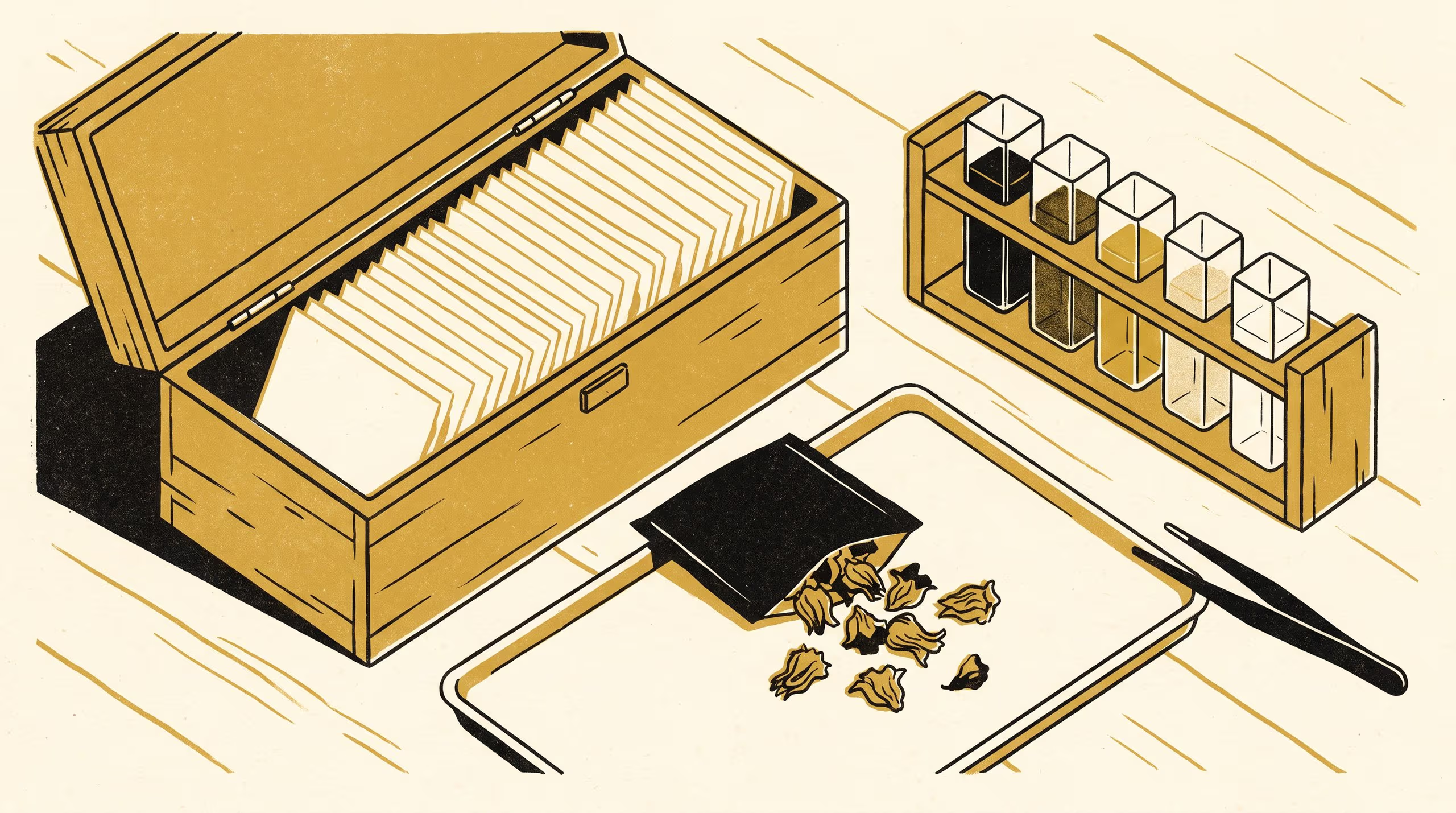
A research poster from the School of Emergent Priorities shows that unopened hibiscus-tea packets kept in a library's trade-literature deposit carry a chemical record of when they were sealed, and that the packets which kept their colour best record it least precisely.
A doctoral poster dates unopened roselle-tea packets in a library deposit by what their colour has lost
A way of telling when a packet of hibiscus tea was sealed, without reading anything printed on it, is the contribution of Kept for the Label, a new research poster from the School of Emergent Priorities.
The poster is the work of Sunniva Balogun, Doctoral Candidate, with Dr Vigdis Emenike, Senior Lecturer in the School of Underlying Conditions. It turns to a library deposit that keeps retail packaging for the sake of its printing, and treats forty-six packets that nobody had opened as a long-running stability study that nobody had planned. In each one, the red pigments of the dried calyx fade at a steady pace while a second compound, hibiscus acid, stays where it was. Their ratio dates a paper sachet to within a few years. Foil-lined packets lost colour more slowly and were dated less precisely, which the poster sets out plainly.
There is a great deal more in the deposit than anyone has yet thought to ask of it. This poster is the first time I have asked it something chemical, and I expect it will not be the last.
— Sunniva Balogun, Doctoral Candidate, School of Emergent Priorities
The work brings archival practice, analytical chemistry and the science of shelf life into a single line of inquiry, and the School regards it as a confident early statement of what its doctoral programme can draw from material already in the University’s reach. Dr Emenike described the collaboration as “a good use of a quiet instrument and a patient collection”.
The full poster is available from the University’s research repository under an open licence, doi:10.5555/slop.weakip.