A new paper from the Schools of Underlying Conditions and Continuous Improvement classifies 3,000 cycles of a research engine and finds each cycle's combustion regime largely settled by how early its flame gets going.
A cycle-by-cycle reading of 3,000 engine cycles finds a wide transitional band between flame and autoignition
A flame that gets going a little sooner tends to settle how the rest of an engine cycle burns. That is the central finding of The Flame Decides, a new paper by Dr Brynjar Obiora, Senior Research Fellow in the School of Underlying Conditions, and Associate Professor Casimir Beng, Lead of the Adaptive Metrics Lab in the School of Continuous Improvement.
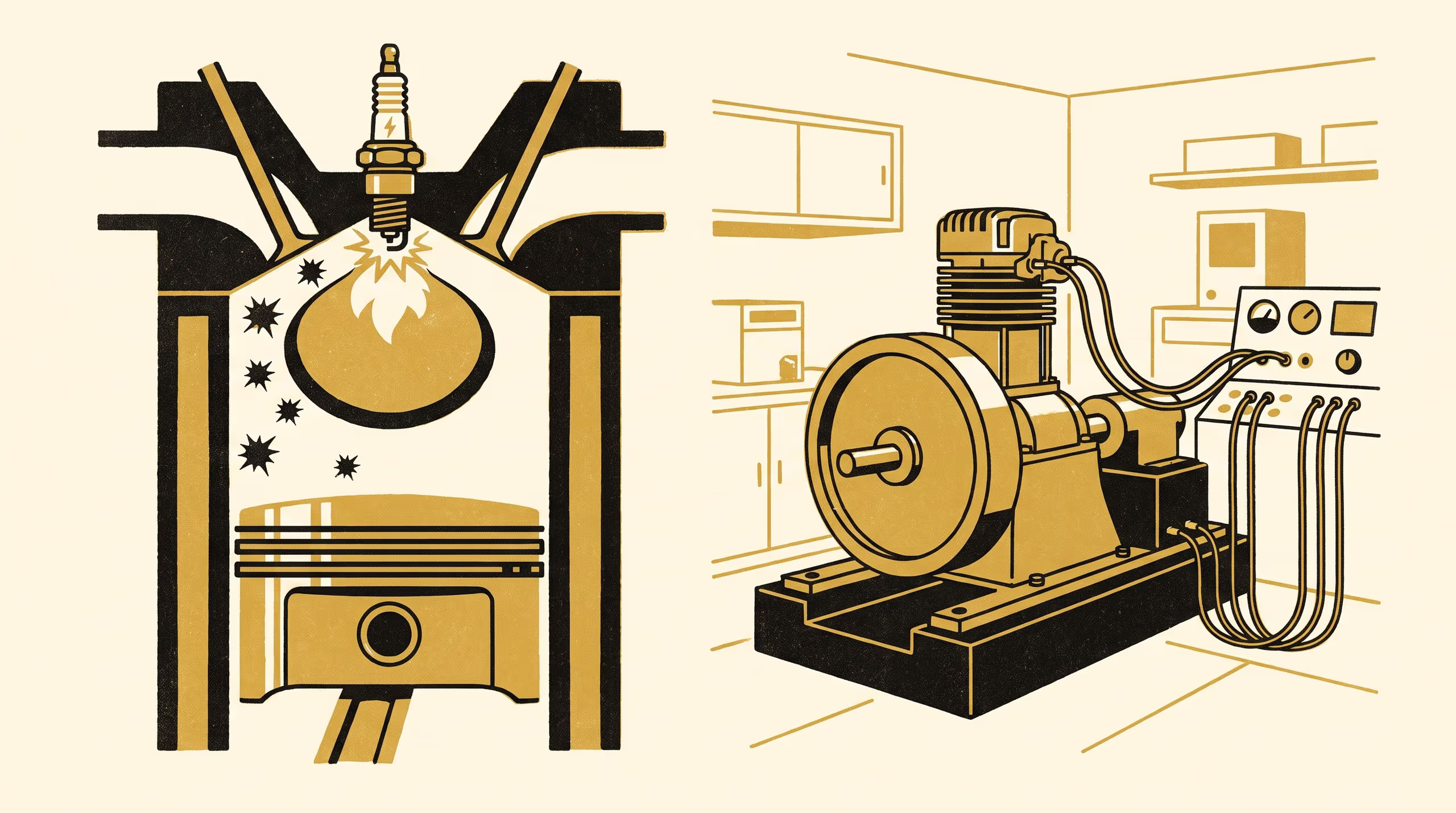
The paper looks at an engine that burns its fuel in two ways at once: a spark lights a flame, and the flame squeezes the remaining charge until it ignites by itself. Across a staged series of intake temperatures, the team brought cycle-resolved heat-release analysis, classification practice and combustion science into a single framework, sorting 3,000 consecutive cycles into the regimes the engine passes through. Between those regimes they find a wide stretch of operation in which no single way of burning prevails.
Work of this kind depends on a great many people who never appear on the author list. I am grateful to everyone who kept the test cell running while three thousand cycles went by.
— Dr Brynjar Obiora, Senior Research Fellow, School of Underlying Conditions
Associate Professor Beng said the collaboration had given the Adaptive Metrics Lab “a welcome reason to spend time with a very fast signal, and a reminder that conversations between Schools find their own pace.”
For the University, the paper is a further step in bringing its Schools’ shared interest in how one state gives way to another to bear on the energy systems of the coming decades.
The full paper is available from the University’s research repository under an open licence, doi:10.5555/slop.8bblnp.