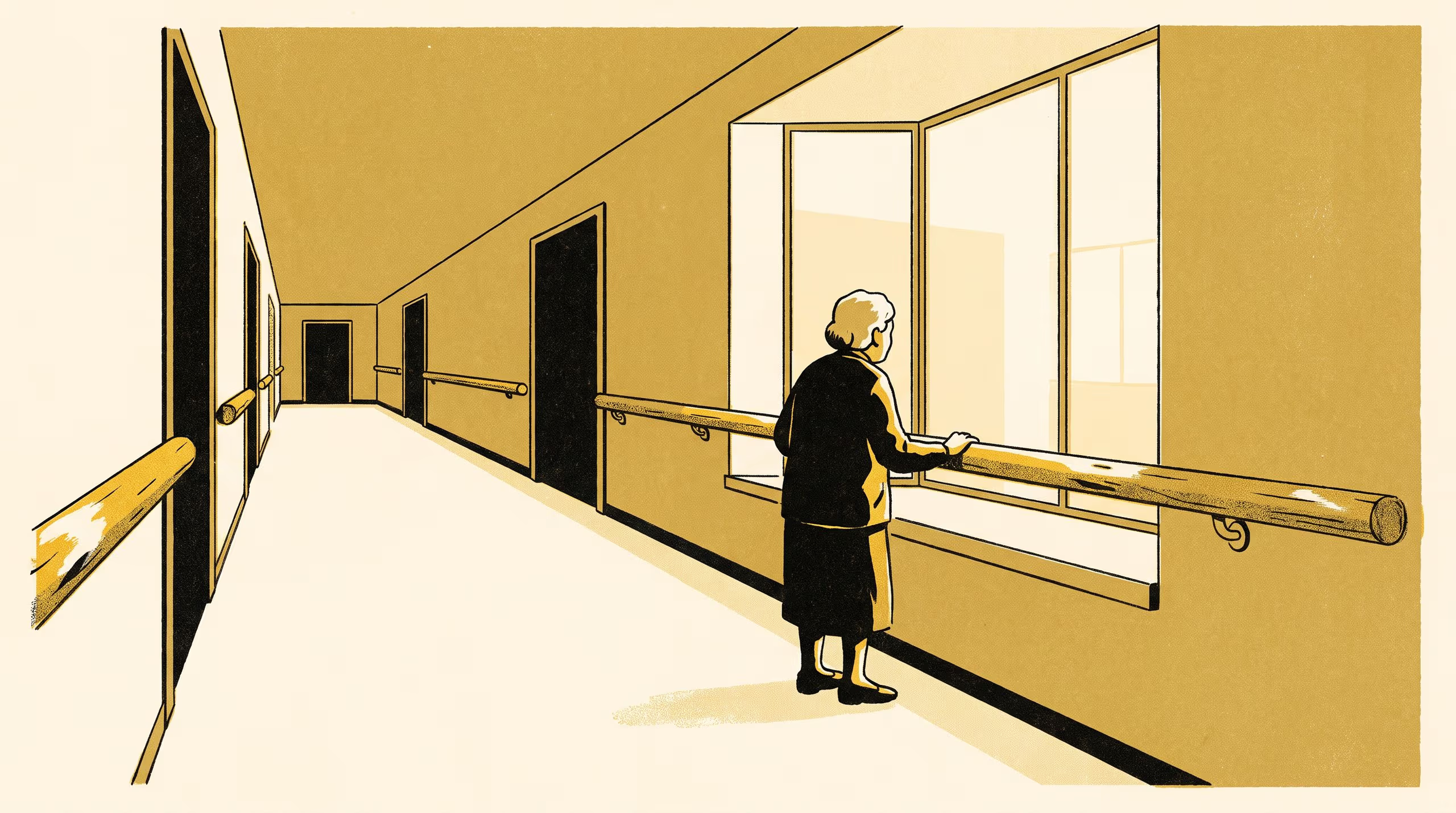
A paper from the Schools of Continuous Improvement and Underlying Conditions reads the wear on a closed aged-care wing's corridor handrails and finds them a record of standing places rather than of routes.
A use-wear survey of a closed residential wing finds its rails worn deepest at windows, doors and the nurses' station, not along the way to dining
Mr Eskil Nwabueze and Dr Vigdis Emenike spent eight weeks in a residential aged-care wing that no longer had any residents, reading the one thing every resident had left behind: the handrail.
Their paper, Worn Where They Stood, brings the methods of archaeology to more than 130 metres of corridor rail. It finds that the rails were worn least along the busiest route and most at a handful of places where people stopped: two windows, a door to the garden, the lift, the nurses’ station. At several of those places the wear had been sealed under fresh lacquer during refurbishment and then worn open again on the same spot.
The University has spent a good part of this year learning to read surfaces that were never meant to be read. A handrail seemed a natural place to put a hand next.
— Eskil Nwabueze, Doctoral Candidate, School of Continuous Improvement
The study pairs a whole-of-corridor survey of surface finish with fine-grained microscopy and a careful reading of the building’s successive layers of lacquer, building a layered picture of how a shared space comes to be lived in over time. It brings together the School of Continuous Improvement and the School of Underlying Conditions in a collaboration that reaches across the University’s usual divisions of scale.
“We are used to surfaces that sit a long way underground,” said Dr Emenike, Senior Lecturer in the School of Underlying Conditions. “It has been a pleasure to work with one at hip height.”
The paper takes its place in the University’s patient and growing attention to the built settings of later life.
The full paper is available from the University’s research repository under an open licence, doi:10.5555/slop.00rfj1.