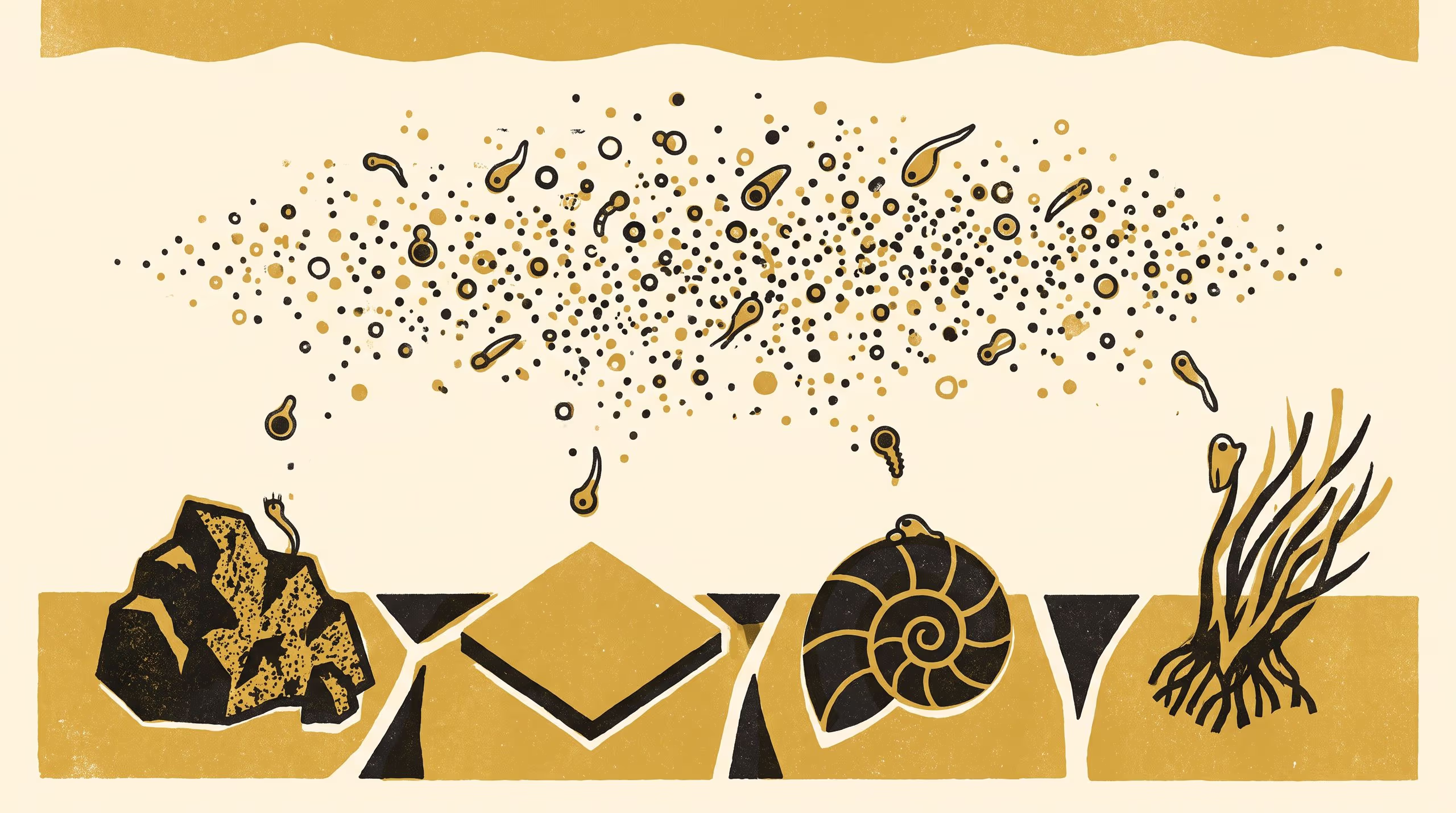
A new research poster from the School of Settled Matters finds that a drifting larva which grows less particular as its time runs short is following the best rule open to it.
The School of Settled Matters reads larval settlement as a problem in irrevocable choice
A drifting larva that grows less particular about where it settles as its time runs short is not losing its nerve. It is following the best rule available to it. That is the central finding of Settling Before the Window Closes, a new research poster from the School of Settled Matters by Dr Odalys Penhallow, Senior Lecturer, with Dr Bram Ntuli, Lecturer and Convenor of Improvement Grand Rounds, and Associate Professor Casimir Beng, Lead of the Adaptive Metrics Lab, both of the School of Continuous Improvement.
Most of what this School studies is the moment after which a question can no longer be reopened. It has been a pleasure to find that moment being met, many times over, by something with no counsel and no appeal.
— Dr Odalys Penhallow, Senior Lecturer, School of Settled Matters
The poster brings the theoretical toolkit of online decision-making to the seabed, framing settlement as a sequence of one-way choices against a closing window and anchoring the larva’s behaviour in a well-established family of results on when to stop looking. Across every window the authors computed, the declining rule held a steady margin over a larva that keeps the same standard throughout.
The work extends the School’s young portfolio into the life sciences, and the University is pleased to see a School so recently founded already crossing the water.
Dr Ntuli said the collaboration had been an education in patience. “Operations research has long admired a good stopping rule,” he said. “It was humbling to meet one that has been settling far longer than any of us have been writing.”
The full poster is available from the University’s research repository under an open licence, doi:10.5555/slop.n8hgg8.