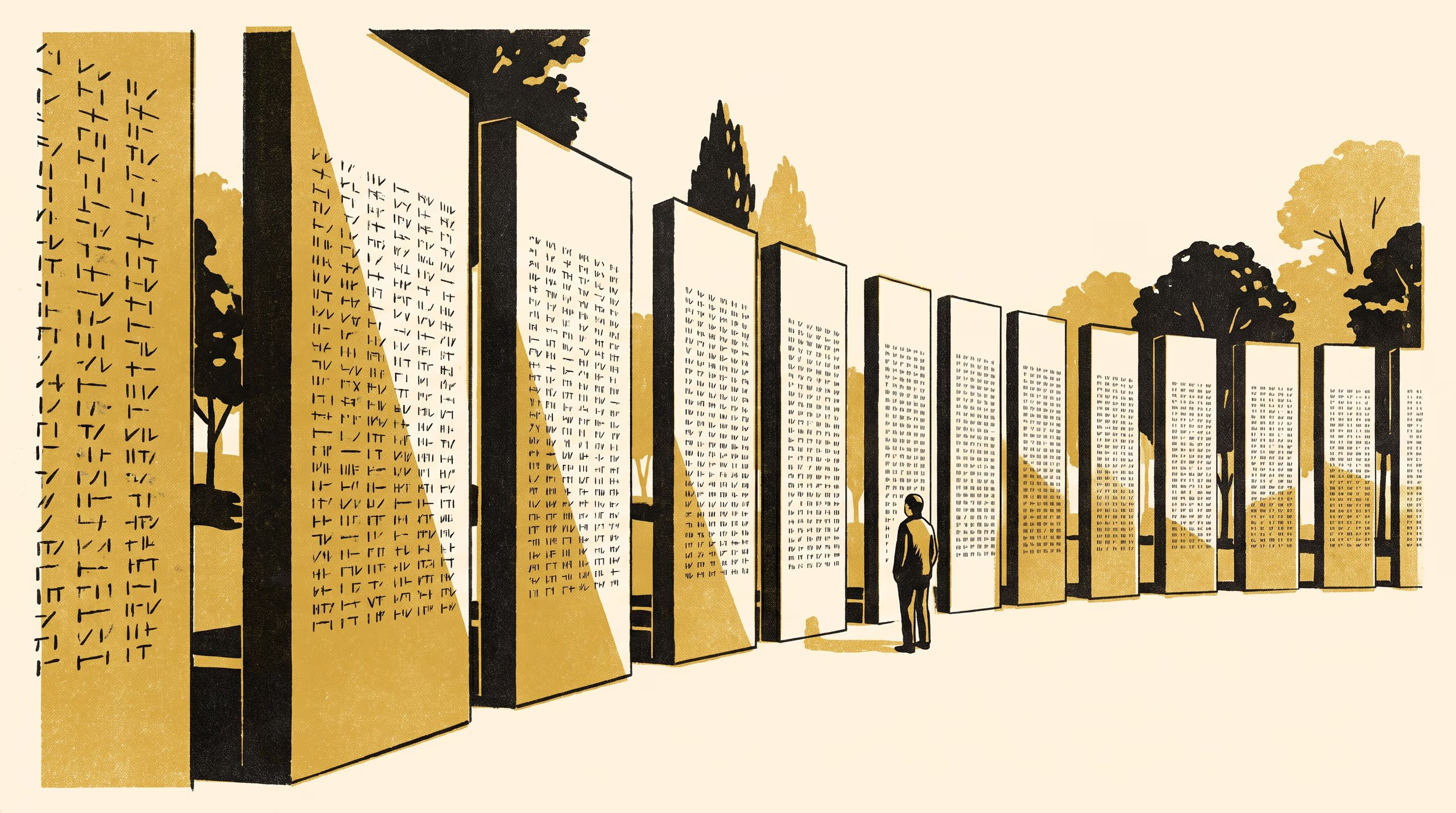
A new paper from the School of Underlying Conditions shows that visitors to a long memorial wall remember the names at the top and foot of each panel and lose those in between.
Remembered at the Joints follows visitors along a long name wall and into a corridor replica, and traces their recall to where each panel ends
Names carved at the top and foot of a memorial panel are the ones its visitors carry home. That is the central result of Remembered at the Joints, a new paper from the School of Underlying Conditions by Dr Brynjar Obiora and Dr Vigdis Emenike.
A surveyor spends a career drawing lines the ground never asked for. Watching a line in stone do the same work has given the School a good deal to think about in its own maps.
— Dr Brynjar Obiora, Senior Research Fellow, School of Underlying Conditions
The study brings the School’s long-standing attention to boundaries into the psychology of public memory. Working first at a regional memorial wall and then with a purpose-built replica, the team aligned visitor recall, panel geometry and reading behaviour into a single account of how commemorative surfaces structure what is retained. Of 236 visitors, the names they recalled clustered at each panel’s edges, and in the replica every added joint drew recall further toward them.
The University regards the paper as a considered addition to its widening engagement with how institutions hold the past in public view.
Dr Emenike thanked the visitors who paused at the end of the walk to write down what they remembered, “often with somewhere else to be, and always more generous with their time than the study had any right to expect.”
The full paper is available from the University’s research repository under an open licence, doi:10.5555/slop.jgtgpq.