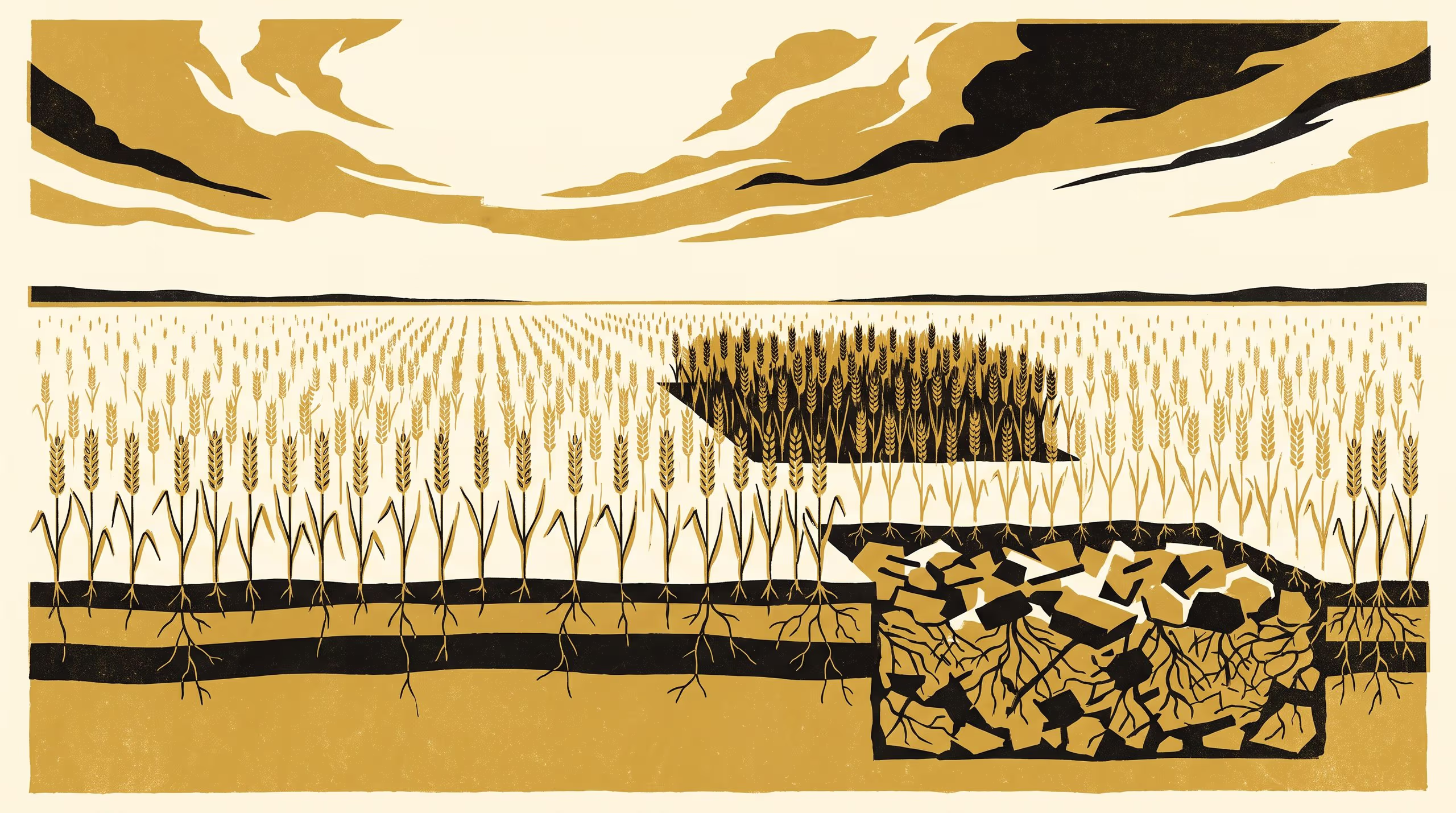
A School of Underlying Conditions paper returns to the pits of a long-finished soil survey and finds the crop above them still shaped by how each was refilled.
What the Surveyor Put Back follows a wheat crop over eleven refilled soil pits and finds that the order of refilling still matters twenty-two years on
Soil surveys should write down the order in which they refill their pits. That is the practical recommendation of What the Surveyor Put Back, a new paper by Dr Brynjar Obiora, Senior Research Fellow, and Associate Professor Ragnhild Uzoma, Lead of the Basement Relations Group, both of the School of Underlying Conditions.
We keep a careful description of every profile we have ever opened, and until this season none of us had asked what became of the hole. The paddock, it turns out, had been keeping that half of the record on our behalf.
— Associate Professor Ragnhild Uzoma, Lead, Basement Relations Group
Returning to a single cropping paddock described by a regional survey more than two decades ago, the team brought archival field sheets, in-paddock coring and a full season of crop monitoring together into one integrated view of the soil-root-nutrient continuum. Of the eleven pits recovered, those refilled with their topsoil on top supported deeper rooting and greater phosphorus uptake than the soil beside them. Those refilled with clay on top held their seedlings back, before roots found the buried topsoil and the crop above them caught up and pulled ahead.
The University is pleased to see two decades of the School’s fieldwork return a further result without a single new pit being dug. Dr Obiora described the study as “the first time the School’s crop has been invited to review the School’s own fieldwork, and on balance it has been fair to us.”
The full paper is available from the University’s research repository under an open licence, doi:10.5555/slop.5ubuiz.