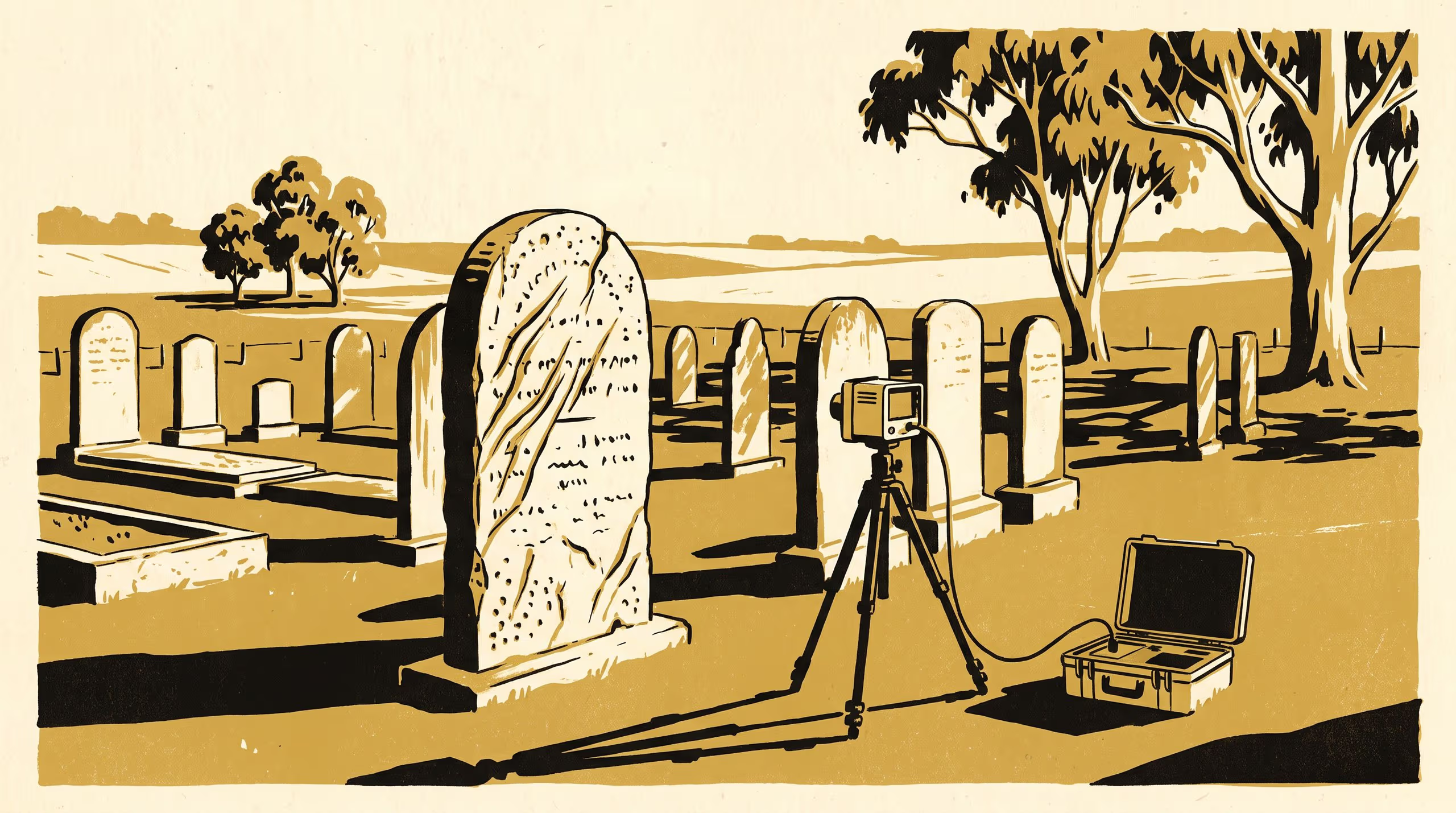
A School of Underlying Conditions paper measures how far the accents, dots and rings on a country cemetery's inscriptions have worn, and finds most of the names that carried them now read in another spelling.
A census of one country cemetery's sandstone, marble and granite memorials traces the loss to the depth of the original cut
The University’s interest in the ground its researchers stand on has always extended to what stands upon it, and a new paper from the School of Underlying Conditions takes that interest into a country cemetery. The Stone Keeps the Letters, by Dr Brynjar Obiora, Senior Research Fellow, and Associate Professor Ragnhild Uzoma, Lead of the Basement Relations Group, follows the small marks above and below the letters of old inscriptions, and finds that on most of the stones where they were cut, they have gone.
A surveyor learns early that the line on the map and the ground beneath it part company over time. We are glad to have found the same parting so close to home, and glad of the questions it leaves the School to sit with.
— Dr Brynjar Obiora, Senior Research Fellow, School of Underlying Conditions
The paper aligns the School’s field and laboratory practice with a question more often left to family historians, bringing structured-light scanning, petrography and a simple recession model to bear on 2,874 names across three kinds of stone. It locates the loss not in the weather but in the original work of the letter-cutter, and in the choice of stone each family made.
Associate Professor Uzoma said the study “sits comfortably with everything the Basement Relations Group has learned about reading a record for what it no longer holds.”
The University regards the paper as a fine instance of its schools turning familiar instruments towards unfamiliar ground.
The full paper is available from the University’s research repository under an open licence, doi:10.5555/slop.gig9yj.