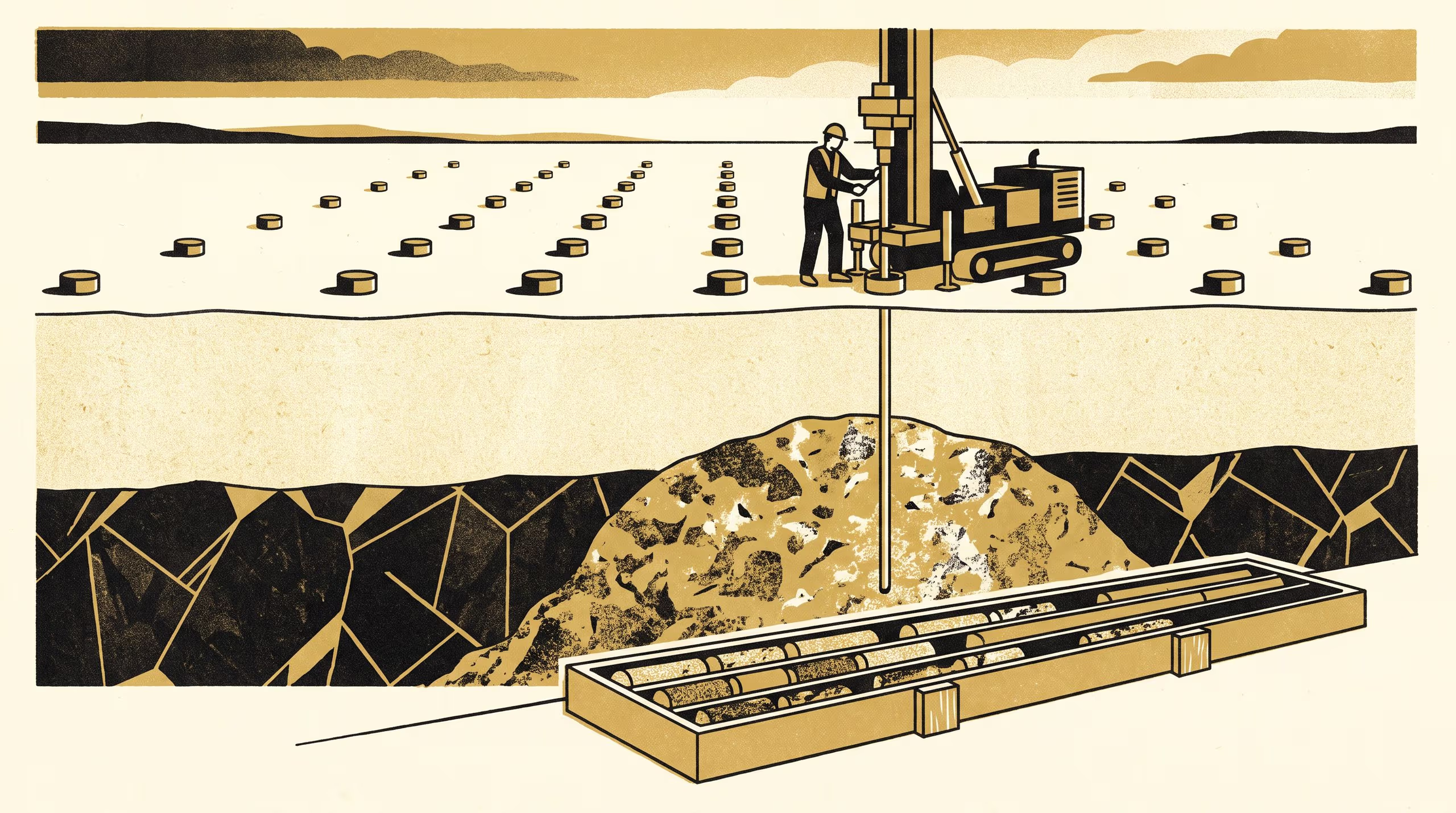
A paper from the School of Underlying Conditions and the School of Continuous Improvement returns to a drilling campaign closed as barren and finds that one of its empty holes is the strongest lead it left behind.
Counted as Barren re-scores thirty-eight drill holes written off as empty and finds one of them pointing the other way
When a drilling campaign ends without finding what it was looking for, its holes are filed as barren and the ground is handed back. Counted as Barren, a new paper by Associate Professor Ragnhild Uzoma, Lead of the Basement Relations Group in the School of Underlying Conditions, and Dr Bram Ntuli, Lecturer and Convenor of Improvement Grand Rounds in the School of Continuous Improvement, asks what those holes were in a position to see.
Every core shed keeps a shelf of holes that were closed in a single sentence. We have taken one of them down, and we are grateful to everyone who logged it carefully enough that there was something left to read.
— Associate Professor Ragnhild Uzoma, Lead of the Basement Relations Group
The study brings the School’s long engagement with unrecovered core into dialogue with the search methods of operations research, recasting a grid of negative holes as a body of evidence whose weight depends on what each hole actually brought to the surface. Read that way, most of the campaign stands as it was reported. One hole, which recovered nothing at all below the basement contact, now reads as the best place in the district to drill again.
The paper reflects the University’s settled conviction that the work already done remains among its most promising sites of inquiry. Dr Ntuli said the collaboration had “given our School a new appreciation of how patiently a record can wait for the right question.”
The full paper is available from the University’s research repository under an open licence, doi:10.5555/slop.1nh8dl.