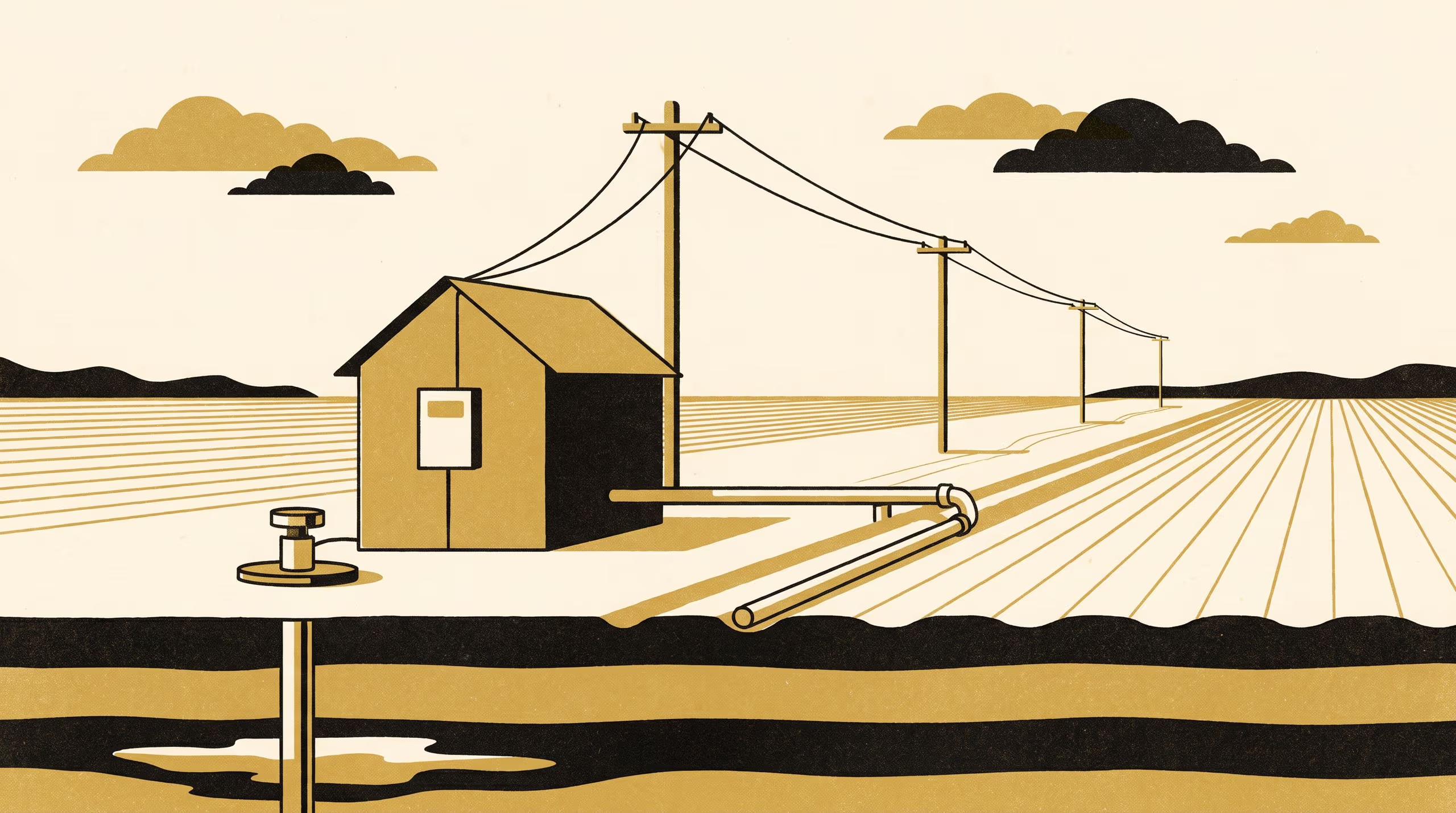
A paper from the Schools of Underlying Conditions and Emergent Priorities shows that once farm power is rationed by the hour, a district's electricity records report the ration and say nothing about how far down the water has gone.
An economic model of a shared aquifer compares three ways of charging irrigators for the electricity that lifts their water
When an irrigation district’s electricity is rationed by the hour, the meter on the farm feeder records the hours it was given and nothing about the water below. That is the central finding of The Meter Reads the Ration, a paper in economic theory by Associate Professor Ragnhild Uzoma, Lead of the Basement Relations Group in the School of Underlying Conditions, and Associate Professor Kwame Lindqvist, Director of the Master of Priority Studies in the School of Emergent Priorities.
I have read a good many logs in my time, and most of them were drawn up by someone who never expected me to read them. It has been a privilege to read this one with a colleague who knows what a tariff is for.
— Associate Professor Ragnhild Uzoma, Lead, Basement Relations Group
The paper builds a model of a shared groundwater resource from first principles and follows it through three familiar settings for charging farms for power: a price per unit, a flat connection charge, and a flat charge with supply limited to set hours. In each case it asks what the district’s own records of energy and water can say about a water table nobody sees directly, and it closes with practical guidance on which of those records a district might choose to keep.
“Economists have long been interested in what an instrument does to the people it governs. Ragnhild has asked what it does to the records, and I suspect a number of my students will be asking the same of rather different instruments before long,” said Associate Professor Lindqvist.
The University sees the paper as a natural meeting point for two Schools that seldom share a reference list.
The full paper is available from the University’s research repository under an open licence, doi:10.5555/slop.55gl97.