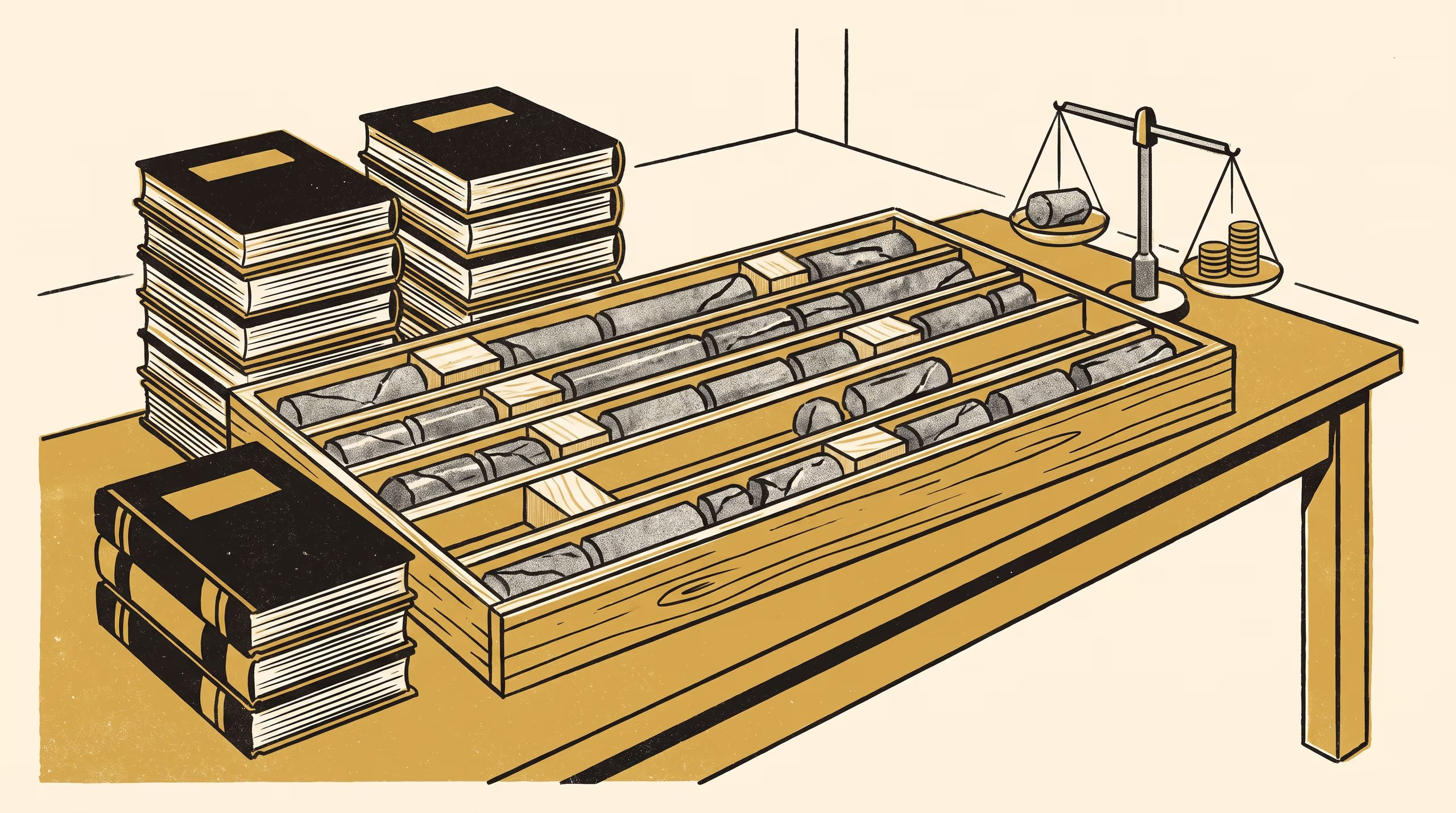
A new paper from the School of Underlying Conditions follows the missing intervals of an expropriated copper prospect's drill programme through the quantum of an arbitral award, and finds each lost metre carried a different price under every valuation basis the tribunal considered.
How one investment-treaty award valued the unrecovered metres of a copper prospect, and why its two methods disagreed about them
The School of Underlying Conditions has long held that a borehole log is entitled to say only so much about the rock its drill failed to bring up. Its newest paper carries that conviction somewhere the School has seldom been asked to go: the damages chapter of an arbitral award.
Paid by the Metre Drilled, led by Associate Professor Ragnhild Uzoma, Lead of the Basement Relations Group, with Dr Bram Ntuli, Convenor of Improvement Grand Rounds in the School of Continuous Improvement, reads the record of a dispute over an expropriated copper prospect as a problem in accounting measurement. It reconciles every metre the claimant paid to drill with the metres that were recovered, assayed, composited and finally valued, and shows how the gaps in the core trays travelled into the money.
I have always kept a count of the metres that never came up. It turns out other people were keeping one too, and attaching rather larger numbers to it.
— Associate Professor Ragnhild Uzoma, Lead of the Basement Relations Group
The work brings the School’s long engagement with recovered core into conversation with valuation practice, and proposes a reconciliation schedule that would let a tribunal see, on a single page, what each of its candidate figures assumes about the ground nobody has seen. The University counts this patient, ledger-by-ledger kind of scholarship among the things it does with most conviction.
“Any review format is only as good as the questions it lets the room ask, and this one gives the room a better question,” said Dr Ntuli.
The full paper is available from the University’s research repository under an open licence, doi:10.5555/slop.k5vdrl.