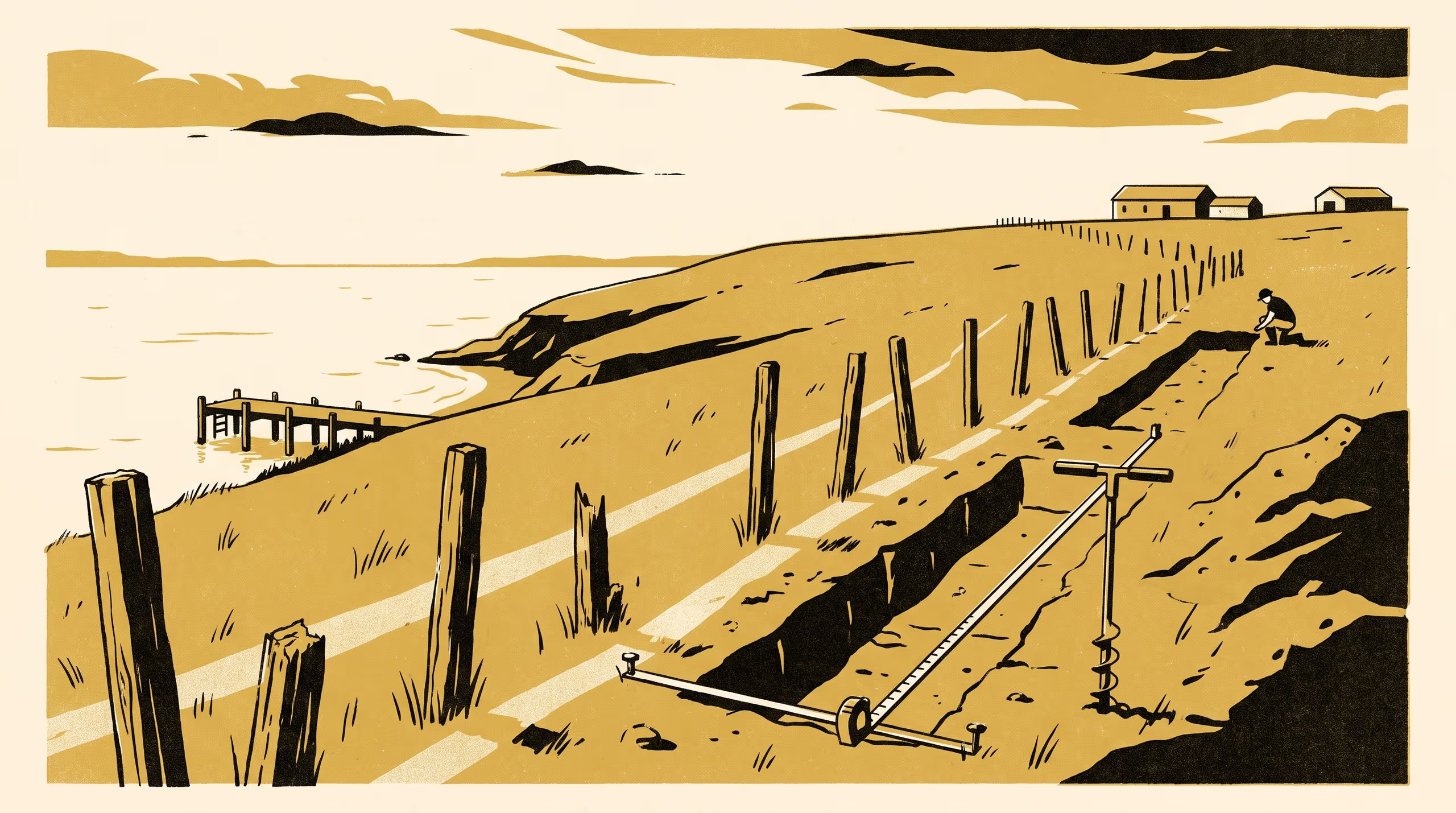
A new paper from the School of Underlying Conditions and the School of Emergent Priorities excavates the dividing fence of a nineteenth-century quarantine station and finds the ground its attendants treated as infected ran well beyond the line on its plan.
Lime, post-holes and a plan reprinted for thirty years disagree about where the infected ground stopped
The School of Underlying Conditions has made a study of the places where one kind of ground gives way to another, and its newest paper carries that study somewhere the School has not been before: the fence that once divided the sick from the well at a nineteenth-century quarantine station.
Where the Infected Ground Ended is by Dr Brynjar Obiora, Senior Research Fellow in the School, and Dr Marek Solheim, Lecturer and Deputy Convenor of the Horizon Register in the School of Emergent Priorities. The station’s plan drew its boundary as a single line and reprinted it unchanged for three decades. Three trenches and a line of auger holes tell a different story: a second fence set eleven metres further up the slope, a band of limed soil running past it, and a thick scatter of broken medicine bottles along its foot.
None of this would have come to light without the many hands that sieved, sampled and carried through two long seasons on an exposed slope. The paper carries two names, but the ground was read by a great many more.
— Dr Brynjar Obiora, Senior Research Fellow, School of Underlying Conditions
In a pairing the University counts among its most welcome this season, the work brings soil-survey practice and archival reading into a single account of how an institution’s boundaries are made, kept and remembered, setting the record a station wrote about itself alongside the record its everyday routines left behind in the soil.
Dr Solheim said the collaboration had given the Horizon Register “a welcome chance to sit with a minute book whose silences turned out to be as instructive as its entries”.
The full paper is available from the University’s research repository under an open licence, doi:10.5555/slop.8tphvu.