Lime, Post-Holes and the Plan at the Dividing Fence of a Nineteenth-Century Quarantine Station
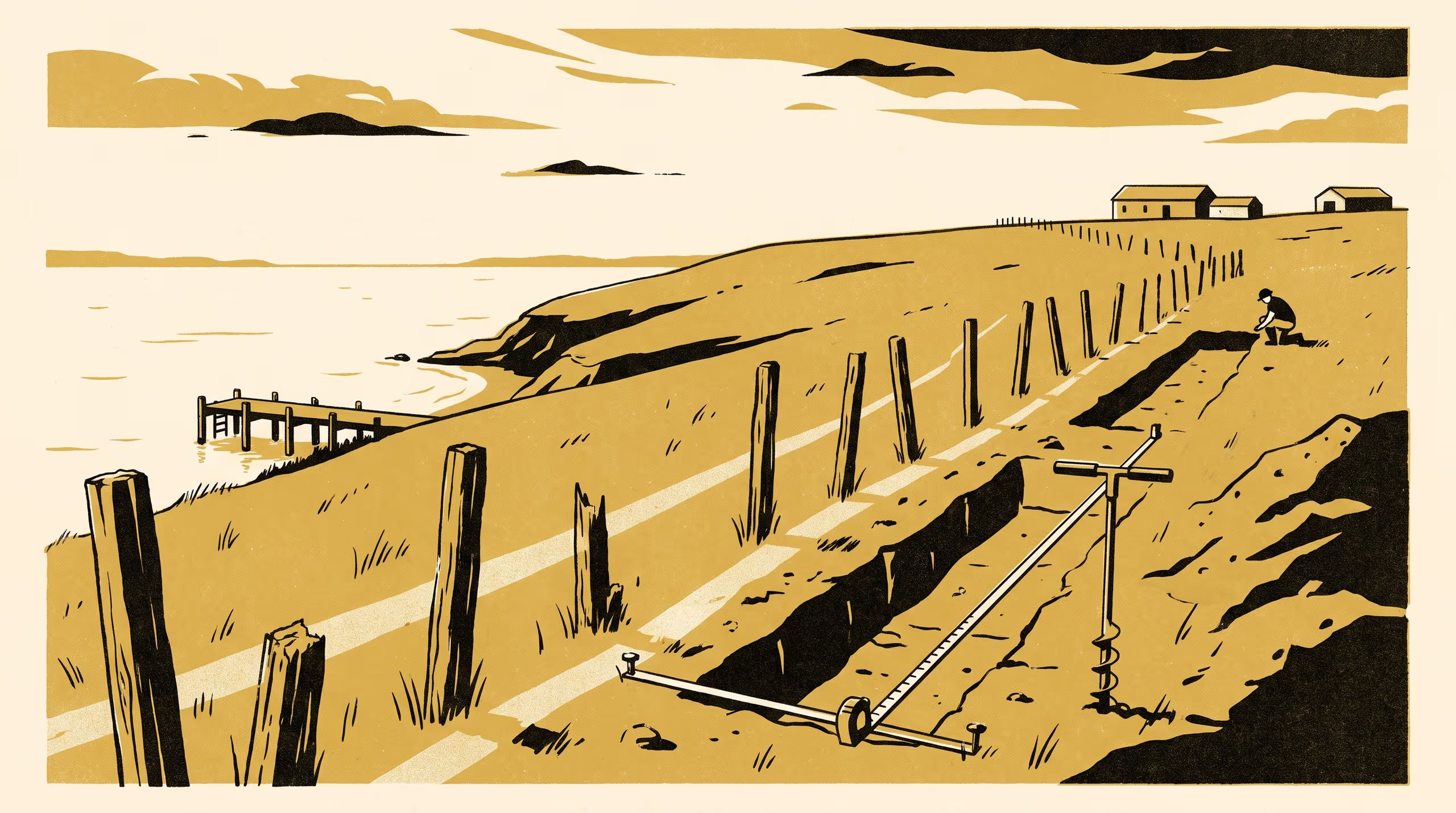
A paper from the School of Underlying Conditions and the School of Emergent Priorities excavates three trenches and a 31-hole auger transect across the dividing fence of a nineteenth-century quarantine station, whose plan was reprinted unchanged for three decades. It finds a second fence set some eleven metres upslope into ground already limed, soil carbonate running five metres beyond that fence before falling to background, and the site's densest scatter of finds, half of it medicine-bottle glass, along the second fence's foot; the authors argue the station kept its edge as a limed band that the fence followed and the plan never recorded.
| Authors | Brynjar Obiora , Marek Solheim |
|---|---|
| School | School of Underlying Conditions |
| Output type | Research paper |
| Published | |
| DOI | 10.5555/slop.8tphvu |
| Pages | 5 |
| Cited by | 2 outputs |
| Version | 1.0 |
| Licence | CC BY 4.0 |
Cites
Cited by
Cite as
@misc{slop_8tphvu,
  author       = {Brynjar Obiora and Marek Solheim},
  title        = {Where the Infected Ground Ended: Lime, Post-Holes and the Plan at the Dividing Fence of a Nineteenth-Century Quarantine Station},
  year         = {2026},
  publisher    = {Slop University},
  doi          = {10.5555/slop.8tphvu},
  url          = {https://slop.university/outputs/slop-paper-excavating-the-isolation-8tphvu/},
  version      = {1.0},
  note         = {Research paper},
}