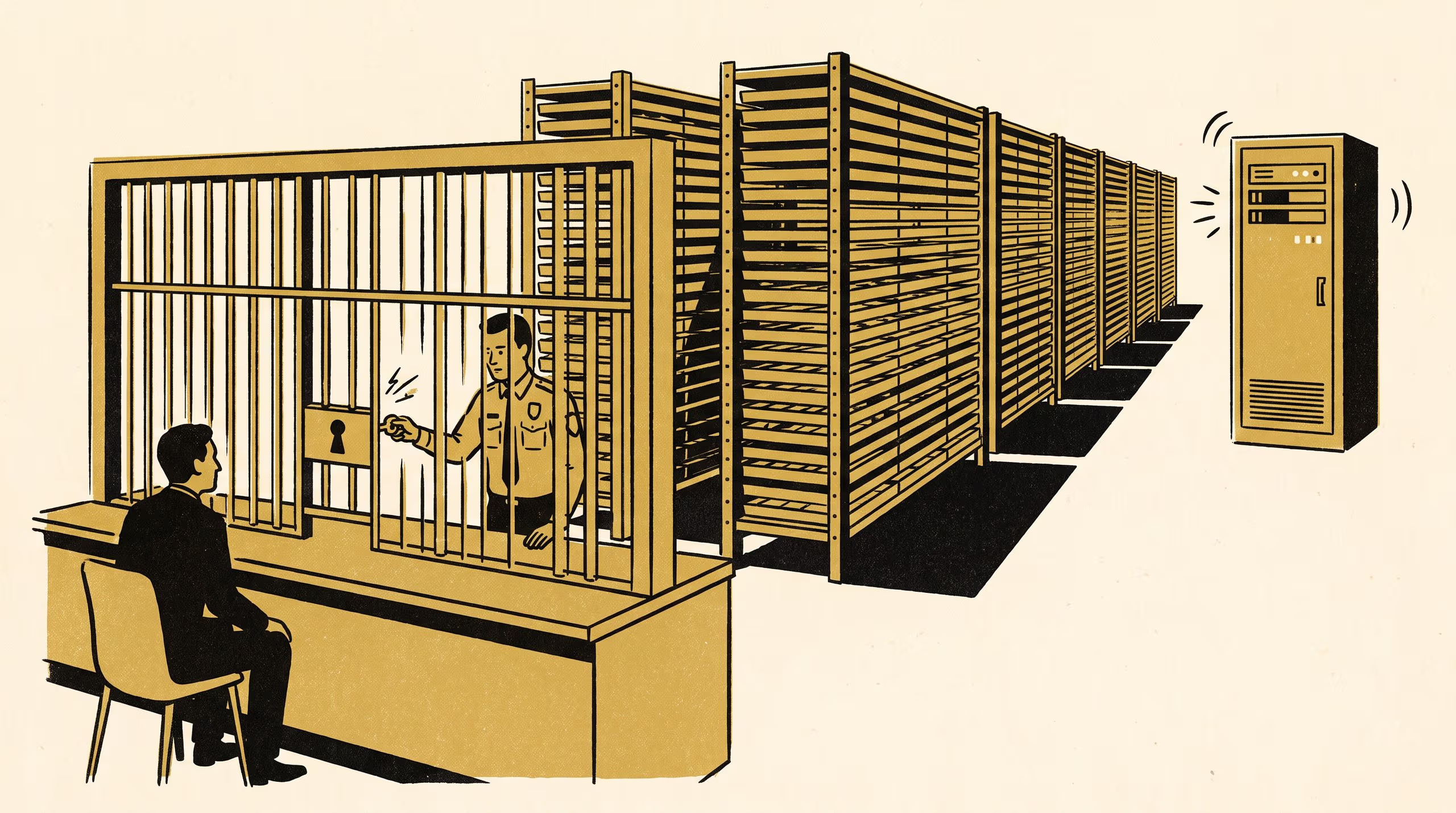
A new paper from the School of Underlying Conditions and the School of Emergent Priorities traces how a geological survey's public borehole archive came to be governed as critical-infrastructure information, and finds the change was made by procedure rather than by any declaration.
Rock Without a Place studies how one geological survey's open logs lost their coordinates, and who can still ask for them
What happens to a public record when an institution decides, quietly, that it needs protecting? The School of Underlying Conditions has spent two teaching periods with that question, and the answer arrives today as Rock Without a Place, a paper by Associate Professor Ragnhild Uzoma, Lead of the Basement Relations Group, and Dr Ingrid Vasseur, Lecturer and Convenor of Futures in Committee in the School of Emergent Priorities.
The paper brings together a survey’s policy record, the voices of the people who keep and use its archive, and a decade of access requests, to show how a collection of drill-hole logs moved from open scientific infrastructure into a more carefully held posture. Its central finding is that nobody had to argue for the change: it travelled through the ordinary instruments of governance, and the logs stayed online while their precise locations did not. Of the requests made by members of the public since, about a third have been granted in full.
Every archive eventually learns that it is also an institution. What has moved me most is how generously the people who use this one shared what that lesson has cost them.
— Associate Professor Ragnhild Uzoma, Lead of the Basement Relations Group
The collaboration joins the two Schools’ standing interests in what lies beneath the surface and in how decisions settle into committee business, and the University counts it among the clearest expressions yet of what its cross-School research can hold together.
“We set out to find the moment someone said the word risk,” said Dr Vasseur. “It turned out the word had been doing the work all along.”
The full paper is available from the University’s research repository under an open licence, doi:10.5555/slop.44ladv.