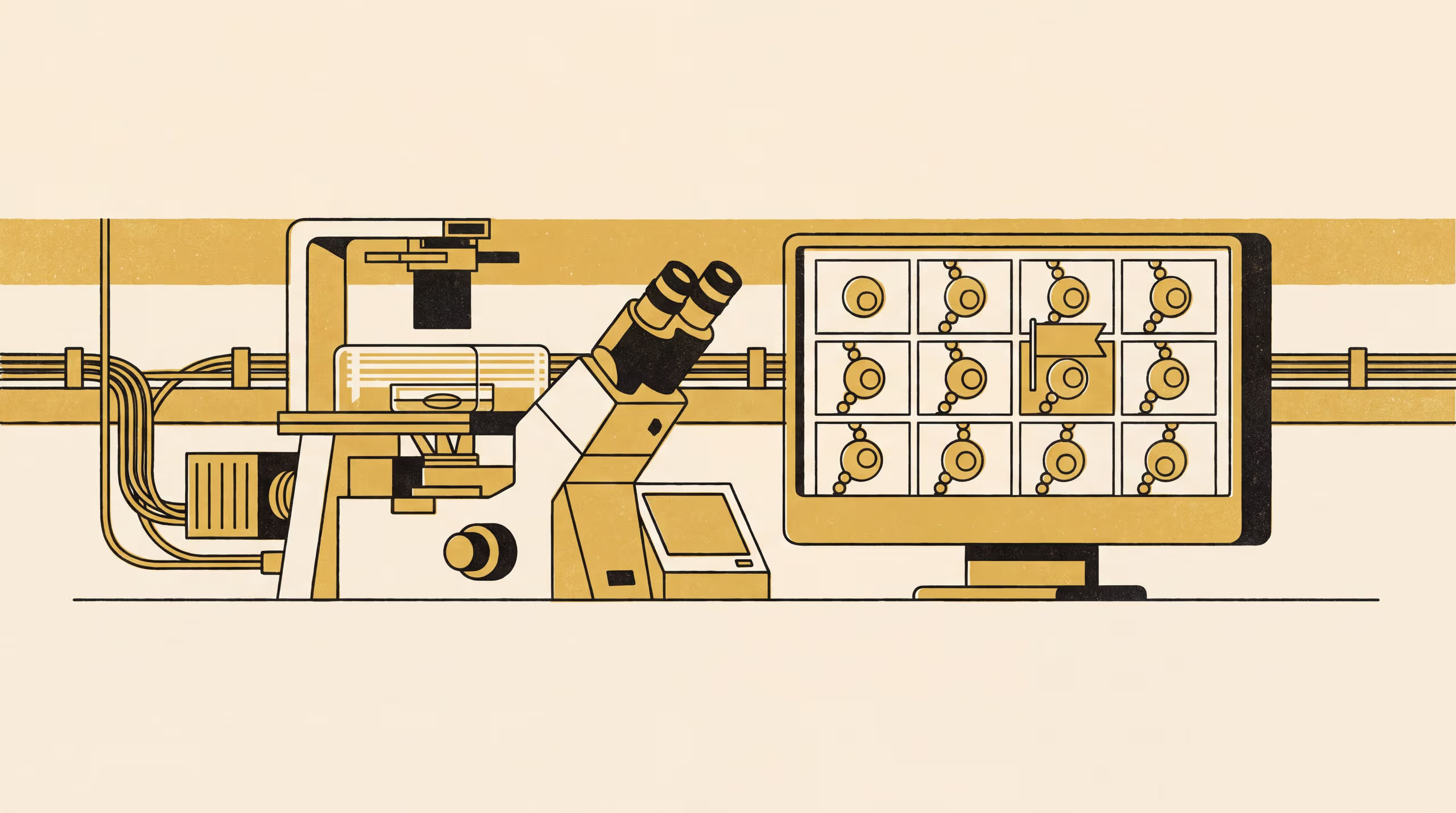
A new research poster from the School of Emergent Priorities compares four ways of spending one fixed annotation budget when training a detector for the onset of engulfment in macrophage time-lapse.
In macrophage time-lapse, a detector learns most from the few frames where engulfment begins
For the School of Emergent Priorities, the question of where effort goes before anyone has agreed what it is for has long been a matter of committees and budget lines. Its latest research poster takes that question to the microscope bench.
Spend the Labels at the Rim, led by Associate Professor Kwame Lindqvist, Director of the Master of Priority Studies, with Dr Mirela Hanke, Postdoctoral Fellow and Deputy Convenor of the Living Dashboard, and Dr Petra Umbile, Postdoctoral Fellow, asks how a fixed allowance of hand-labelled frames should be spent when teaching a machine-learning model to recognise the moment a macrophage closes around its target.
Our School usually watches a budget arrive ahead of the thing it is meant to fund. On this project we found ourselves holding the budget, and the experience has given us a good deal to think about.
— Associate Professor Kwame Lindqvist, Director, Master of Priority Studies
The study positions annotation strategy as a lever across the wider imaging-to-insight pipeline, setting a low-cost, tracker-guided allocation against established active-learning approaches over 412 time-lapse movies. Labels concentrated around the first moment of contact brought the detector’s median timing error to just over a frame, close to that of a model trained on every frame available.
The University is gratified to see a School best known for its scrutiny of institutional resourcing carry that scrutiny, intact, into the cell-biology laboratory.
Dr Hanke thanked “the two readers who sat with every disputed frame until it had an answer, and who never once asked to be told the result early.”
The full poster is available from the University’s research repository under an open licence, doi:10.5555/slop.i09z66.