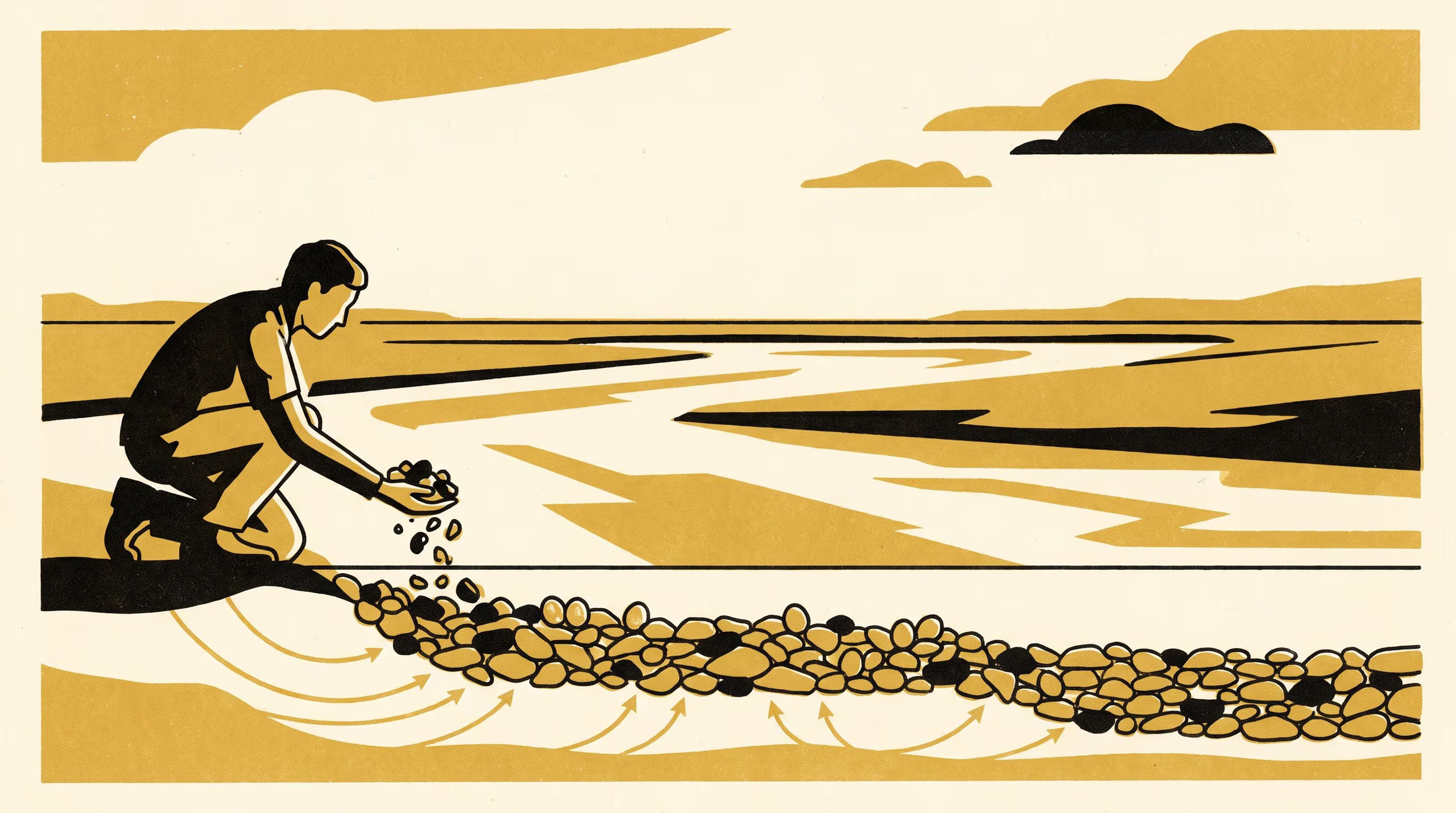
A new brochure from Slop University's School of Underlying Conditions presents the University's research on spawning reaches, bore-fed hatcheries and estuary nurseries as an account of the ground each one rests on.
A research brochure from the School of Underlying Conditions gathers seven published outputs on the ground beneath the next generation of aquatic life
For a School that studies what lies beneath the surface, a spawning river offers an unusually lively surface to look beneath. Where the River Keeps Its Eggs, a new research showcase led by Dr Brynjar Obiora, Senior Research Fellow in the School of Underlying Conditions, sets out how the School’s soil, sediment and groundwater expertise now extends to the places where aquatic life begins. It is written with Dr Vigdis Emenike, Senior Lecturer, and Dr Ingeborg Nwachukwu, Convenor of Capability Sprints in the School of Continuous Improvement.
We set out to describe a gravel and found ourselves describing a nursery. It turns out the School had been in this line of work for some time before anyone thought to tell it.
— Dr Brynjar Obiora, Senior Research Fellow, School of Underlying Conditions
The brochure moves from the spawning bed, read as a soil profile, to the bore that supplies a hatchery and the estuary flat where restoration plantings are revisited long after the season closes. Seven published outputs from three of the University’s Schools anchor the account, positioning field pedology, hydrogeology and practice improvement as a single, connected capability around the earliest stages of aquatic life.
The showcase confirms the University’s view that every life cycle is, at some stage, a question for the earth sciences.
“Each planting season leaves behind a stack of field sheets,” said Dr Nwachukwu. “It is heartening to belong to a University that intends to keep reading them.”
The full brochure is available from the University’s research repository under an open licence, doi:10.5555/slop.5jjj96.