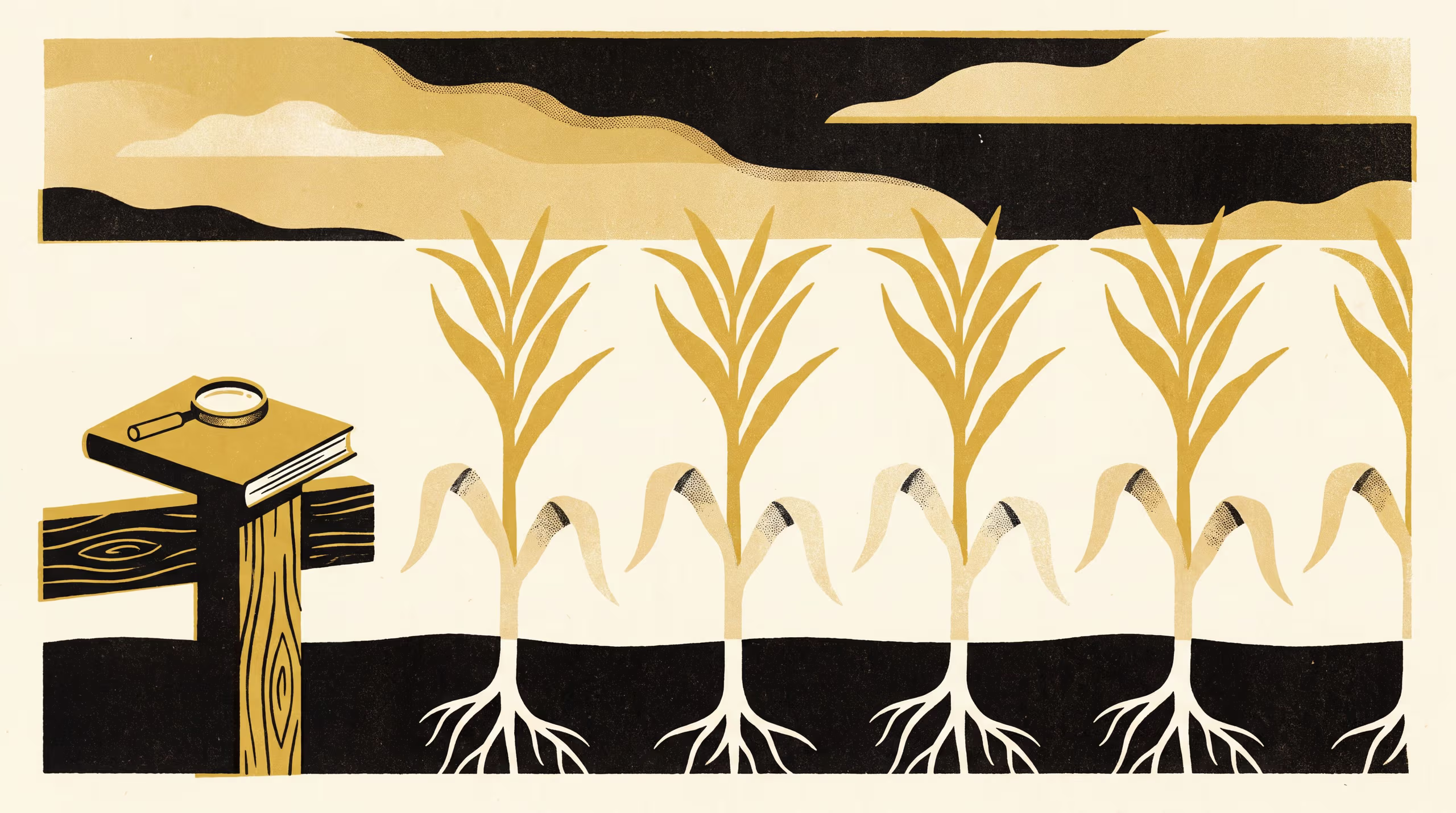
Associate Professor Ragnhild Uzoma and Dr Brynjar Obiora read a field bulletin's nutrient-deficiency key line by line and find that the root it diagnoses is never the subject of a sentence.
A School of Underlying Conditions poster reads four editions of one field bulletin, verb by verb
“Symptoms appear first on the older, lower leaves.” So opens the nutrient-deficiency key at the centre of Older Leaves First, a new research poster from the School of Underlying Conditions that takes that sentence, and every sentence after it, at its word.
Associate Professor Ragnhild Uzoma and Dr Brynjar Obiora read four editions of a single two-page key from a state agricultural field bulletin, logging each verb by what it is said of. Leaves do almost all of the key’s work. The plant speaks only in the language of provision. The root, which the whole key is about, is never the subject of a sentence.
We tend to think of a key as something you use and put down. A year with one that nobody had thought to read slowly has changed how the Group handles every document on its shelves, our own included.
— Associate Professor Ragnhild Uzoma, Lead of the Basement Relations Group
The poster brings the School’s long-standing capability in subsurface evidence into conversation with literary method, aligning close-reading practice with the diagnostic texts that underpin everyday agricultural decision-making. The University counts it among a growing body of work that treats the printed page as a field site in its own right.
Senior Research Fellow Dr Obiora said the reading had left the School “with more questions about the ground than we started with, which in our experience is the sign of a good season”.
The full poster is available from the University’s research repository under an open licence, doi:10.5555/slop.ahtho1.