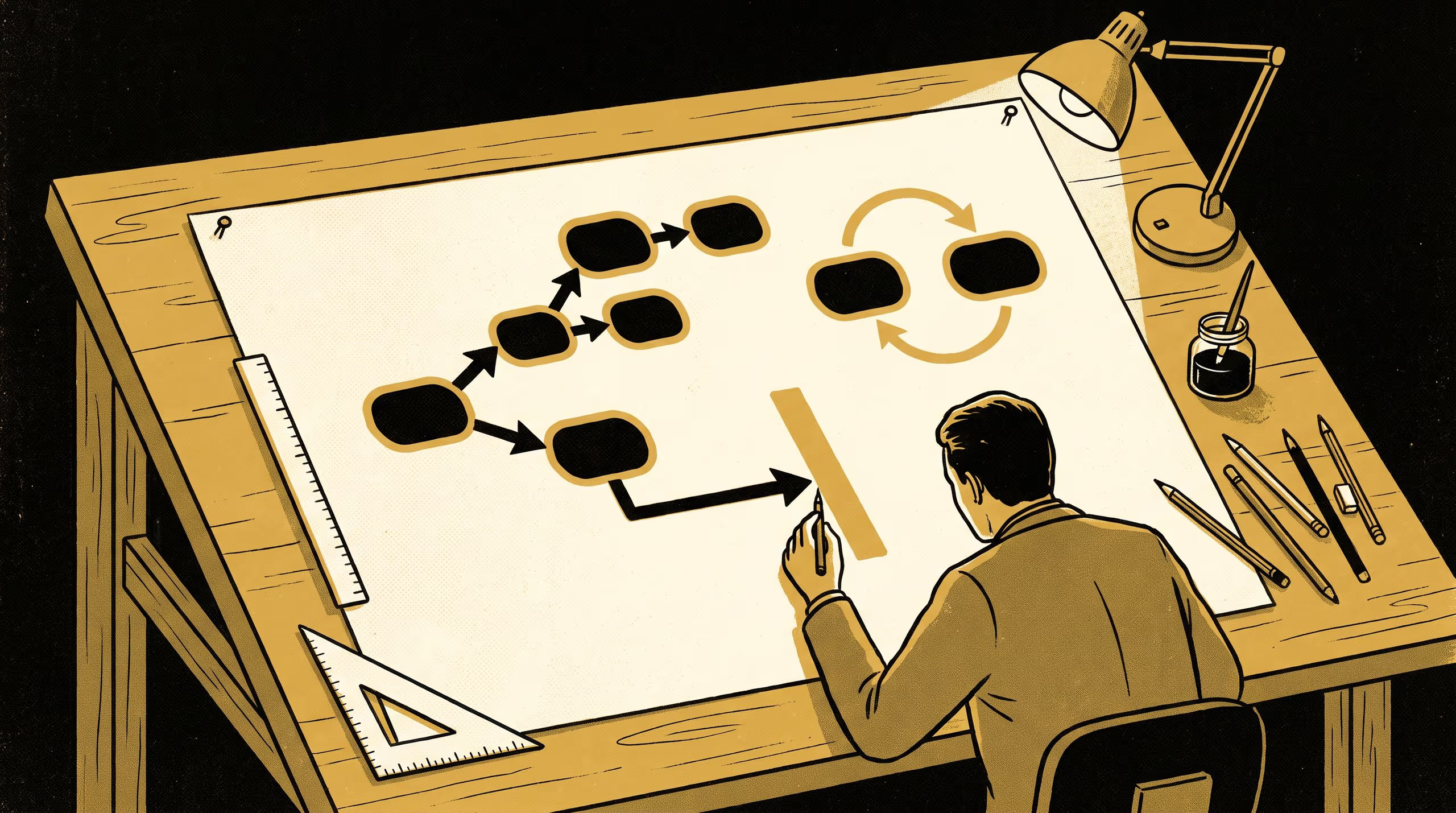
Associate Professor Ragnhild Uzoma and Ylva Onyekwere read how one teaching archive's signalling diagrams draw a protein being switched off.
A new paper asks how one teaching archive draws a signalling protein at rest, and finds it seldom does
Twenty-two years of lecture slides, 342 redrawn figures and 3,118 hand-drawn lines, each coded by its shape, its direction and what sits at its tail: that is the working material of The Blunt End, a new paper by Associate Professor Ragnhild Uzoma, Lead of the Basement Relations Group in the School of Underlying Conditions, and Ylva Onyekwere, Doctoral Candidate in the School of Emergent Priorities.
The paper brings the methods of media and communication studies to the signalling-pathway diagram, the figure through which most students first meet the proteins that switch a cell’s messages on and off. It finds the archive fluent in activation and sparing with its opposite, and reads the short perpendicular bar at the end of an inhibitory line as the diagram’s way of drawing something that does not happen.
Eight years of taking minutes teaches you that a motion which lapses is still an item of business, with its own line in the record. Reading these slides, I kept looking for that line, and the looking gave the work its shape.
— Ylva Onyekwere, Doctoral Candidate, School of Emergent Priorities
The University counts the paper as a considered addition to its developing attention to the visual infrastructure of teaching, and as an example of the cross-School partnership its research settings are built to enable.
“We spent most of the project looking at white space,” said Associate Professor Uzoma. “It turns out to be one of the busiest parts of a slide.”
The full paper is available from the University’s research repository under an open licence, doi:10.5555/slop.prirs6.