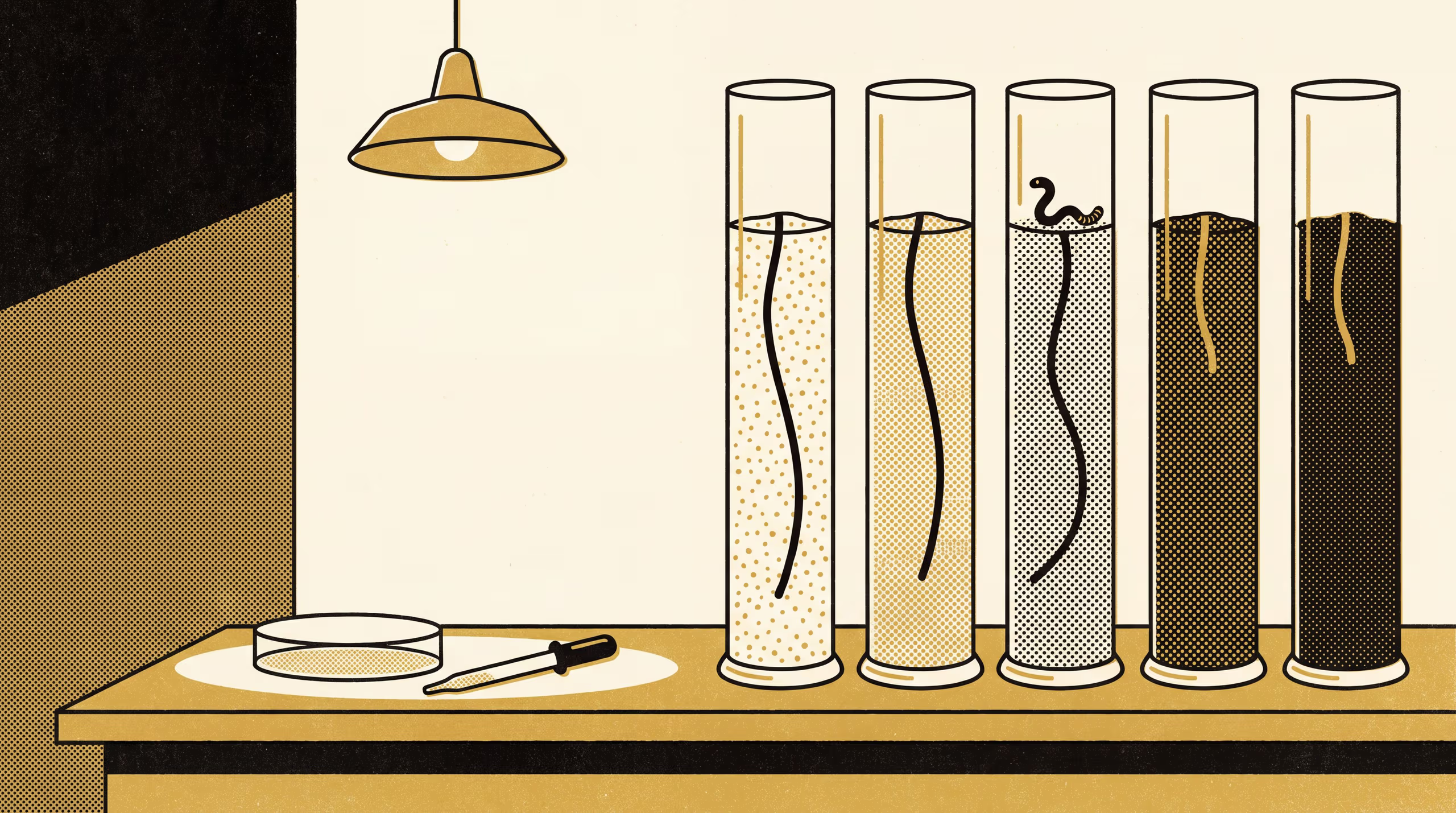
Dr Vigdis Emenike's new display advertisement carries the School of Underlying Conditions' research on serotonin receptors and burrowing depth to the landscape signage panels under the line "The receptor matters. So does the ground."
A display advertisement sets an earthworm burrowing study from the School of Underlying Conditions before everyone who passes a signage panel
An earthworm’s decision about how far down to go is now part of the University’s public conversation. The Receptor Matters. So Does the Ground., a new display advertisement prepared by Dr Vigdis Emenike, Senior Lecturer in the School of Underlying Conditions, takes the School’s research on receptors in the animals of the soil off the bench and onto the landscape signage panels.
The campaign rests on The Soil Sets the Floor, the School’s research poster on serotonin receptor blockade and burrowing depth. Its image is five glass columns on a laboratory bench after dark, each holding a burrow drawn to its own depth, and its supporting line carries the poster’s finding in a single breath: in sand the blocked receptor mattered, and in clay the soil had already decided.
Every one of those columns was packed by hand, by students and technical staff whose names will never appear on a screen. What the panel shows is their patience as much as ours.
— Dr Vigdis Emenike, Senior Lecturer, School of Underlying Conditions
The work positions the School’s receptor research within a wider underground-to-everyday continuum, aligning laboratory practice with the University’s public-facing signage posture. Each panel closes with a short reading list from the University’s published record, so that a passer-by with a moment to spare can follow the result to its source.
“The columns spent their working life on a bench,” said Dr Brynjar Obiora, Senior Research Fellow. “It is good to see them somewhere with more foot traffic.”
The University counts the campaign among its clearest statements yet that a finding is finished only when it has been put where people wait.
The full poster is available from the University’s research repository under an open licence, doi:10.5555/slop.k3v8rw.