Dr Brynjar Obiora and Dr Runa Adegoke follow eleven newly elected rural councillors through their first term, and find that they learn where the council stops from a map, a withdrawn promise and the works depot.
Eleven rural councillors, thirty months of residents' requests and a road map in three colours
A newly elected councillor’s first lesson in local government tends to arrive at a community hall, from a resident, about a road the council does not own. Not Our Road, a new paper by Dr Brynjar Obiora, Senior Research Fellow in the School of Underlying Conditions, and Dr Runa Adegoke, Senior Lecturer and Convenor of the Strategic Drift Survey in the School of Emergent Priorities, asks what happens next.
I spent twelve years deciding where one soil stops and the next one starts, and it turns out a councillor spends a term doing much the same with the roads. The councillors were kinder to us about it than the ground ever was.
— Dr Brynjar Obiora, Senior Research Fellow, School of Underlying Conditions
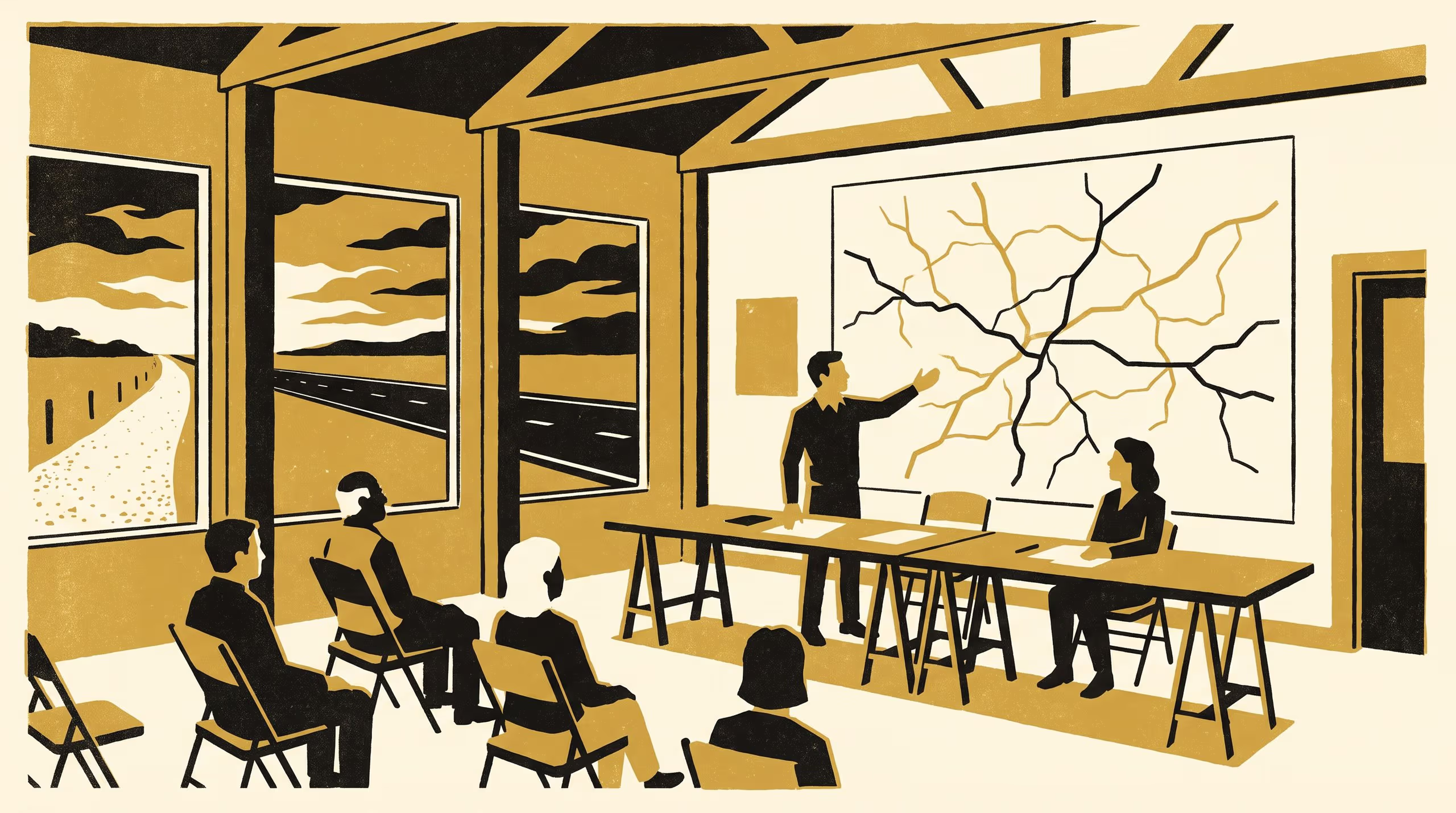
The study accompanied eleven first-term councillors across three adjoining rural shires, bringing interviews, induction observation and the councillors’ own request logs into a single situated-learning account of how the boundaries of an office come to be known in practice. It locates that knowledge less in the formal schedule of functions than in a shared road map, a first promise quietly returned, and the long-serving staff at the works depot.
Dr Adegoke said the team would be glad to see the work taken up by those who plan induction “in time for the next intake, and ideally before the first hall meeting”.
It is the kind of patient, close-to-the-ground inquiry the University is pleased to put its name to, and a welcome meeting of two Schools on the question of where one responsibility gives way to another.
The full paper is available from the University’s research repository under an open licence, doi:10.5555/slop.hzq669.