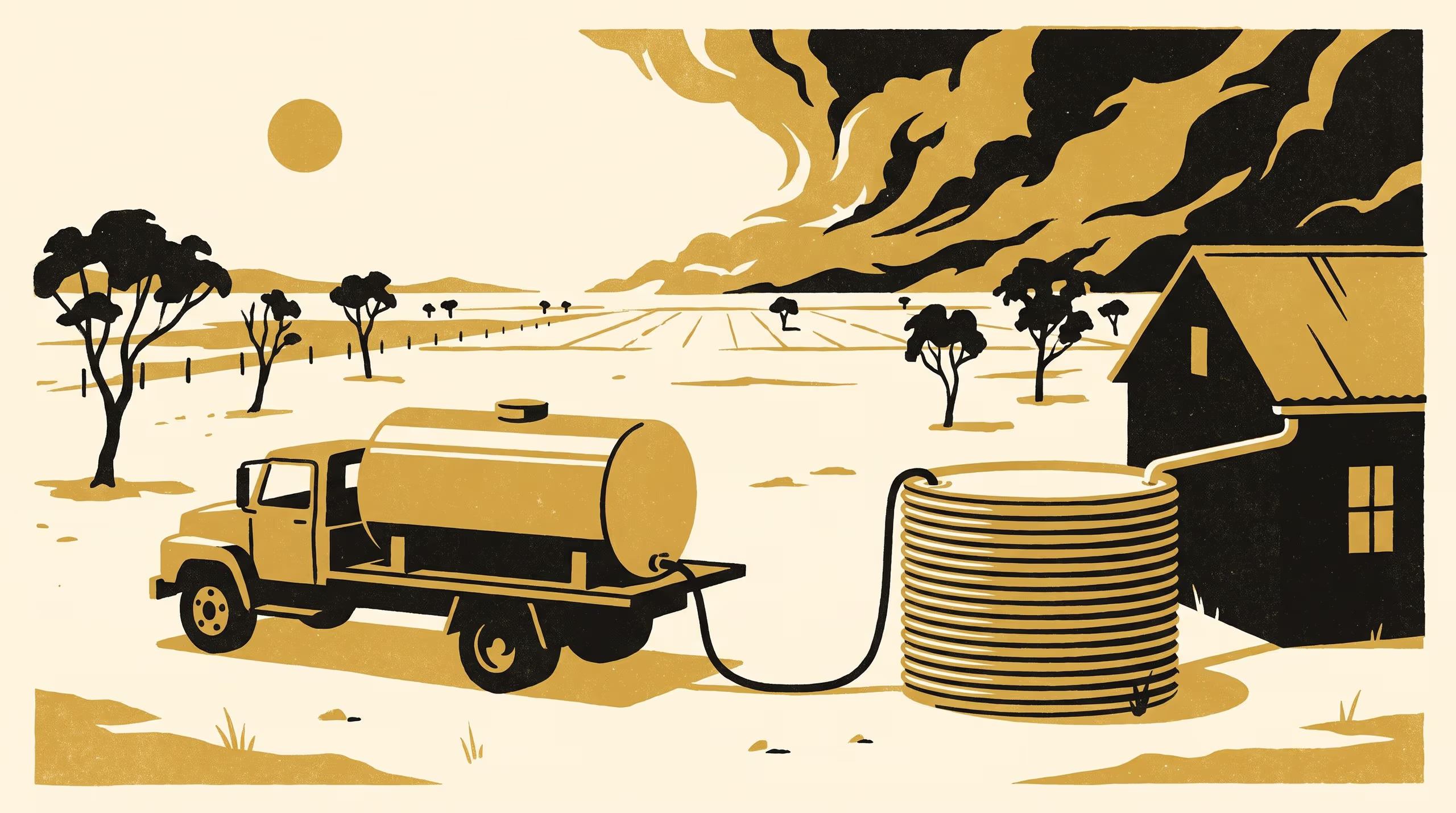
Dr Vigdis Emenike and Mr Halvard Nnamani show that a rural water carter's quiet customers are, more often than not, customers whose roofs have done the carter's work for a season.
A model that reads each household's silence against its tank finds most lapsed accounts were simply full
The School of Underlying Conditions has spent its short life on water held out of sight: in aquifers, in bores, in the ground beneath the paddock. With The Tank Between Orders, it turns to water held in plain view, in the corrugated tank beside a rural house, and to the commercial relationship that keeps that tank from running dry. The paper is by Dr Vigdis Emenike, Senior Lecturer in the School of Underlying Conditions, and Mr Halvard Nnamani, Doctoral Candidate in the School of Emergent Priorities.
The School is more at ease with water that falls than with water that is bought, and this collaboration has given us a vocabulary for the second kind. We expect to keep borrowing it, and to keep finding that the two kinds of water are harder to tell apart than either discipline assumed.
— Dr Vigdis Emenike, Senior Lecturer, School of Underlying Conditions
The study sets six years of a water carrier’s delivery records beside the rainfall that fell over the same years, and reads every customer’s ordering against the water their own roof would have supplied in between. Of the 742 households the carrier had marked as lapsed, 398 went on to order again, and the paper’s model locates most of them among homes whose tanks had simply been kept full.
“Anyone who has kept a registration list knows that a name can go quiet for a season and still come back,” said Mr Nnamani. “It has been heartening to see that patience given a proper structure.”
The paper is a welcome instance of two of the University’s schools discovering that their agendas share a water table.
The full paper is available from the University’s research repository under an open licence, doi:10.5555/slop.yde63q.