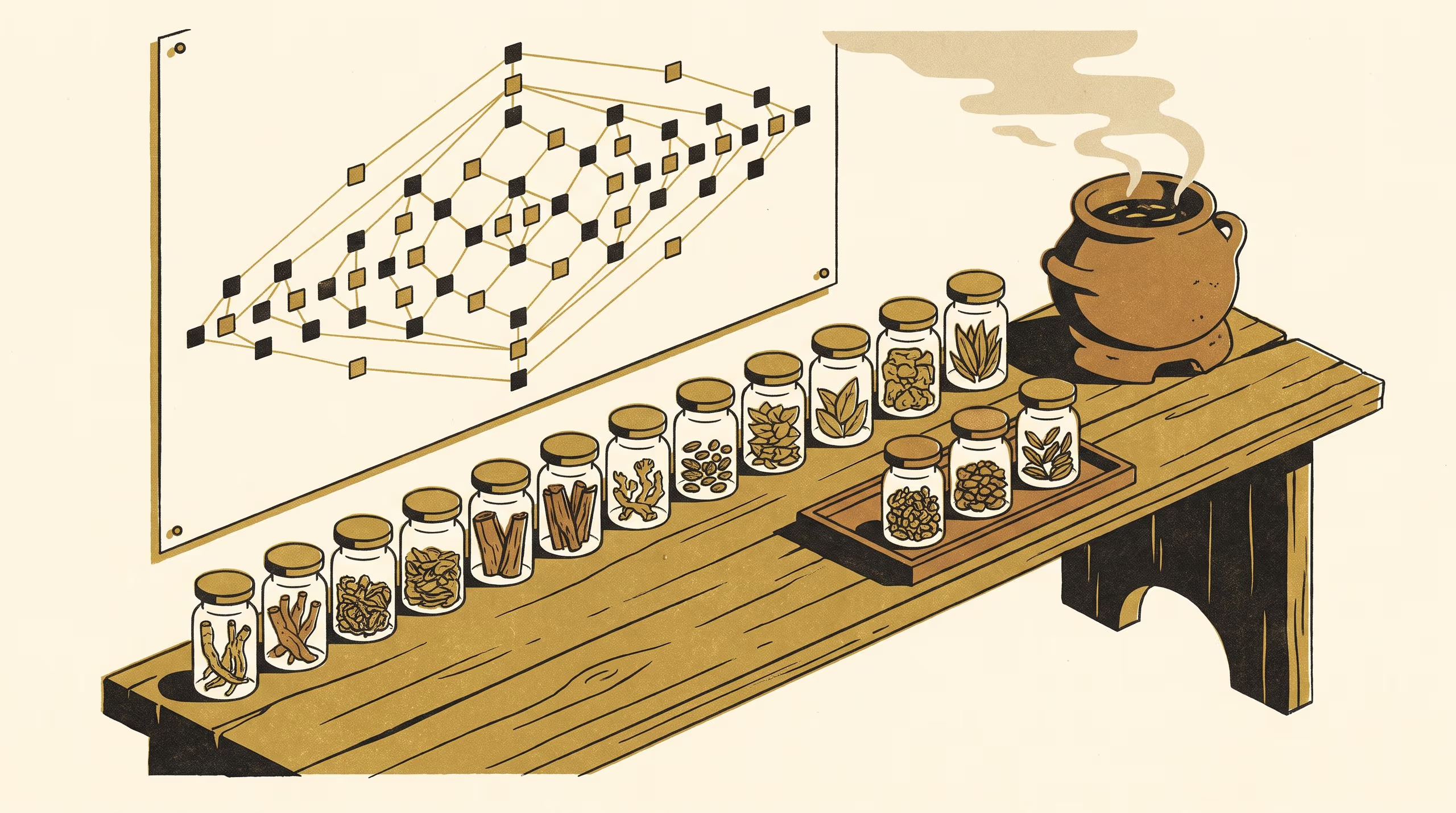
A paper from the School of Underlying Conditions brings the tools of theoretical computer science to the laboratory practice of testing a herbal formula with ingredients held back, and bounds the number of tests that practice requires.
A new paper sets firm limits on how many tests it takes to learn which ingredients a many-herb formula actually needs
How many times must a remedy be taken apart before anyone can say which of its ingredients it depends on? A new paper from the School of Underlying Conditions, Dismantling a Decoction, puts a number on the question, and then puts a second number underneath it.
Written by Dr Vigdis Emenike and Associate Professor Ragnhild Uzoma, the paper reframes a familiar bench routine, preparing a formula with ingredients withheld and checking whether its effect survives, as a structured inquiry pathway, and aligns it with established frameworks from the theory of computation to fix upper and lower limits on the effort involved. One of its worked cases, a fifteen-ingredient formula built from seven pairs, cannot be fully understood in fewer than 135 tests.
Most of my working life has been spent taking one thing away at a time and waiting to see whether anything changes. It is a comfort to have it shown, in writing, that this was very nearly the best anyone could do, and a useful discomfort to learn what it was never going to tell me.
— Dr Vigdis Emenike, Senior Lecturer, School of Underlying Conditions
Associate Professor Uzoma, Lead of the Basement Relations Group, said the School valued short proofs “in the same way it values a light core tray: there is less to carry, and more of it arrives intact.”
The University sees in the paper a research culture prepared to count its own steps, and to treat the count as a finding in its own right.
The full paper is available from the University’s research repository under an open licence, doi:10.5555/slop.8sxi7m.