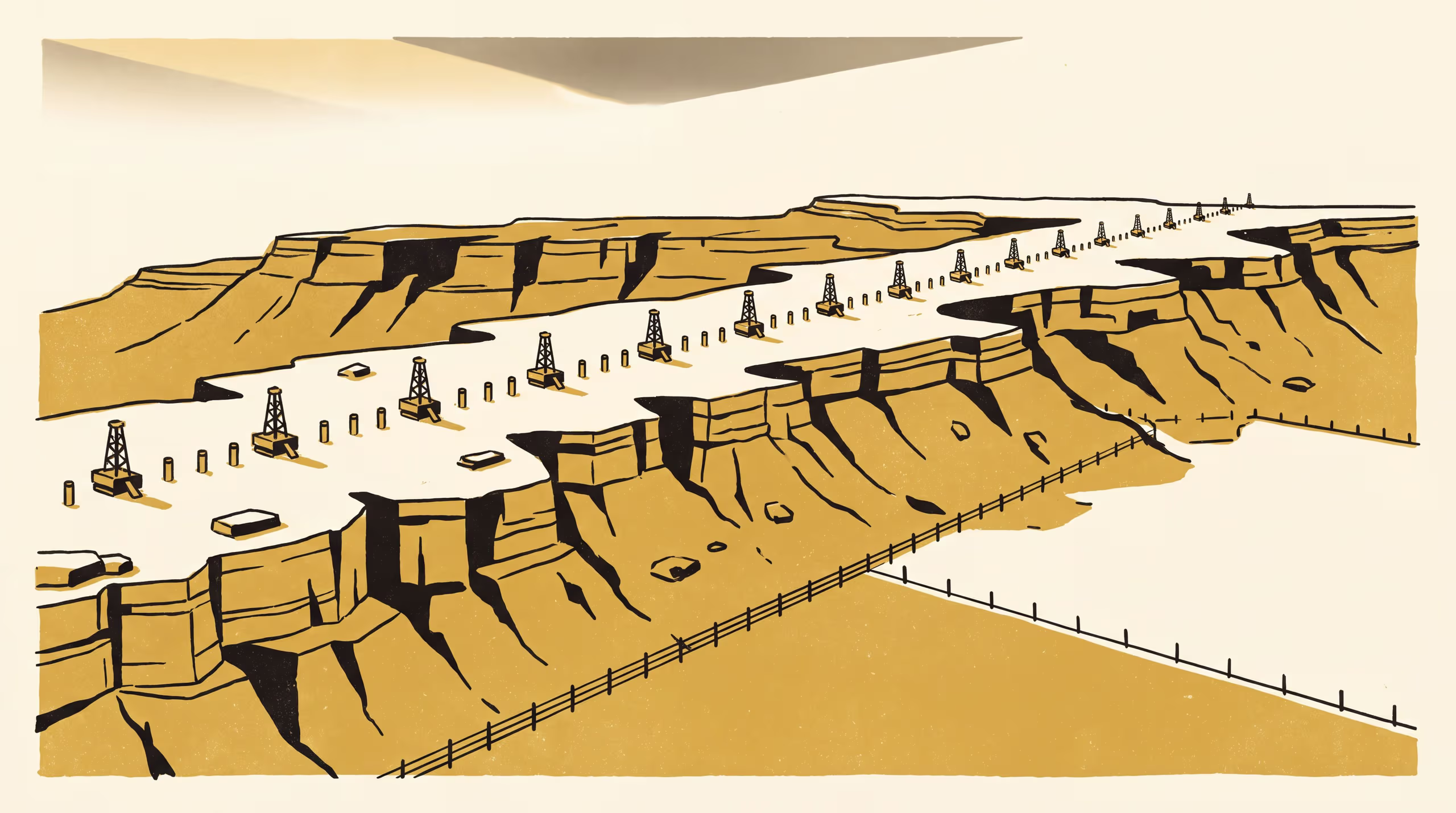
A research poster from the School of Underlying Conditions sets 31 mapped landscape-unit boundaries against a line of cored holes and finds that about half of them sit over a change in the rock.
A cored transect across a sandstone plateau finds breaks of slope follow the rock while vegetation edges follow the fence
About half of the lines on a plateau’s landscape map sit over a change in the rock, and the other half answer to something else, according to a research poster released today by the School of Underlying Conditions.
The Basement Relations Group has always kept two sets of drawings, one of what we cored and one of what we walked across. Laying them on the same table has taught the group a good deal about its own habits, and the table is staying where it is.
— Associate Professor Ragnhild Uzoma, Lead of the Basement Relations Group
Combining a straight line of shallow cored holes with field mapping completed before any core tray was opened, the team brought surface reading and subsurface evidence into a single, transect-scale conversation. Of 31 mapped boundaries, those drawn on a break of slope tracked the rock closely, while those drawn on a change in vegetation or land use mostly followed a fence, a track or the edge of a clearing. Where the drill recovered nothing, the poster treats the rock’s edge as a band rather than a line, a refinement the School regards as central to its continuing attention to the ground its maps describe.
“There is a great deal more plateau,” said Dr Brynjar Obiora, Senior Research Fellow, “and the School means to cross as much of it as its patience allows.”
The poster contributes to an evolving, cross-scale understanding of how landscapes are read, recorded and relied upon, and it was supported by the Anticipatory Capability Fund.
The full poster is available from the University’s research repository under an open licence, doi:10.5555/slop.j6tnif.