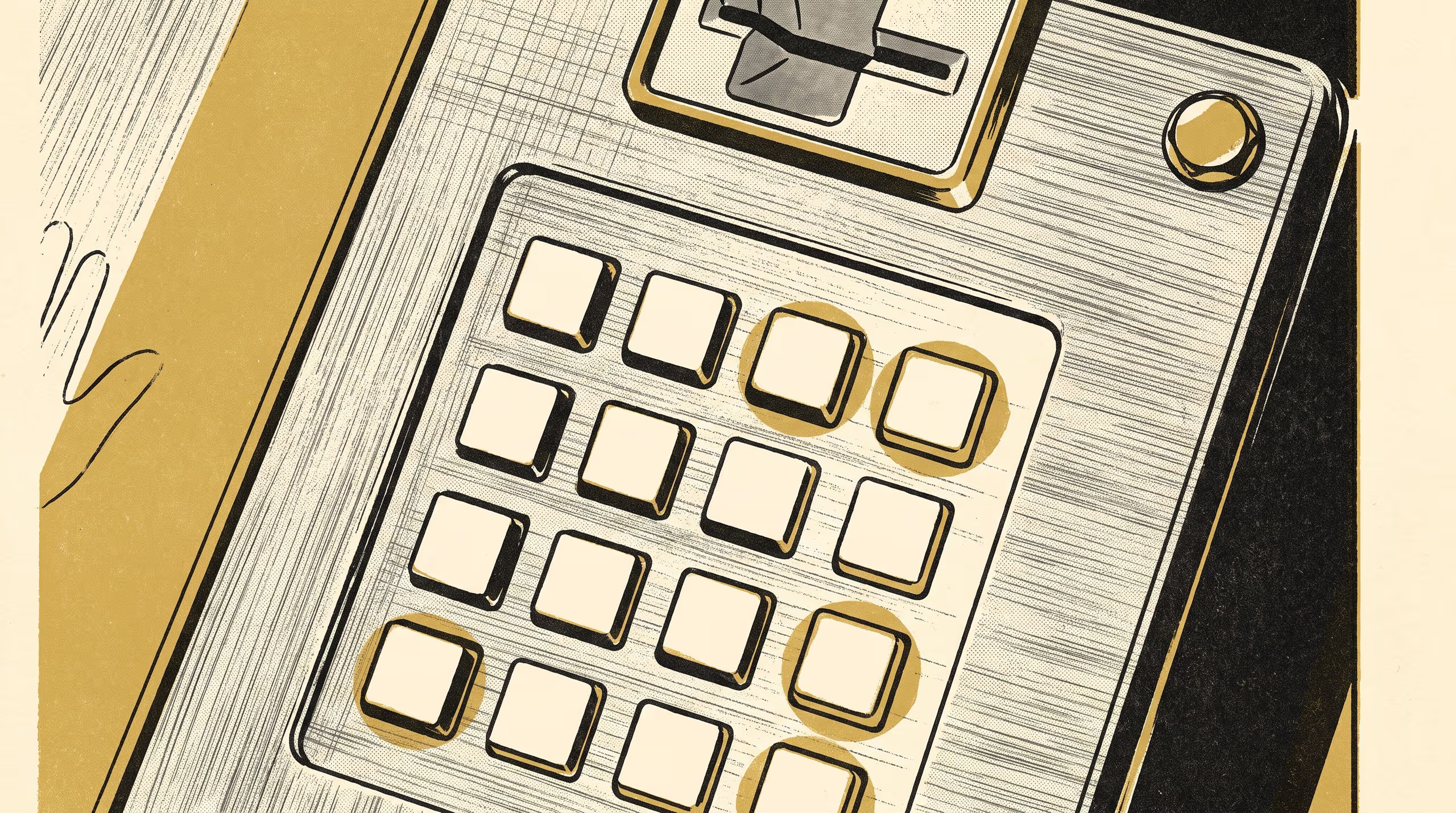
Dr Marit Osayande, Dr Mirela Hanke and Associate Professor Ragnhild Uzoma find that a public keypad keeps a closer record of reading than of pressing.
On a retired fleet's steel plates, the deepest marks after the Confirm key were left by hands that pressed nothing
The Living Dashboard has long asked who reads a record once it has been switched on. Its newest paper puts the same question to a sheet of brushed steel.
Where the Steel Went, by Dr Marit Osayande, Lecturer and Convenor of the Living Dashboard, and Dr Mirela Hanke, Postdoctoral Fellow and Deputy Convenor, both of the School of Continuous Improvement, with Associate Professor Ragnhild Uzoma, Lead of the Basement Relations Group in the School of Underlying Conditions, examines 31 keypad plates from a fleet of railway ticket machines retired after some fifteen years of service.
We came to these panels expecting to learn about the machines, and I think the Living Dashboard has learned rather more about itself. That is generally the sign of a good year.
— Dr Marit Osayande, Lecturer and Convenor, Living Dashboard
The team brought together laboratory surface measurement, a re-enactment programme on a restored machine and structured conversations with former station and maintenance staff, aligning each strand into a single account of how a public control surface accumulates its history. The Confirm key, as expected, wore most. Close behind it came places where nothing was pressed at all: the edge of the keypad where passengers steadied a hand while reading the screen, a narrow ledge beneath the card reader, and one fixing bolt within reach of a waiting hand.
The work extends the School’s commitment to records that keep themselves, and brings that commitment, for the first time, to the scale of a fingertip. Dr Hanke described the paper as “a welcome reminder that a good question can arrive by surplus disposal”.
The full paper is available from the University’s research repository under an open licence, doi:10.5555/slop.si85t8.