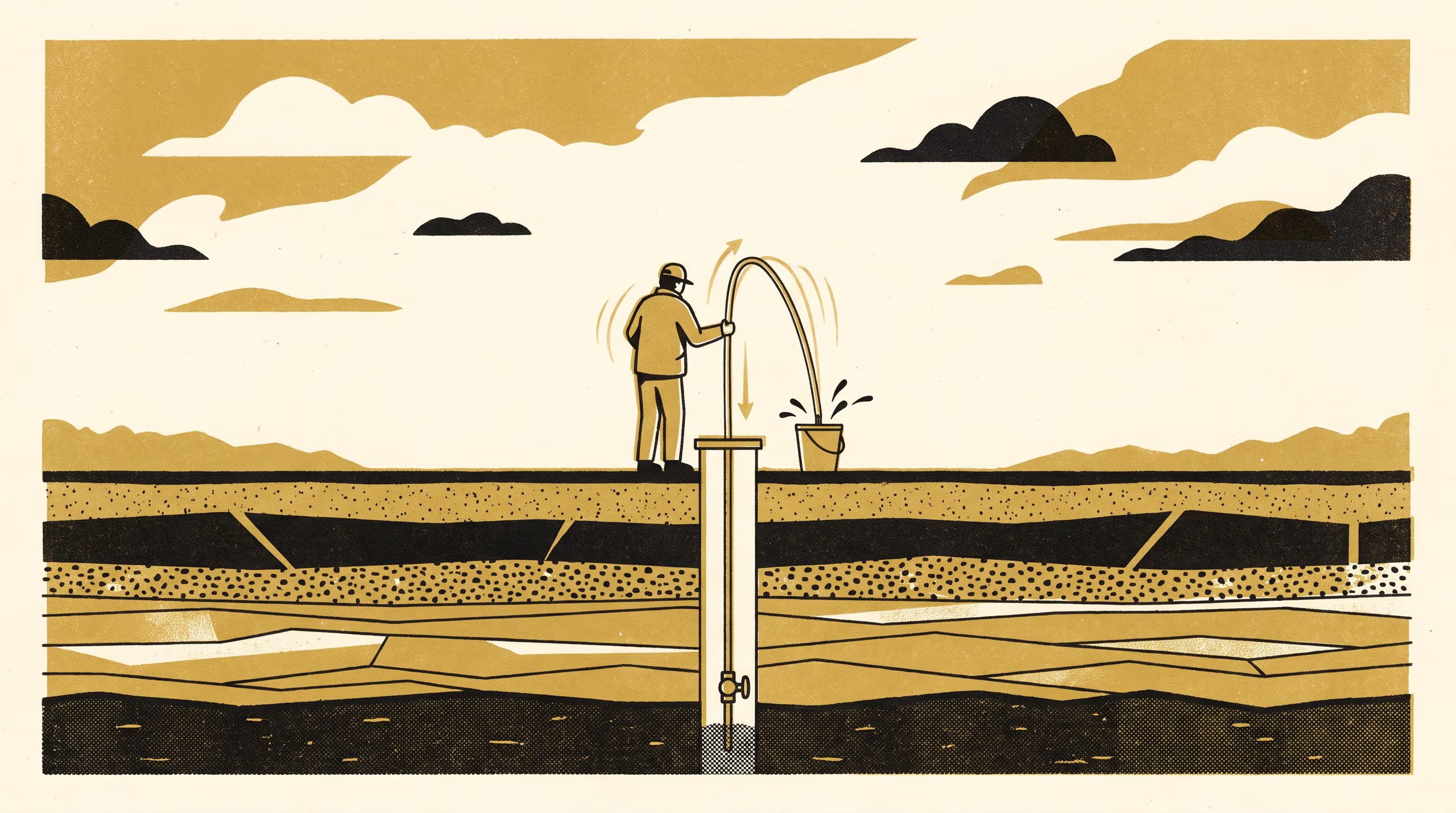
A paper from the Schools of Underlying Conditions and Continuous Improvement measures how much mechanical work goes into purging a monitoring bore by hand, and finds that the habitual stroke costs nearly three times as much in the deepest bore.
An instrumented pump handle, four monitoring bores and the stroke field staff reach for without thinking
How much effort goes into a single groundwater sample has never been a column in the sampling record. A new paper from the School of Underlying Conditions now offers one. Work per Litre, by Dr Vigdis Emenike, Senior Lecturer, and Associate Professor Casimir Beng, Lead of the Adaptive Metrics Lab, measures the energy a field technician spends at the handle of a hand-operated inertial pump, litre by litre, as the water table falls further from the surface.
Everyone who has purged a deep bore by hand has an opinion about it. We are pleased to offer them a number to sit beside the opinion, and we expect the opinions to carry on regardless.
— Dr Vigdis Emenike, Senior Lecturer, School of Underlying Conditions
Through a combination of an instrumented pump handle, downhole accelerometry and a careful account of the water column’s motion, the authors trace how a stroke learned on shallow bores loses its purchase in deeper ones, until in the deepest bore it costs nearly three times the work of a longer stroke and takes five times as long.
The University regards the patient accounting of fieldwork as part of the care it owes its longest-running records. Associate Professor Beng described the collaboration as “the most strenuous measurement the Lab has yet been invited into”, adding that he “was glad to observe most of it from the collar”.
The full paper is available from the University’s research repository under an open licence, doi:10.5555/slop.o4mz8t.