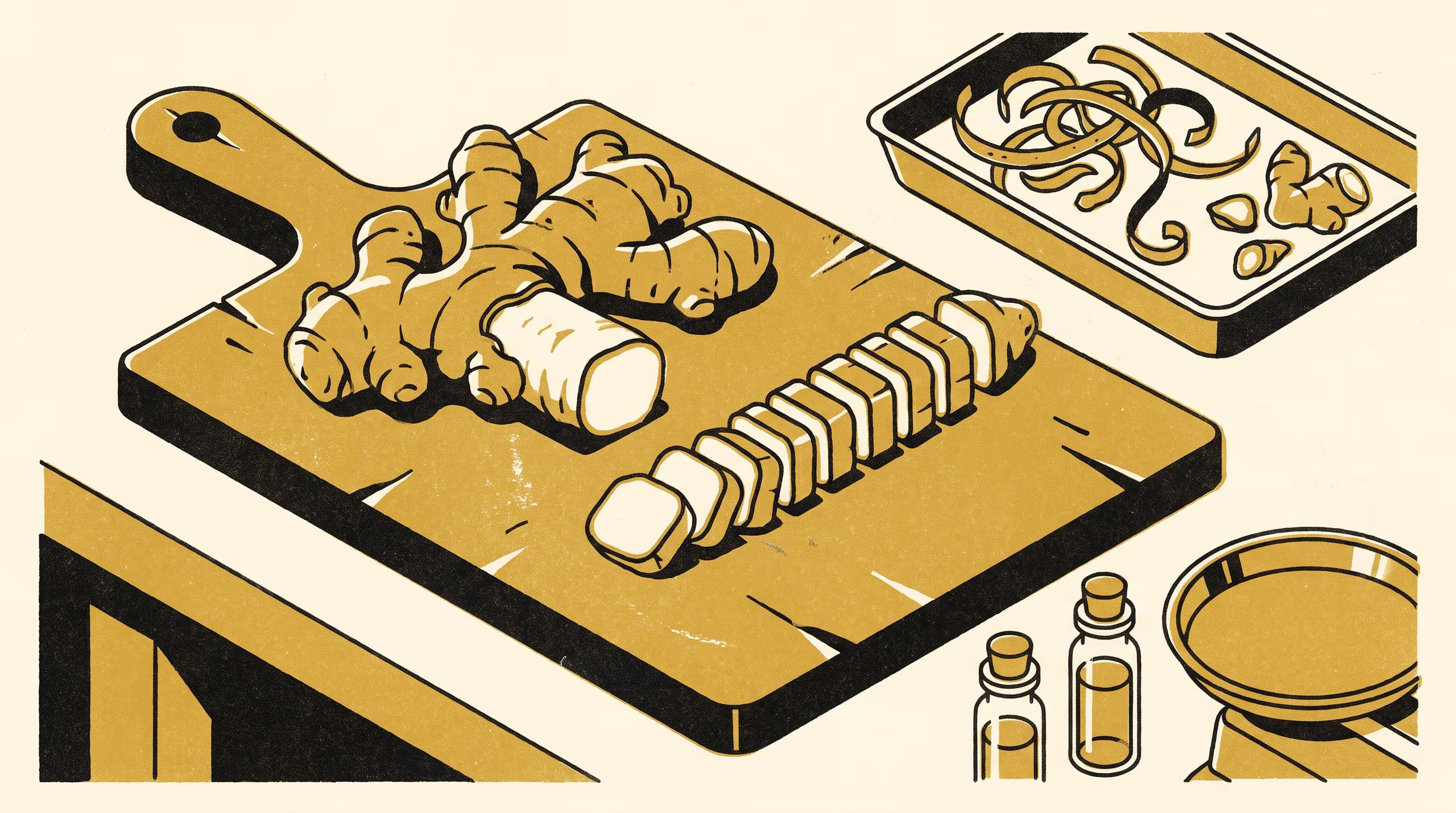
A paper from the School of Underlying Conditions finds that a ginger processing bench's routine 6-gingerol sample lands close to the true figure for a lot only because two of its exclusions err in opposite directions.
A paper on peel, trimmed tips and the mother rhizome in one lot of fresh ginger
Two small habits at a ginger processing bench, one that pulls a reading down and one that pushes it back up, have been found to meet almost exactly in the middle. What the Assay Never Sees, a new paper by Associate Professor Ragnhild Uzoma, Lead of the Basement Relations Group, and Dr Vigdis Emenike, Senior Lecturer, both of the School of Underlying Conditions, takes 24 hands of fresh ginger apart, piece by piece, to ask which parts of each one a routine assay actually sees.
Ginger has been very generous with us. The least we could do was weigh every part of it, including the parts nobody had asked about.
— Associate Professor Ragnhild Uzoma, Lead, Basement Relations Group
The work brings the School’s long-standing attention to sampling, recovery and representativeness into the prep room, aligning dissection, chromatography and a nested model of variance into a single, careful account of what a lot figure stands for. It sets out a sampling approach that composites within each hand, and invites benches to say which tissues their figures describe.
The University counts the paper among a growing body of work in which its earth scientists carry their instruments indoors, and regards that habit as one of its quieter strengths. Dr Emenike said of the study that “the bench is part of the field, and it always has been.”
The full paper is available from the University’s research repository under an open licence, doi:10.5555/slop.1ag5cm.