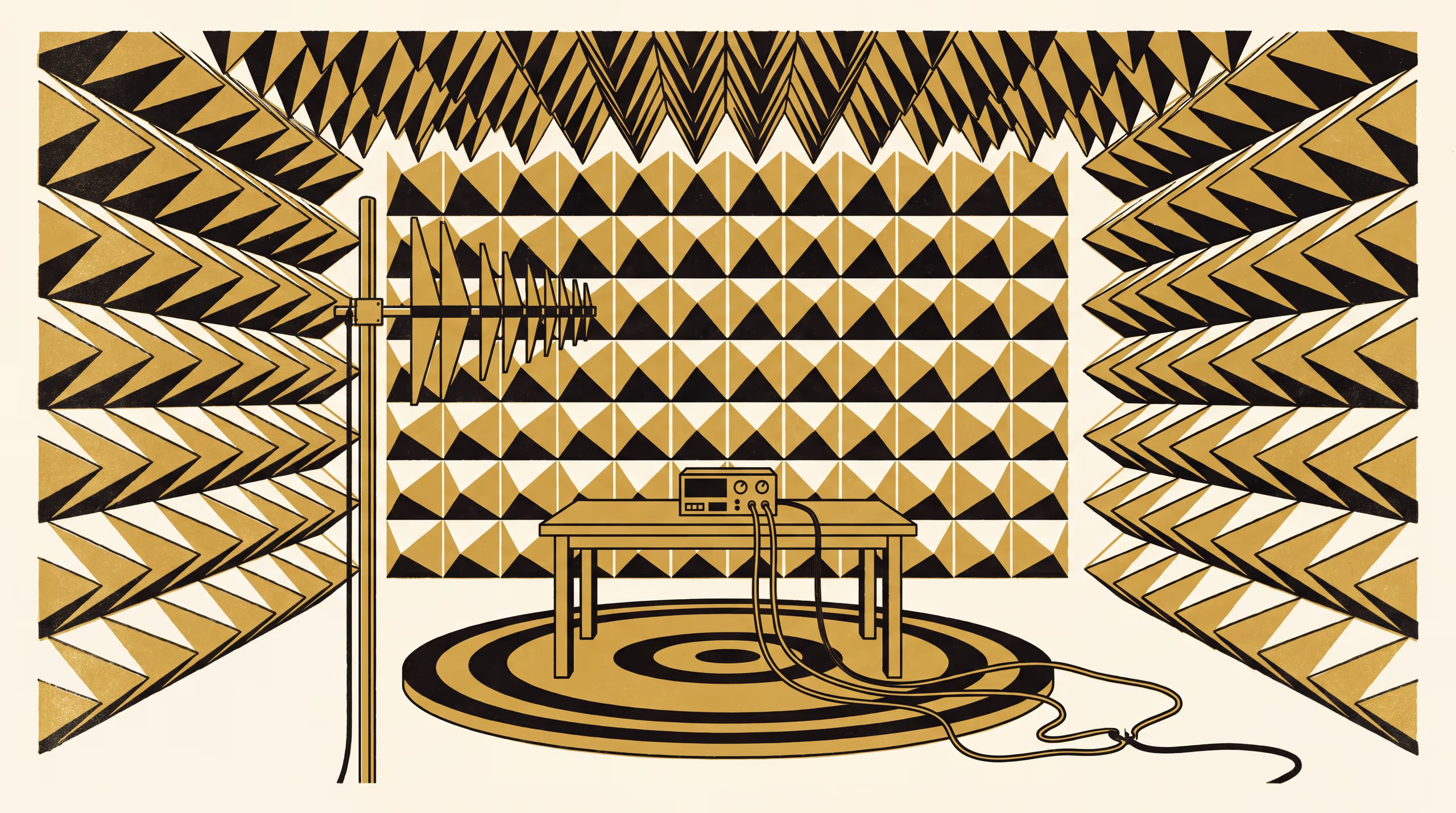
Eivind Onwuka and Associate Professor Casimir Beng find that where an operator lays the cables can decide whether an electronic unit passes its emissions test.
Thirty setups of one small unit in a shielded chamber, and the margin moved with every one
I spent most of this study kneeling beside one table, and I can recommend it. You see a great deal from down there that the paperwork is too tall to notice.
— Eivind Onwuka, Doctoral Candidate, School of Continuous Improvement
That table sits at the centre of Where the Cable Lies, a new research poster by Mr Onwuka and Associate Professor Casimir Beng, Lead of the Adaptive Metrics Lab, both of the School of Continuous Improvement. It asks how much of an electronic unit’s radiated-emission result belongs to the unit, and how much to the way its cables were arranged on the morning of the test.
Working with a partner testing laboratory, the team asked six experienced operators to set up the same small control unit thirty times between them, each following the laboratory’s own written instruction to the letter. Chamber measurement, operator practice and variance analysis were brought together into one account of where a reported margin comes from. Left untouched, the unit repeated itself closely. Set up afresh, it did not, and a handful of setups carried it over the line it otherwise cleared.
The poster extends the School’s long patience with procedures that are followed exactly and still arrive at different places. Associate Professor Beng said the work “keeps faith with everyone who has ever tidied a cable before a measurement and wondered whether it mattered”.
The full poster is available from the University’s research repository under an open licence, doi:10.5555/slop.d46w1n.