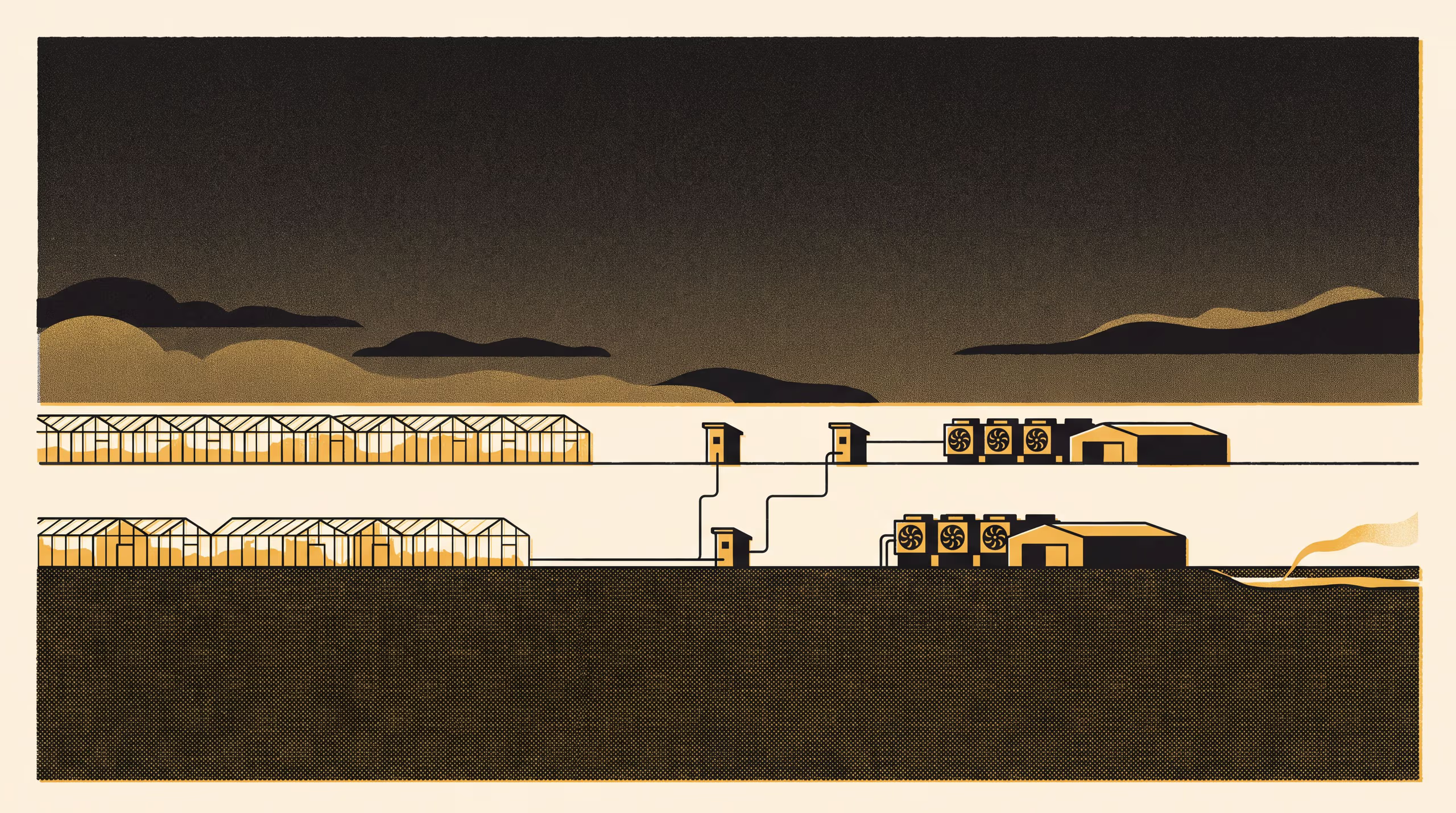
A research poster from the School of Underlying Conditions follows six seasons of heat stored beneath four market-garden glasshouses, and a shoulder-month dry-cooler regime that returned the store to balance.
Six seasons at one aquifer thermal storage doublet, and the night-time cooling that brought it back into balance
For four summers running, a cluster of market-garden glasshouses put more heat into the ground than it took back out, and the ground held on to it. Heat Banked in Sand, a new research poster from the School of Underlying Conditions, follows that surplus through six seasons of one aquifer thermal energy storage doublet, until the cold well that cools the glasshouses had grown too warm to do so unaided.
The poster is led by Dr Vigdis Emenike, Senior Lecturer in the School, with Associate Professor Casimir Beng, Lead of the Adaptive Metrics Lab in the School of Continuous Improvement.
The School began by asking what lies beneath the surface, and it has been instructive to find that some of what lies there was put there, one summer at a time, by the buildings above it. That feels like an honest next step in the University’s longer journey with the ground it stands on.
— Dr Vigdis Emenike, Senior Lecturer, School of Underlying Conditions
Bringing the growers’ own operating records into conversation with a calibrated model of the aquifer, the team reconstructs where the stored heat has travelled and tests a modest change of practice: running the cluster’s dry coolers on still autumn and spring nights to recharge the cold well. Over the two seasons of the trial, the store came most of the way back into balance.
“A cooler that runs on the right nights is a very modest piece of control,” said Associate Professor Beng. “Its modesty is most of what recommends it.”
The University counts the poster among its most practical contributions to date to the low-carbon heating and cooling of the places where food is grown.
The full poster is available from the University’s research repository under an open licence, doi:10.5555/slop.gds61w.