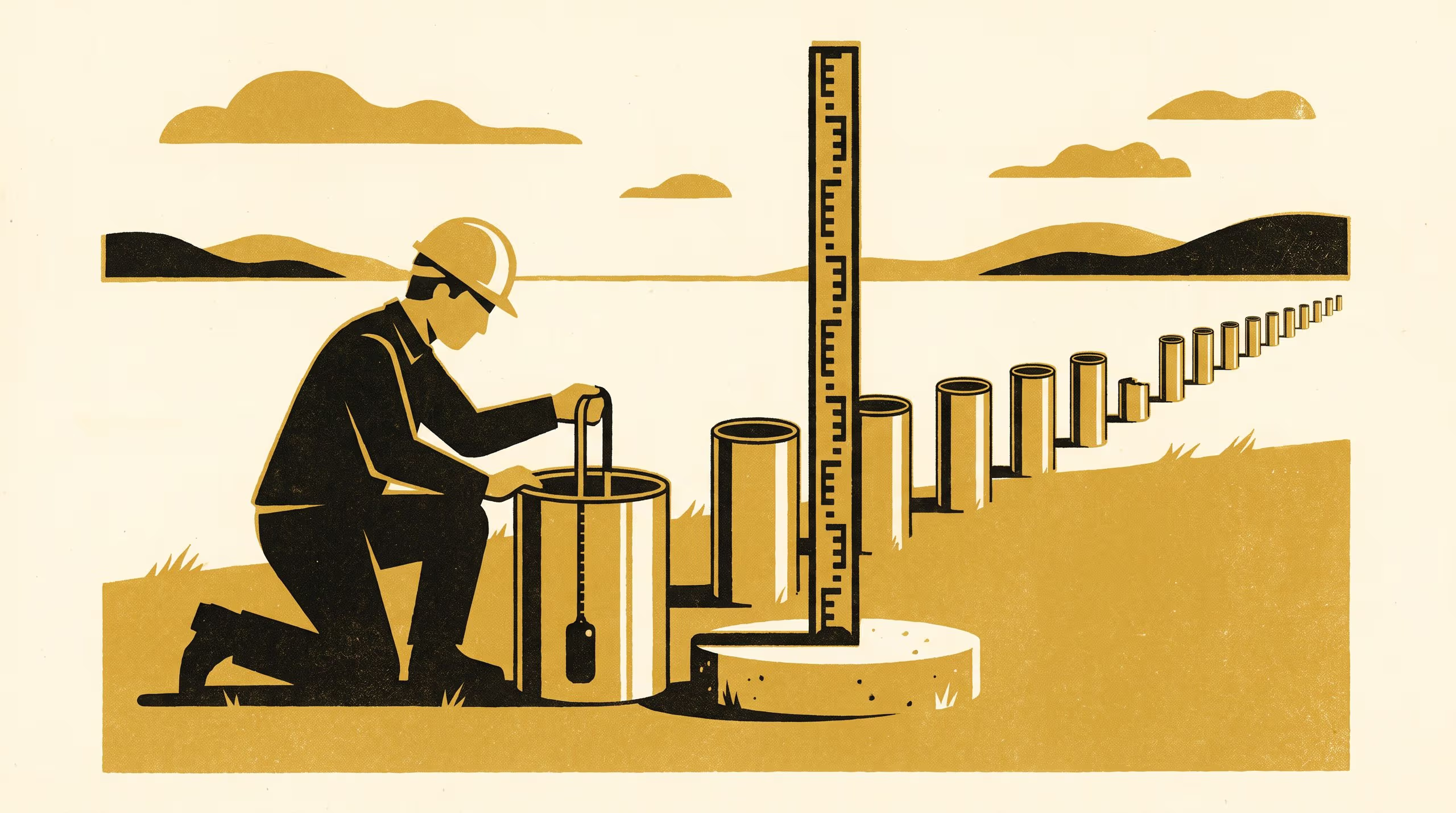
Dr Vigdis Emenike and Dr Torun Ezeigwe find the steps that cut-down casings and replaced caps leave in decades of groundwater level readings, and check them against a fresh survey.
Comparing each monitoring bore with its neighbours shows where the point the tape is read from has quietly moved
Every reading we take starts from the top of a pipe, and we had not thought to ask the pipe how it was getting on. Our students will be meeting this paper early, and I suspect they will be asking it questions for a while yet.
— Dr Torun Ezeigwe, Senior Lecturer and Director, Master of Applied Measurement
A bore’s water level is only as steady as the rim it is measured from, and a new paper from the School of Underlying Conditions and the School of Continuous Improvement sets out to find where that rim has shifted without anyone writing it down. Where the Tape Starts is by Dr Vigdis Emenike, Senior Lecturer in the School of Underlying Conditions, and Dr Torun Ezeigwe, Director of the Master of Applied Measurement.
The study brings a comparative approach from climate science into conversation with the long-run practice of groundwater monitoring, reading each bore’s record against those of its neighbours so that a change belonging to one pipe alone stands out from the weather they share. A field resurvey of 64 measuring points then puts the method’s findings alongside the ground itself.
The paper sits comfortably within the University’s long-standing regard for the record that has been kept the longest and examined the least.
“What a hydrograph remembers depends on who last touched the casing,” said Dr Emenike. “It has been good to sit with that, and to give the people who mend these bores some credit for how much they shape what we know.”
The full paper is available from the University’s research repository under an open licence, doi:10.5555/slop.3htlw5.