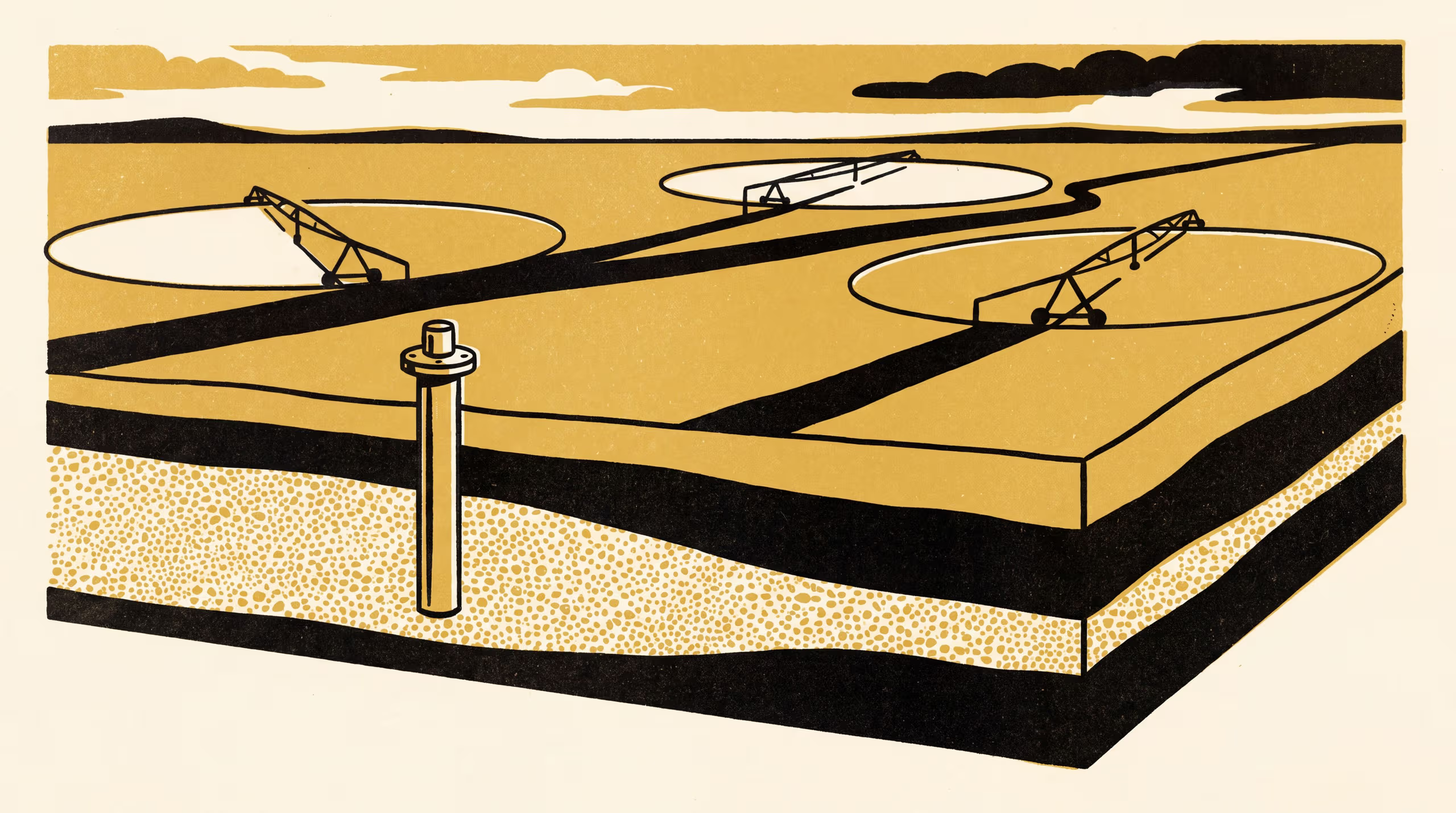
A research poster from the School of Underlying Conditions finds that a district's auction to retire irrigation bores bought mostly from bores over the thinnest part of the aquifer, many of them expected to stop pumping regardless.
Seventy-two sealed bids, one retirement round and the saturated sediment under each irrigation bore
Seventy-two sealed envelopes, a single auction round and a close reading of the sediment beneath every bore that bid: these are the materials of The Cheapest Bore Was Already Going Dry, a new research poster from the School of Underlying Conditions. It asks what a district actually buys when it invites irrigators to name their price for giving up a bore, and finds that the lowest prices came, for the most part, from the thinnest ground.
The work is led by Associate Professor Ragnhild Uzoma, Lead of the Basement Relations Group, with Dr Runa Adegoke, Senior Lecturer and Convenor of the Strategic Drift Survey, and Associate Professor Kwame Lindqvist, Director of the Master of Priority Studies, both of the School of Emergent Priorities.
Every evaluation I have run has turned, sooner or later, on what people know and are never asked. It is heartening to see that question put in sealed envelopes, and the envelopes taken seriously.
— Dr Runa Adegoke, Senior Lecturer and Convenor, Strategic Drift Survey
The poster sets auction design alongside hydrogeological record-keeping, positioning the bid itself as a carrier of local knowledge and opening a pathway toward retirement rounds that weigh what is offered against what the ground could still have given.
It stands as a further expression of the University’s conviction that a market, read patiently enough, is also a geological record.
“The ground keeps its own counsel, and the people who farm above it keep a fair share of it too,” said Associate Professor Uzoma. “We are glad to have begun listening to both at once.”
The full poster is available from the University’s research repository under an open licence, doi:10.5555/slop.5a2clo.