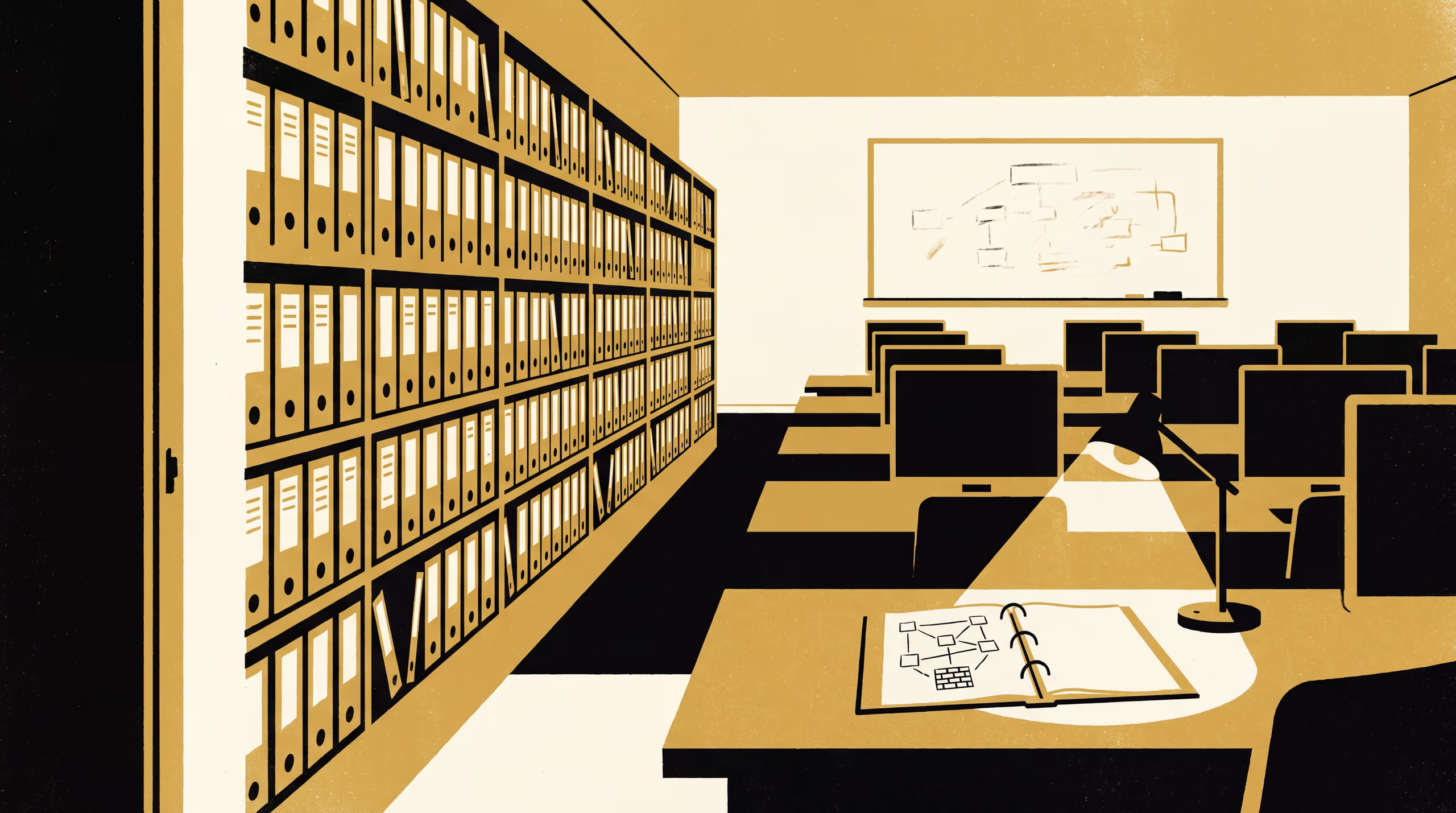
A new research poster from the School of Underlying Conditions treats the brick-wall sign for a firewall, drawn by hand across a quarter-century of incident binders, as a motif with a history of its own.
An art-historical reading of one operations archive's hand-drawn network diagrams finds the bricks giving way to a label
For a quarter of a century, the staff of one security operations centre drew their network by hand whenever an incident called for it, and nearly every time they drew the firewall as a wall of bricks. Fewer Bricks Each Year reads those drawings as an art historian would. The work was led by Dr Brynjar Obiora, Senior Research Fellow in the School of Underlying Conditions, alongside Ms Sunniva Balogun, Doctoral Candidate in the School of Emergent Priorities, and Dr Solveig Adeyemi, Lecturer and Deputy Convenor of the Review Cadence Observatory in the School of Continuous Improvement.
A surveyor learns early that a line on a map is a decision somebody made in the field. It has been a privilege to watch another kind of fieldwork make that decision year after year, a little more lightly each time.
— Dr Brynjar Obiora, Senior Research Fellow, School of Underlying Conditions
Working across sixty-one binders and fourteen distinct hands, the team brings the tools of iconography and connoisseurship to a body of operational drawing that has seldom been looked at as drawing, placing the everyday sketch of the incident desk within the University’s widening engagement with the visual cultures of digital security. Over the period the poster covers, the median wall thins from six courses of brick to one, and a written label takes the bricks’ place.
Ms Balogun said the archive had “kept these sheets for what they were, which is the kindest thing an archive can do for a question nobody has asked yet”.
The University counts the poster among the clearest signs to date that its School of Underlying Conditions will go wherever a boundary has been drawn by hand, and stay long enough to see it redrawn.
The full poster is available from the University’s research repository under an open licence, doi:10.5555/slop.c3dw5f.