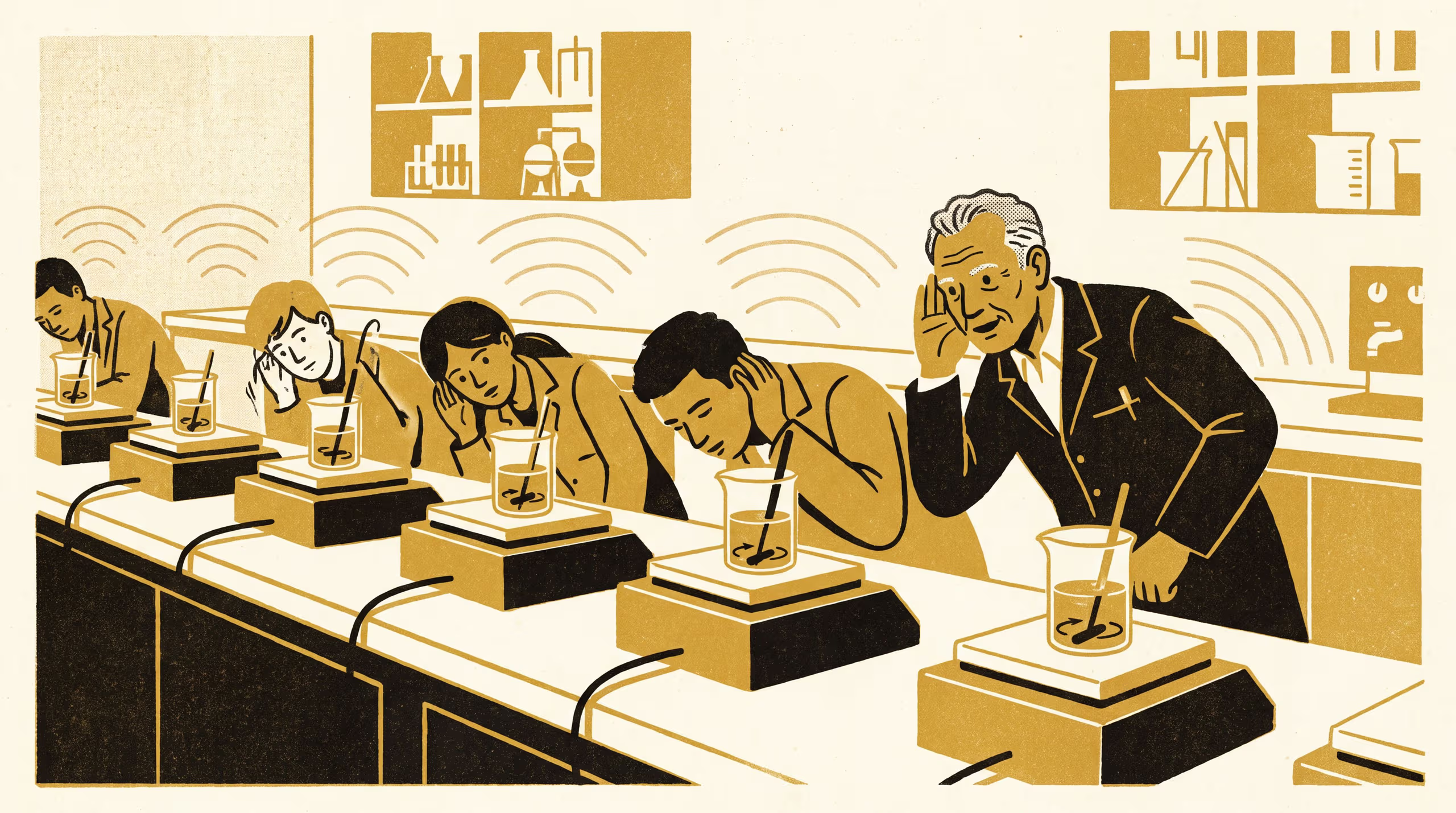
A new research poster from the School of Emergent Priorities listens to students setting a magnetic stirrer by ear before a potentiometric reading, and finds the right speed is passed from teacher to student as a pitch.
Three demonstrators, three pitches, and a stirrer dial that nobody reads
The School of Emergent Priorities has a standing interest in what an institution hands on without ever writing it down, and a new research poster finds one such thing on an undergraduate chemistry bench: a note.
Stir Until It Sings is by Dr Ingrid Vasseur, Lecturer and Convenor of Futures in Committee, with Dr Anneke Tolan, Senior Research Fellow and Deputy Convenor of Futures in Committee, and Associate Professor Casimir Beng, Lead of the Adaptive Metrics Lab in the School of Continuous Improvement.
We went in to write about a dial and came out writing about a tune. There is a good deal more to ask of it, and we are glad to have the rest of the University asking alongside us.
— Dr Anneke Tolan, Senior Research Fellow and Deputy Convenor, Futures in Committee
Across two semesters and 148 student sessions, the team brought the listening practices of ethnomusicology into dialogue with the everyday life of the teaching laboratory, attending to the moment a student decides the stirring is right and to the lineage of instruction behind that decision. The poster situates a modest piece of bench craft within a broader conversation about apprenticeship, embodied skill and the quiet continuity of practice.
The work adds to the School’s ongoing attention to the knowledge an institution keeps in its people rather than in its paperwork, and it is a particular pleasure to see that attention meet the instruments of the chemistry laboratory. Associate Professor Beng said the collaboration had shown “how long a setting can hold steady when it lives in the people who use it”.
The full poster is available from the University’s research repository under an open licence, doi:10.5555/slop.phhvk5.