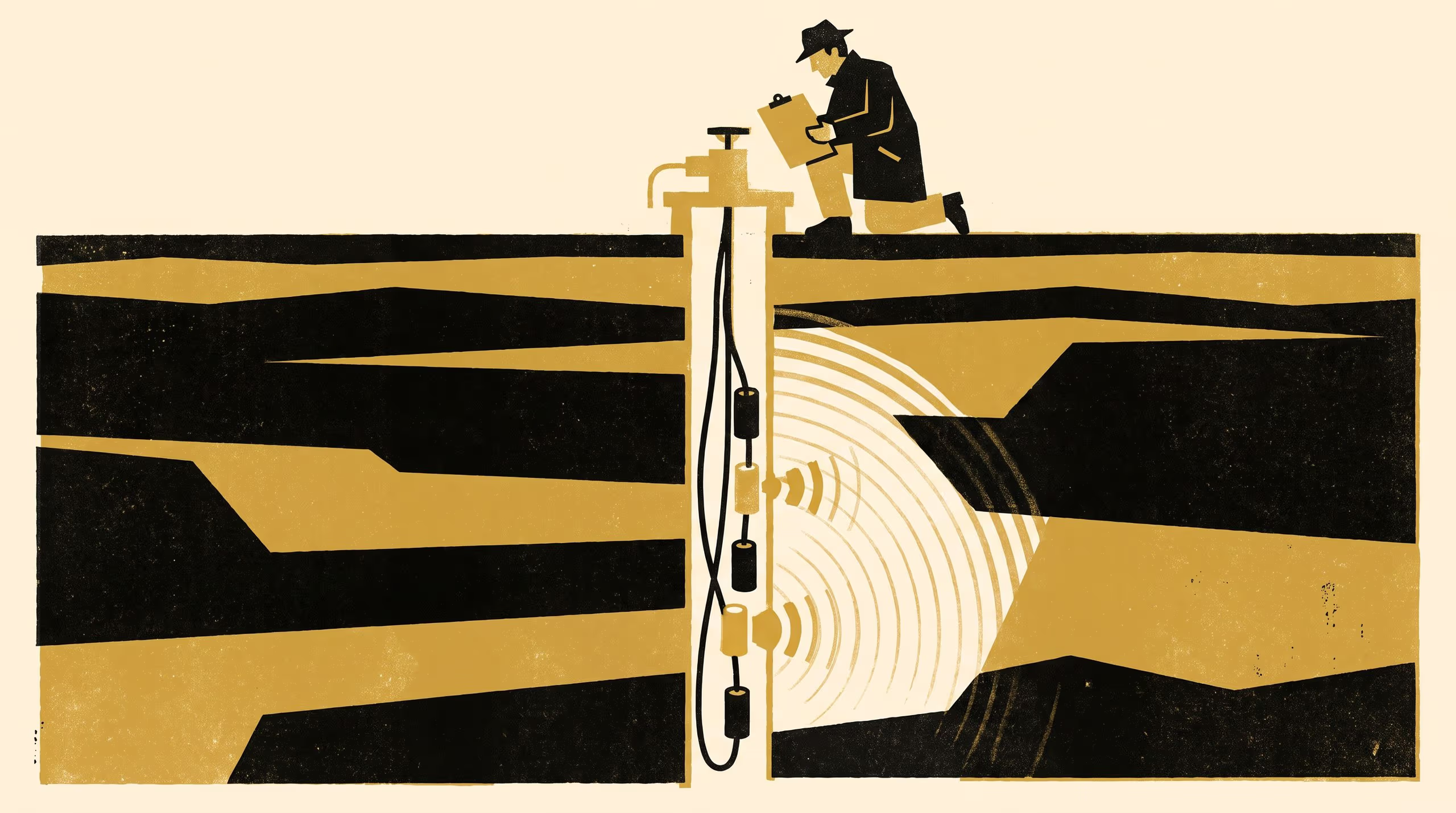
Associate Professor Ragnhild Uzoma and Dr Brynjar Obiora show that a downhole geophone string returned with dead levels can still behave as a capable sensing array, provided its top and bottom levels are among the survivors.
A study from the Basement Relations Group counts every way a sixteen-level string can lose its sensors, and what it can still locate afterwards
By working through all 65,536 patterns of working and silent sensors that a sixteen-level string of downhole geophones can bring back from a borehole, two researchers in the School of Underlying Conditions have arrived at a short instruction for field crews: check the ends first.
An Accidental Sparse Array is by Associate Professor Ragnhild Uzoma, Lead of the Basement Relations Group, and Dr Brynjar Obiora, Senior Research Fellow in the School.
Field crews have been reading dead channels off a printout for as long as there have been strings to lower. We hope they recognise their own judgement in this, set down a little more formally than it usually is.
— Dr Brynjar Obiora, Senior Research Fellow, School of Underlying Conditions
The paper positions instrument failure as a structural feature of downhole sensing rather than an interruption to it, bringing the sparse-array tradition of signal processing into dialogue with the everyday realities of the borehole. Its simulations find that seven surviving levels, well placed, can locate thirteen sources at once, where a string cut short to the same seven locates six.
It is the kind of patient arithmetic the University is glad to see carried out to the wellhead. Associate Professor Uzoma said the work had “given the School a better way of saying what a string still knows,” and that the ends of a string were “always the part everyone watched going down.”
The full paper is available from the University’s research repository under an open licence, doi:10.5555/slop.l6bmzg.