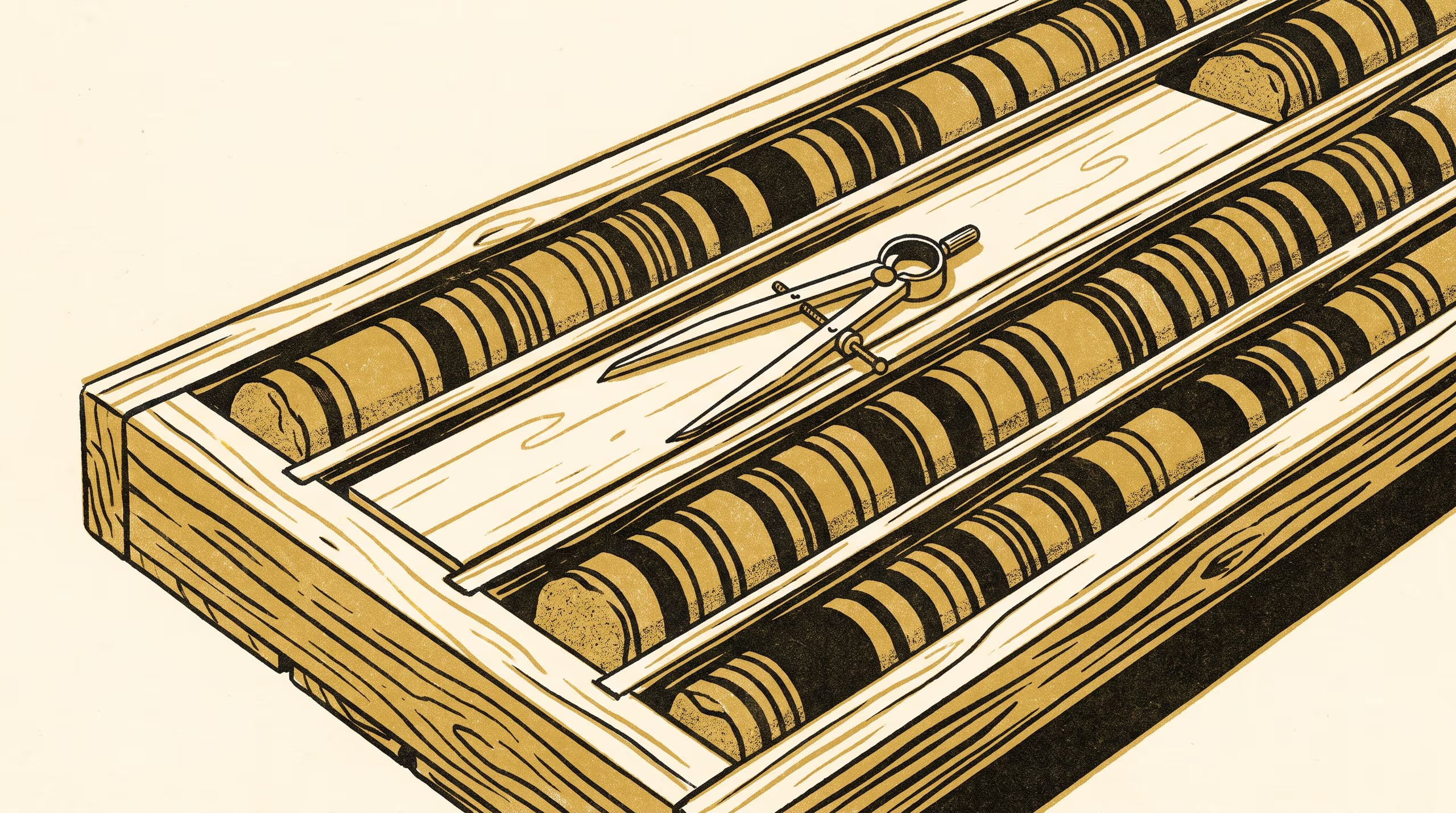
A new paper treats the stripes in banded drill core as a pattern with a phase, and shows where a log should record a count in an unrecovered interval and where it should record a range.
A pattern-formation paper from the School of Underlying Conditions puts a range where the core tray has a block
By treating the stripes in a banded drill core as a pattern with a phase of its own, two researchers in the School of Underlying Conditions have given the University’s logs a way to say how far into a missing interval they can still count.
How Many Bands Are Missing?, by Associate Professor Ragnhild Uzoma and Dr Vigdis Emenike, asks a question familiar to anyone who has stood over a core tray: when a drill run fails to bring up part of a banded sequence, how many bands went with it? The answer, it turns out, depends on the length of the gap measured in bands. Inside a certain span, the count can be stated. Beyond it, the paper recommends a range.
Every core store has a shelf of wooden blocks with nothing written on them. It feels right that the Basement Relations Group should be the ones to give those blocks something to say, even when what they say is a range.
— Associate Professor Ragnhild Uzoma, Lead of the Basement Relations Group
The paper brings the mathematics of pattern formation into working partnership with the everyday practice of the core shed, aligning a phase-based account of rhythmic banding with a calibrated inference framework to establish where a single figure is supportable and where a more measured entry serves the record better. Applied to one logged hole, it settled the count for 19 of 47 unrecovered intervals and offered ranges for the remainder.
Dr Emenike said the approach “sits comfortably beside the School’s monitoring practice, where a reading has always travelled with its uncertainty”.
The release adds a further strand to the School’s growing body of work on what a record can responsibly claim about the material it did not keep.
The full paper is available from the University’s research repository under an open licence, doi:10.5555/slop.51v7jq.