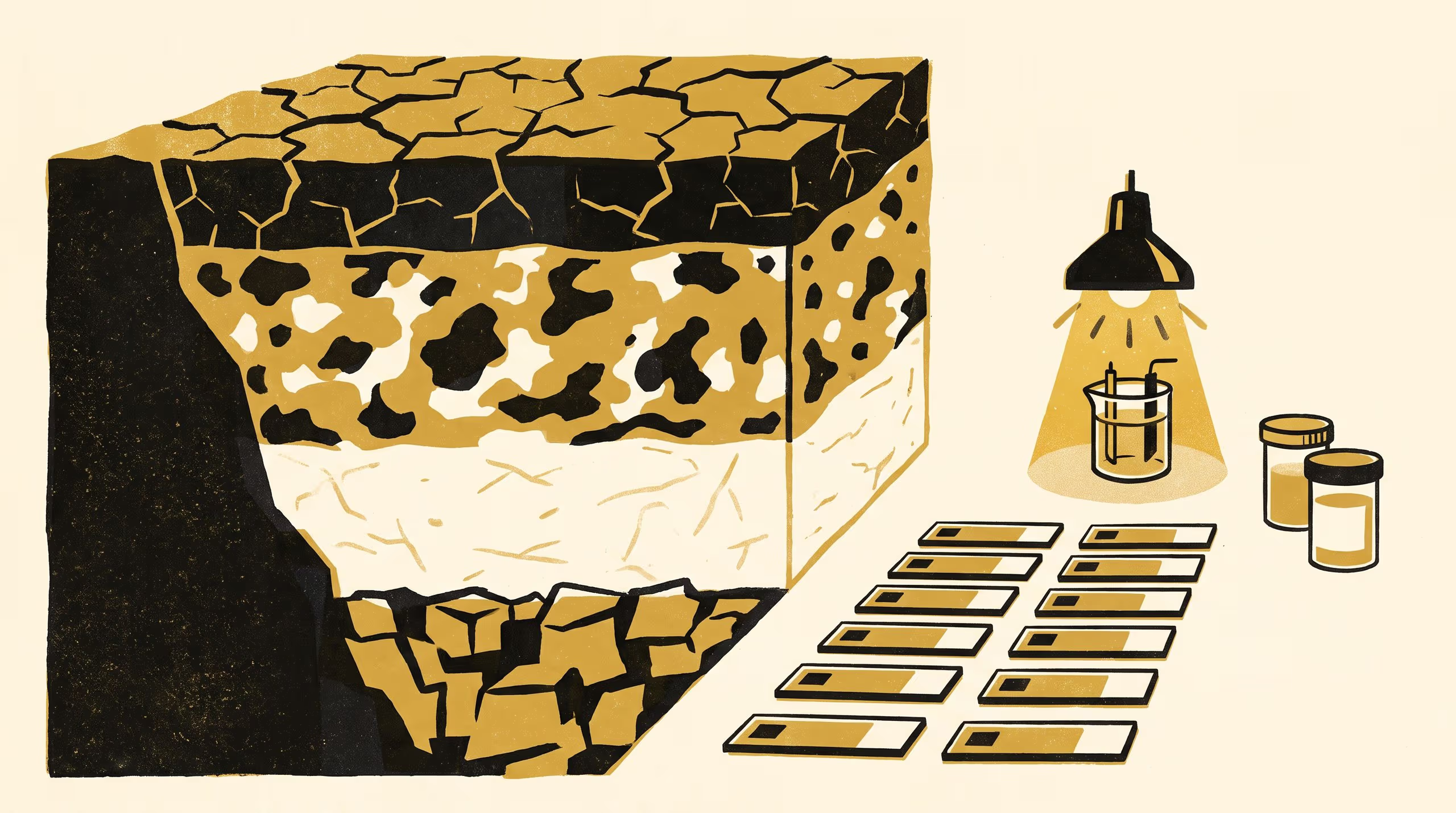
Dr Brynjar Obiora and Associate Professor Ragnhild Uzoma cast hematite photoanodes from the iron of each horizon of one lateritic profile, and find the horizons sorting cleanly under the lamp.
Iron from six horizons of a single profile becomes six photoanodes, and the films change where the surveyor drew the line
Six samples of one hillside, taken at six depths, have been turned into six working solar electrodes. In Down the Profile, Dr Brynjar Obiora, Senior Research Fellow, and Associate Professor Ragnhild Uzoma, Lead of the Basement Relations Group, follow the iron of a single lateritic soil profile from the pit face to the photoelectrochemical bench.
None of this would have happened without the people who keep the School’s profile collection in order, year after year, so that a question like this one has somewhere to start. The pit was ours; the habit of describing it carefully belongs to all of them.
— Dr Brynjar Obiora, Senior Research Fellow, School of Underlying Conditions
The paper situates the field description of a soil profile as a working input to materials research, aligning the surveyor’s horizon-by-horizon practice with the bench methods of solar fuels chemistry. Films cast from the iron-rich ferricrete crust outperformed a control made from laboratory salt, while those from deeper, clay-rich horizons trailed behind it. Across two of the boundaries the surveyor had pencilled on the pit face, the electrodes changed where the soil changed: sharply at one, gradually at the other.
The work extends the School’s sustained attention to what lies beneath the surface into territory where field and laboratory share a single sampling frame.
“It has raised more questions for the Basement Relations Group than it has settled, which is exactly the kind of paper we hoped the School would write,” said Associate Professor Uzoma.
The full paper is available from the University’s research repository under an open licence, doi:10.5555/slop.ihmrdp.