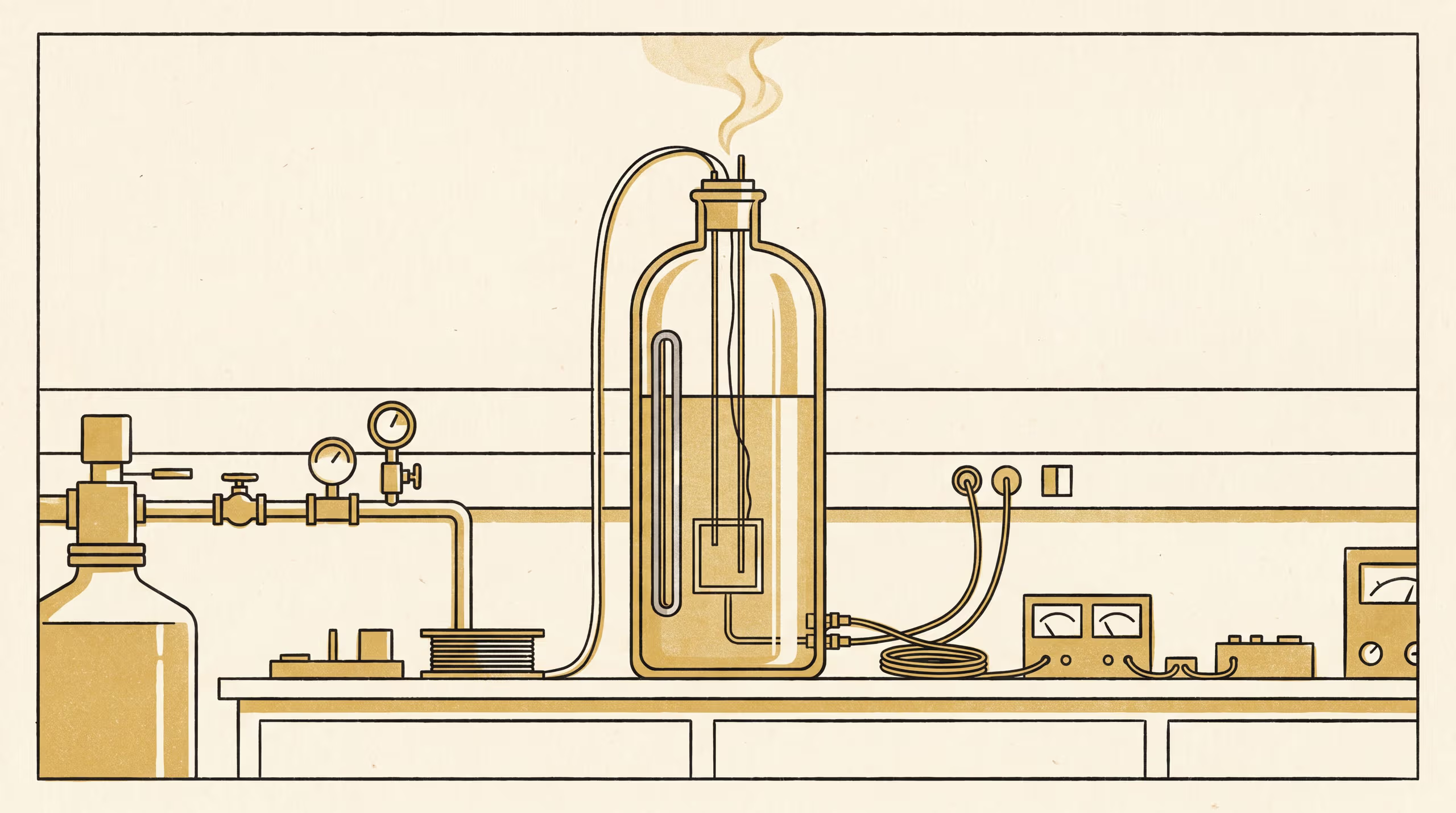
Professor Verity Marris, Dr Anouk Mensah and Dr Brynjar Obiora time 120 decays of a counterflow vortex tangle and find that how long it was driven, not only how dense it became, shapes how it fades.
A research poster from the School of Emergent Priorities follows quantum turbulence in superfluid helium as it fades after its heater is cut
Switch a heater off, wait, and listen. Repeated one hundred and twenty times in a channel of liquid helium a little above absolute zero, that patient routine sits at the heart of Same Density, Different Futures, a new research poster from the School of Emergent Priorities.
The poster is led by Professor Verity Marris, Director of the Trajectory Analytics Group, with Dr Anouk Mensah, Postdoctoral Fellow, and Dr Brynjar Obiora, Senior Research Fellow in the School of Underlying Conditions.
Our Group has spent a long time asking what a commitment leaves behind once the conditions for it have gone. It is a pleasure to carry that question somewhere very cold, and to have it answered so courteously.
— Professor Verity Marris, Director, Trajectory Analytics Group
The study brings a low-temperature acoustic capability to bear on a tangle of quantised vortices, holding steady the heat that sustains it while varying only how long that support runs. Tangles that arrive at the same density turn out to settle on different timetables, and the imprint of a longer drive persists until roughly the minute mark, beyond which further effort leaves no trace. Dr Obiora, who brought his School’s habits of careful description to the channel, called the collaboration “a fine reason to spend the winter indoors.”
The poster extends the University’s cross-school portfolio into a new temperature range, and the School of Emergent Priorities expects to keep it in view.
The full poster is available from the University’s research repository under an open licence, doi:10.5555/slop.3xg1qc.