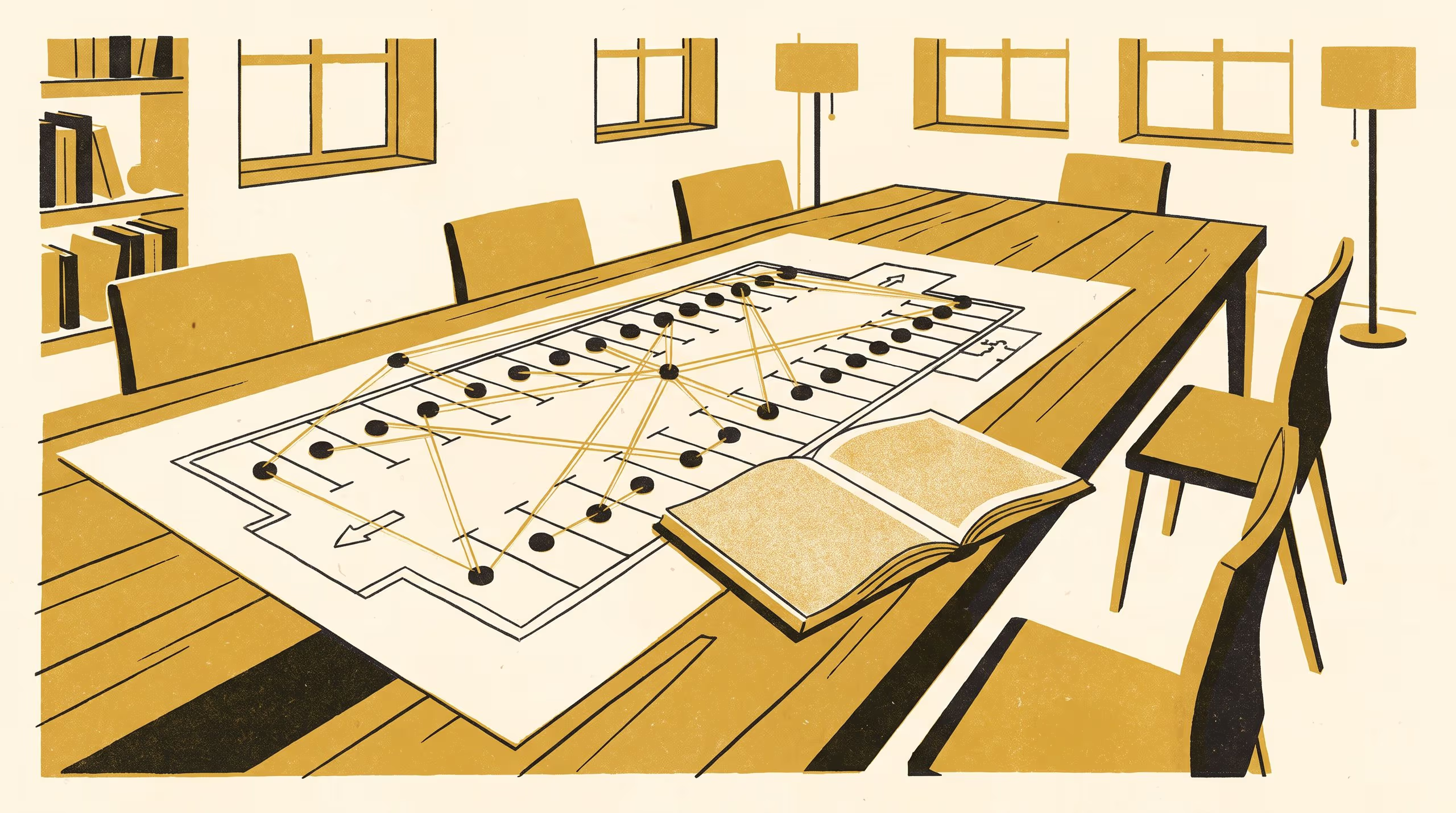
A new research poster reads the minute books of owners-corporation committees as legal philosophy and finds that their meetings applied a standard of compliance their by-laws never wrote down.
A research poster from the School of Emergent Priorities asks whether a by-law can require an allocation no committee can reliably compute
Whether a rule can ask more of the people bound by it than they could ever reliably deliver is one of the older questions in legal philosophy. A new research poster from the School of Emergent Priorities takes it to an unexpected place: the meetings where residential owners corporations hand out car-park bays, storage cages and committee seats.
Ought Implies Polynomial Time is by Dr Anneke Tolan, Senior Research Fellow and Deputy Convenor of Futures in Committee, with Dr Ingrid Vasseur, Lecturer and Convenor of Futures in Committee, and Ms Ylva Onyekwere, Doctoral Candidate. Working from minute books donated by 61 owners corporations, the team followed 148 allocations that an owner had challenged, and found that committees were held to the letter where the best allocation could be worked out, and to something more forgiving where it could not.
Every school eventually discovers that it has been doing philosophy all along. It has been a pleasure to watch ours find out in a basement car park.
— Dr Anneke Tolan, Senior Research Fellow and Deputy Convenor, Futures in Committee
The poster translates the everyday business of allocation into the formal vocabulary of computational complexity, then holds that vocabulary up against the long jurisprudential argument over duty and possibility, positioning the committee room as a site where theory of law and theory of computation quietly meet.
“A minute book is patient,” said Ms Onyekwere. “It waits for someone to read it all the way through.”
The study widens the School’s long-standing attention to how committees decide into a register the University has not often heard from it, and the University welcomes the company.
The full poster is available from the University’s research repository under an open licence, doi:10.5555/slop.8o9ora.