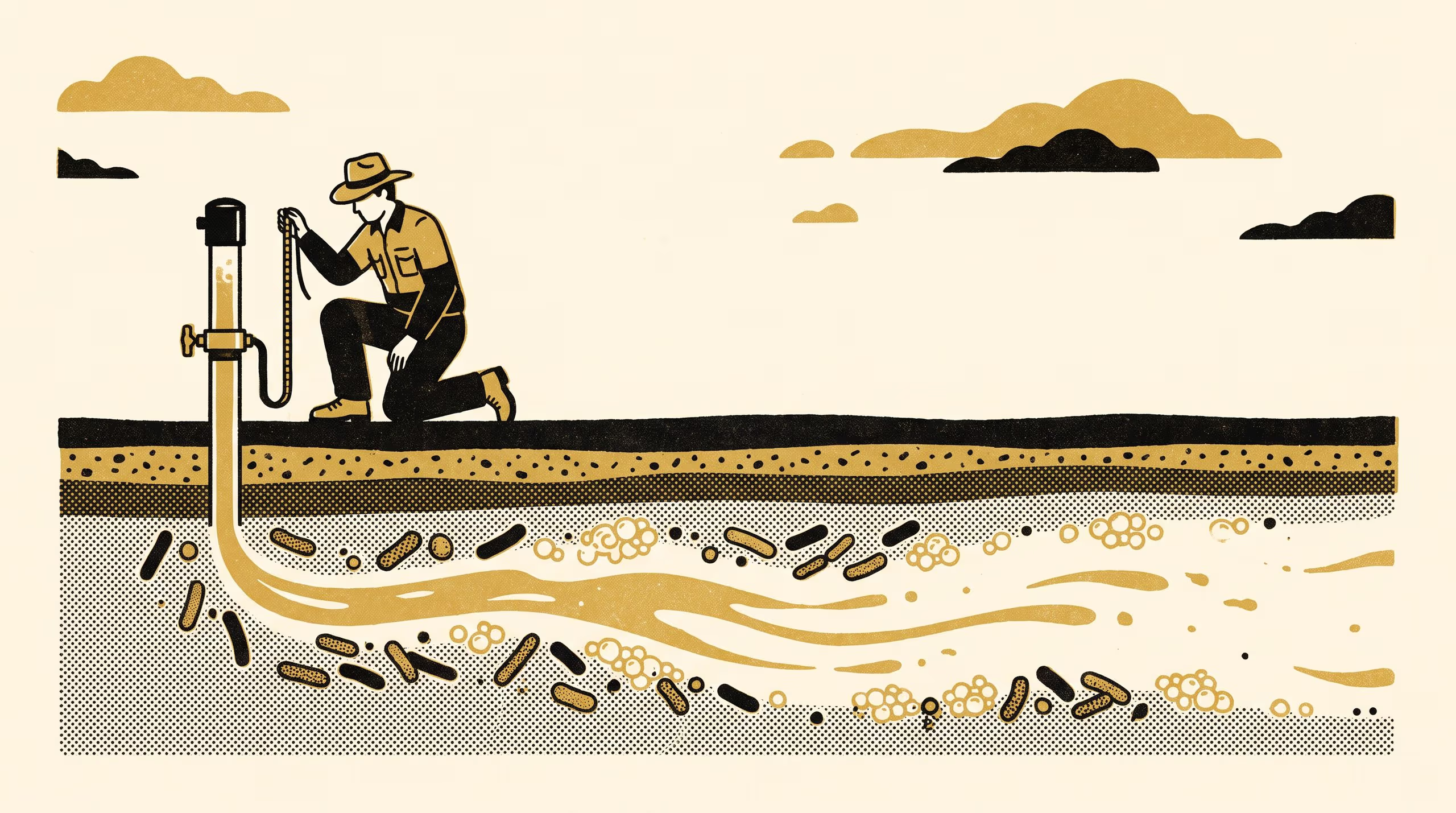
A new display campaign from the School of Underlying Conditions presents the slow work of leaving contaminated groundwater to its microbes, and of measuring it while they work.
A portrait campaign for the University's screens shows a plume left to its bacteria and read down a bore each quarter
The University’s portrait screens this week carry a campaign about the part of groundwater remediation that happens without anyone lifting a spade. For Leaving It to the Microbes, prepared by Dr Vigdis Emenike, Senior Lecturer in the School of Underlying Conditions, sets the School’s quieter fieldwork before a public that more often sees the excavator.
A good deal of our fieldwork consists of going back to the same bore and finding the ground has been busy in our absence. It seemed only fair that the School should say so somewhere people wait for buses.
— Dr Vigdis Emenike, Senior Lecturer, School of Underlying Conditions
The poster pairs a field officer kneeling at a monitoring bore with a cutaway of the strata beneath, where a plume thins as it moves through the water-bearing layer and colonies of bacteria gather at its margins. Its campaign line carries the School’s standing on its own attenuation index, and its small print points readers to three works from the School’s record, on a tributary plume across a river channel, on what a micelle computes, and on the monitoring bore as an instrument.
The University regards the campaign as a timely expression of its confidence in evidence that accrues on the ground’s own schedule, and of a School content to let its sites set the pace. Dr Emenike said she hoped the panels would “reach the people who walk past our bores every day without wondering what is going on underneath.”
The full poster is available from the University’s research repository under an open licence, doi:10.5555/slop.mjll6t.