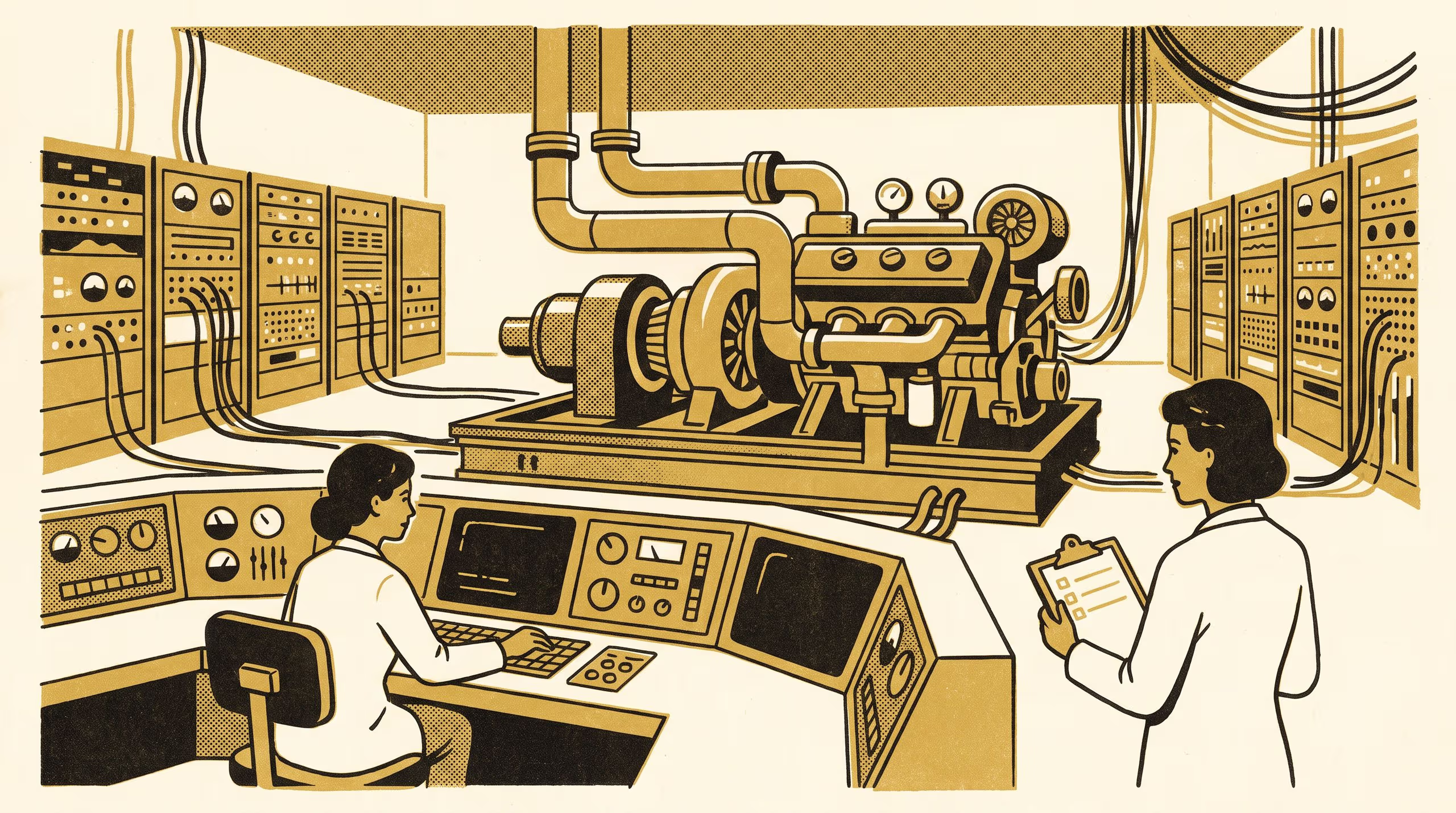
The School of Continuous Improvement's Impact Report 2021–2026 follows its work with combustion laboratories on what it takes to run a research engine alone.
An impact report on the competency frameworks behind each operator's sign-off in a network of combustion laboratories
The School of Continuous Improvement has published its Impact Report 2021–2026, an account of the five years it spent with combustion laboratories on a deceptively modest question: when may a person be trusted to run a research engine alone?
The Competent Operator was prepared under the direction of Dr Torun Ezeigwe, Senior Lecturer and Director, Master of Applied Measurement, with Associate Professor Casimir Beng, Lead of the Adaptive Metrics Lab, and Dr Ingeborg Nwachukwu, Lecturer and Convenor of Capability Sprints.
The operators let us watch them at their most careful and their least certain. Whatever is good in the framework, they put there before we wrote it down.
— Dr Torun Ezeigwe, Senior Lecturer and Director, Master of Applied Measurement
Across four case studies, the report traces how a laboratory’s tacit judgement became an observed-competency framework, how the assessors applying it were brought into calibration with one another, and how the framework was revised in the open as partner laboratories moved engine time towards gaseous-fuel programmes. A final study follows the framework into the Master of Applied Measurement and the Capability Sprints line, where the people it governs now learn to rewrite it.
The report stands as a considered contribution to the University’s wider work on translational improvement, and as evidence of what a School can build when it stays in the room long enough. Associate Professor Beng described the five years as “a long apprenticeship in other people’s caution, which the School intends to keep serving”.
The full report is available from the University’s research repository under an open licence, doi:10.5555/slop.zh7rhi.