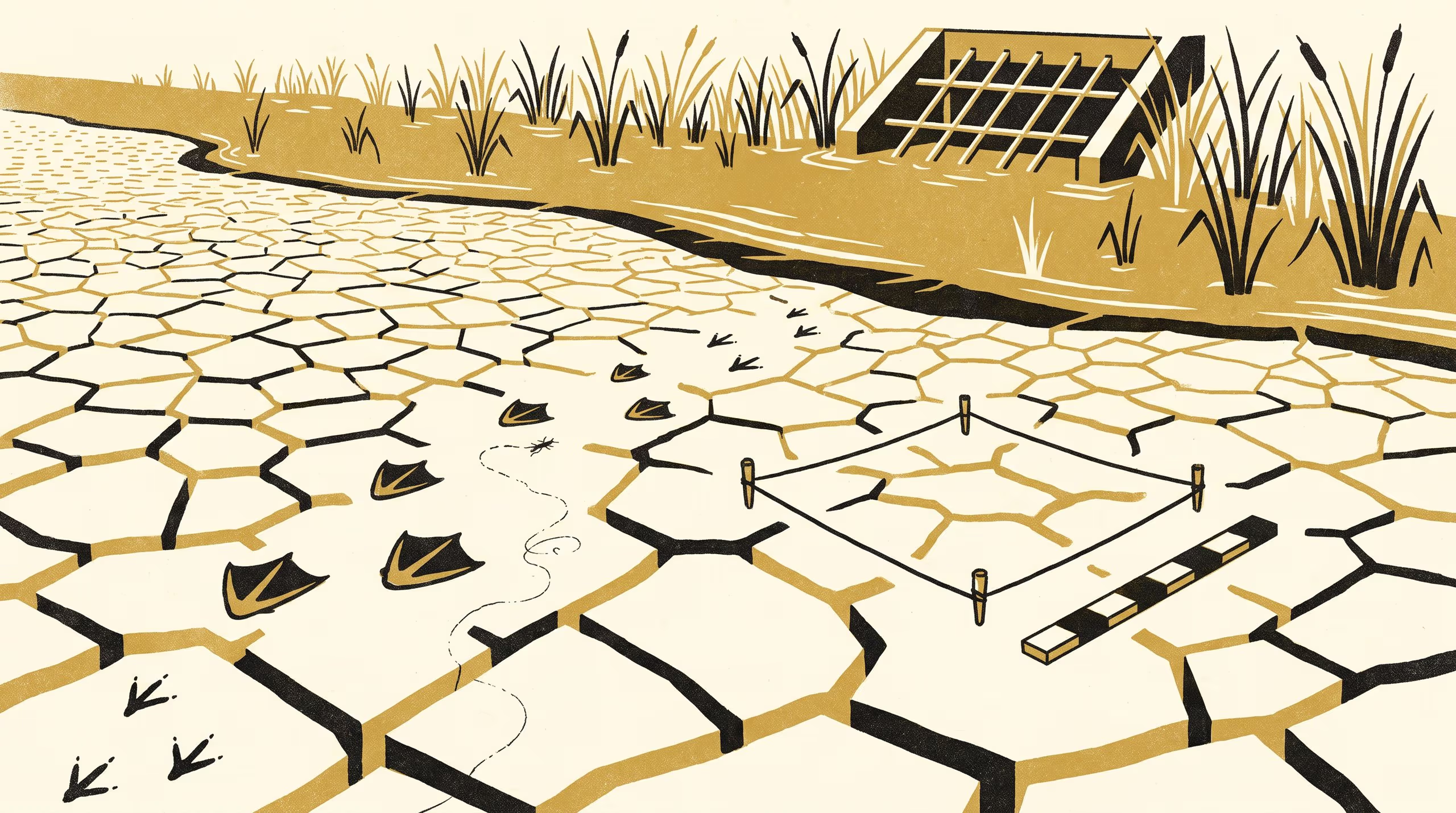
A new paper from the Schools of Emergent Priorities and Underlying Conditions watches a stormwater basin's drying edge for a full season and asks which of the tracks made there would ever reach the fossil record.
A season on the drying edge of a silted campus basin, followed from first print to burial
Before the dredge returns to the stormwater basin on the University’s grounds, two researchers have taken the basin’s drying edge apart, five millimetres at a time, to see which of the season’s footprints it had decided to keep.
What the Margin Keeps is by Ms Ylva Ogunbanjo, Doctoral Candidate in the School of Emergent Priorities, and Associate Professor Ragnhild Uzoma, Lead of the Basement Relations Group in the School of Underlying Conditions. Of 3,412 tracks, trails and casts recorded across one drying season, 214 made it under the next layer of silt, and those that did were mostly the deep prints of waterfowl.
We expect to be asked what a wetter year would have kept. We would very much like to be asked, and the basin may yet oblige us.
— Ms Ylva Ogunbanjo, Doctoral Candidate, School of Emergent Priorities
The study brings the long-run perspective of palaeontology into conversation with the everyday rhythms of campus water management, positioning the University’s own grounds as a living laboratory for questions usually reserved for deep time. Daily observation, seasonal fieldwork and a careful final excavation combine to show how much of what happens on a shoreline depends on the weather that follows it.
Associate Professor Uzoma described the basin as “a very good colleague, in that it never once tidied up before we arrived.”
The paper extends the University’s growing commitment to treating its own infrastructure as a field site of record.
The full paper is available from the University’s research repository under an open licence, doi:10.5555/slop.fr5fcn.