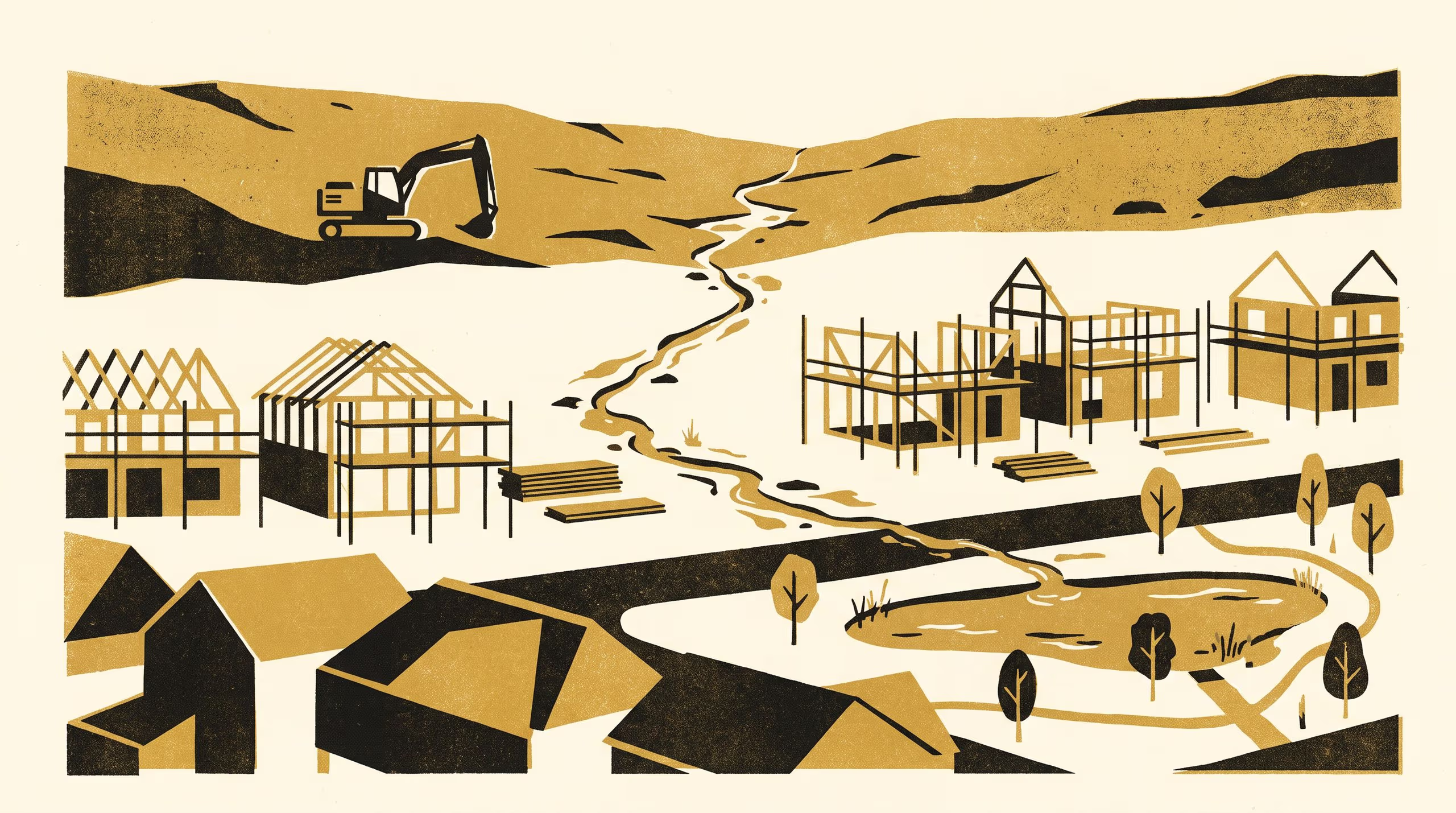
A new research poster finds that most of a staged housing estate's sediment basins became parkland while ground upslope of them was still bare, and proposes a consent condition keyed to the catchment rather than the stage.
A research poster from the School of Underlying Conditions on staged release and temporary drainage in a greenfield subdivision
The School of Underlying Conditions has made a habit of asking where one thing is judged to end and the next to begin. Its latest research poster, The Basin Handed Over Too Soon, carries that question out of the paddock and into the planning office, and finds that on one growing estate the answer was set by the staging plan rather than by the slope.
The poster is led by Dr Brynjar Obiora, Senior Research Fellow, with Dr Ronja Oyelaran, Senior Lecturer and Deputy Convenor of the Strategic Drift Survey, and Dr Marek Solheim, Lecturer and Deputy Convenor of the Horizon Register. Reading the estate’s consent record alongside its changing ground cover, the team found that five of its six construction sediment basins were handed over as parkland while land above them was still stripped, for a mean of 30 months each.
Every condition of consent is a small promise about how long something will be needed. We would be glad to hear from anyone who has drafted one and wondered, some years later, whether it was kept.
— Dr Ronja Oyelaran, Senior Lecturer and Deputy Convenor, Strategic Drift Survey
Working from the estate’s own paperwork, the study aligns the lifecycle of temporary drainage infrastructure with the evolving footprint of upslope activity, and offers planning authorities a catchment-anchored settings change to underpin it.
The University regards the poster as a welcome case of its earth scientists lending an eye for boundaries to a neighbouring profession. Dr Obiora said the project had taught the School “to look twice at the lines we draw for our own convenience, and we found a few”.
The full poster is available from the University’s research repository under an open licence, doi:10.5555/slop.uedfjj.