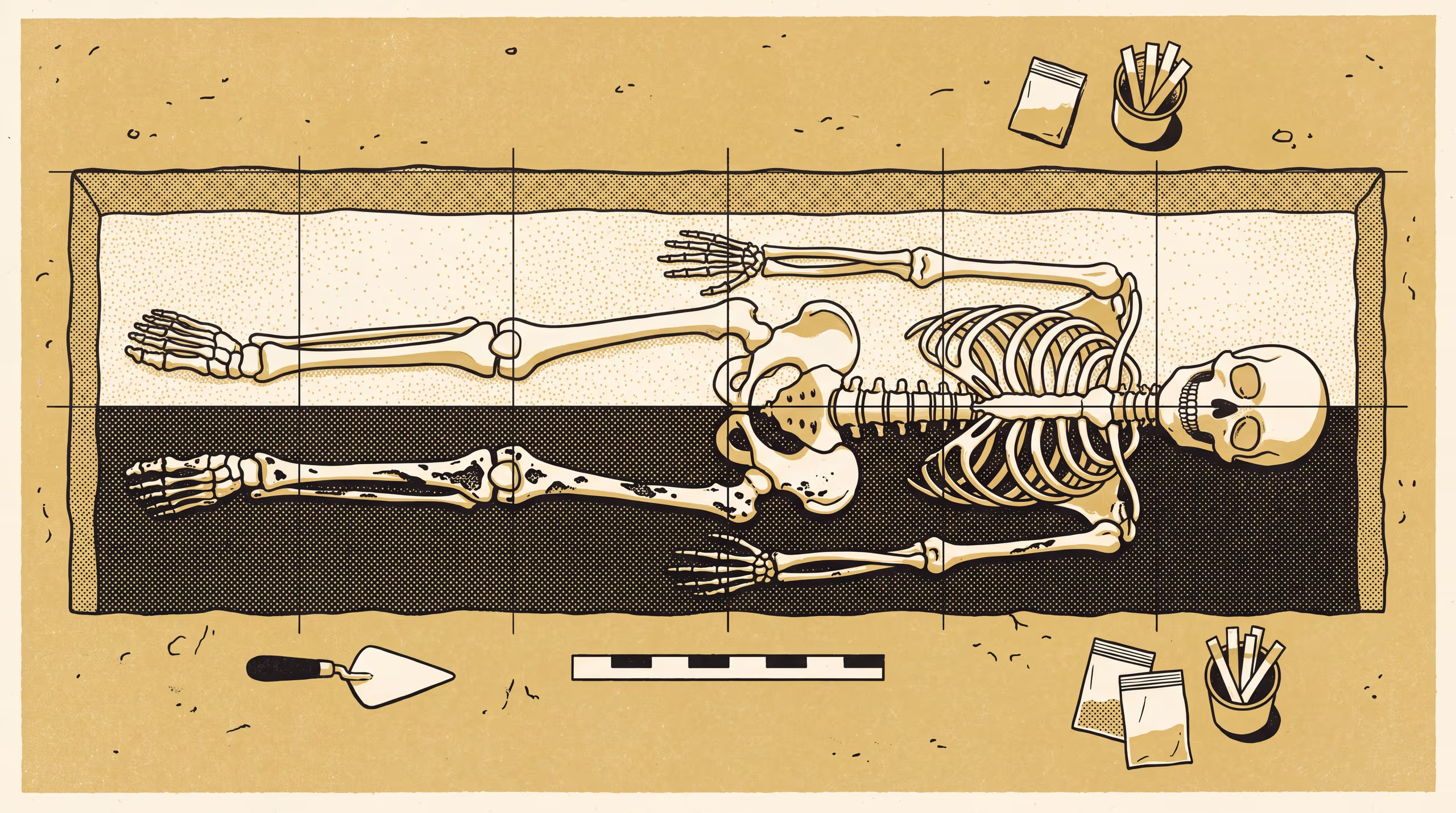
A new research poster maps the line between two soils through a single grave and finds that the eroded half of a skeleton was hiding its symmetry, not its health.
A soil boundary drawn through a churchyard grave changes how a pair of leg bones is diagnosed
The School of Underlying Conditions has always held that the ground beneath a thing is part of the thing, and its newest research poster carries that conviction into a rural churchyard.
One Grave, Two Soils is by Dr Brynjar Obiora, Senior Research Fellow, and Associate Professor Ragnhild Uzoma, Lead of the Basement Relations Group. It concerns a single adult burial whose grave was cut through the edge of an old ditch, so that one leg came to rest in chalky ground and the other in acidic fill. Where the soil had eaten away the bone’s surface, the team declined to record nothing as nothing. Of the nine places on the leg bones that could be read on both sides, eight told the same story.
A log is only as honest as what it admits it never saw. It has been a quiet pleasure to watch that habit travel from the core tray to the churchyard.
— Associate Professor Ragnhild Uzoma, Lead of the Basement Relations Group
The poster aligns field soil mapping with established osteological recording, situating a single case within a broader conversation about evidence, preservation and the limits of the visible record.
Dr Obiora said the work was “the first time I have drawn a boundary that someone else needed more than I did”, and that the forearms, which also lay across the line, would be read next.
The poster joins a growing body of University scholarship conducted, for the most part, on its knees.
The full poster is available from the University’s research repository under an open licence, doi:10.5555/slop.lxy8rc.