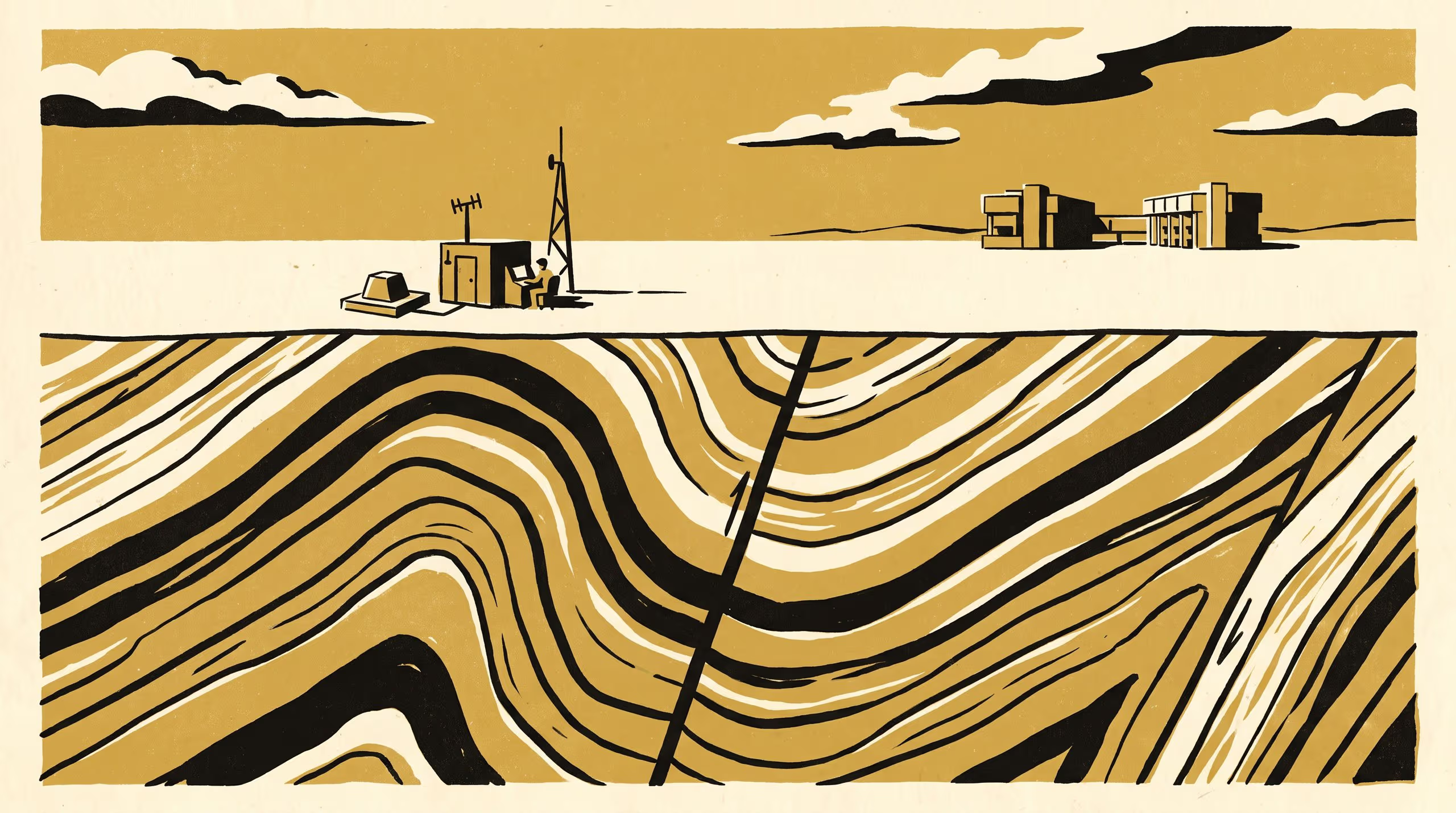
Slop University's new Strategic Plan commits the institution to the geological and geophysical sciences worldwide, and asks its own governance to keep time with the ground.
The Strategic Plan 2026-2031 makes field stations, long-record instruments and the core collection institutional priorities
Five years is too short to leave a layer in most rock. Slop University’s Strategic Plan 2026-2031 takes that as its starting point rather than its excuse, and places the slow sciences of the solid Earth at the centre of the institution’s next chapter.
The plan sets out five priorities: a network of standing field stations held open between projects across the world’s principal tectonic settings, long-record observatories designed to outlast the plan that installs them, a Solid Record Trust for the University’s core and sample collections, a shared foundation in deep time for every commencing student, and governance settings recalibrated so that long-lived assets are reviewed on a cadence matched to their lifespan. Its preparation was led by Dr Mirela Hanke, Postdoctoral Fellow and Deputy Convenor of the Living Dashboard, with Associate Professor Ragnhild Uzoma, Lead of the Basement Relations Group, and Dr Marek Solheim, Lecturer and Deputy Convenor of the Horizon Register.
Most of what I have worked on refreshes every few minutes. Writing this plan taught the School something about what it means to report on an asset that barely changes in a lifetime, and the Living Dashboard will be the better for slowing down.
— Dr Mirela Hanke, Postdoctoral Fellow and Deputy Convenor, Living Dashboard
For Associate Professor Uzoma, the plan’s value lies largely beyond its own period. “The cores we shelve this decade will be read by people who have not yet chosen their degrees,” she said. “A plan that admits that is a plan worth having.”
The document positions the University’s three schools as a single long-horizon capability, aligning field presence, instrumentation and stewardship behind a posture of institutional patience. It marks a considered step in the University’s understanding of its own place in time.
The full plan is available from the University’s research repository under an open licence, doi:10.5555/slop.ia48ls.