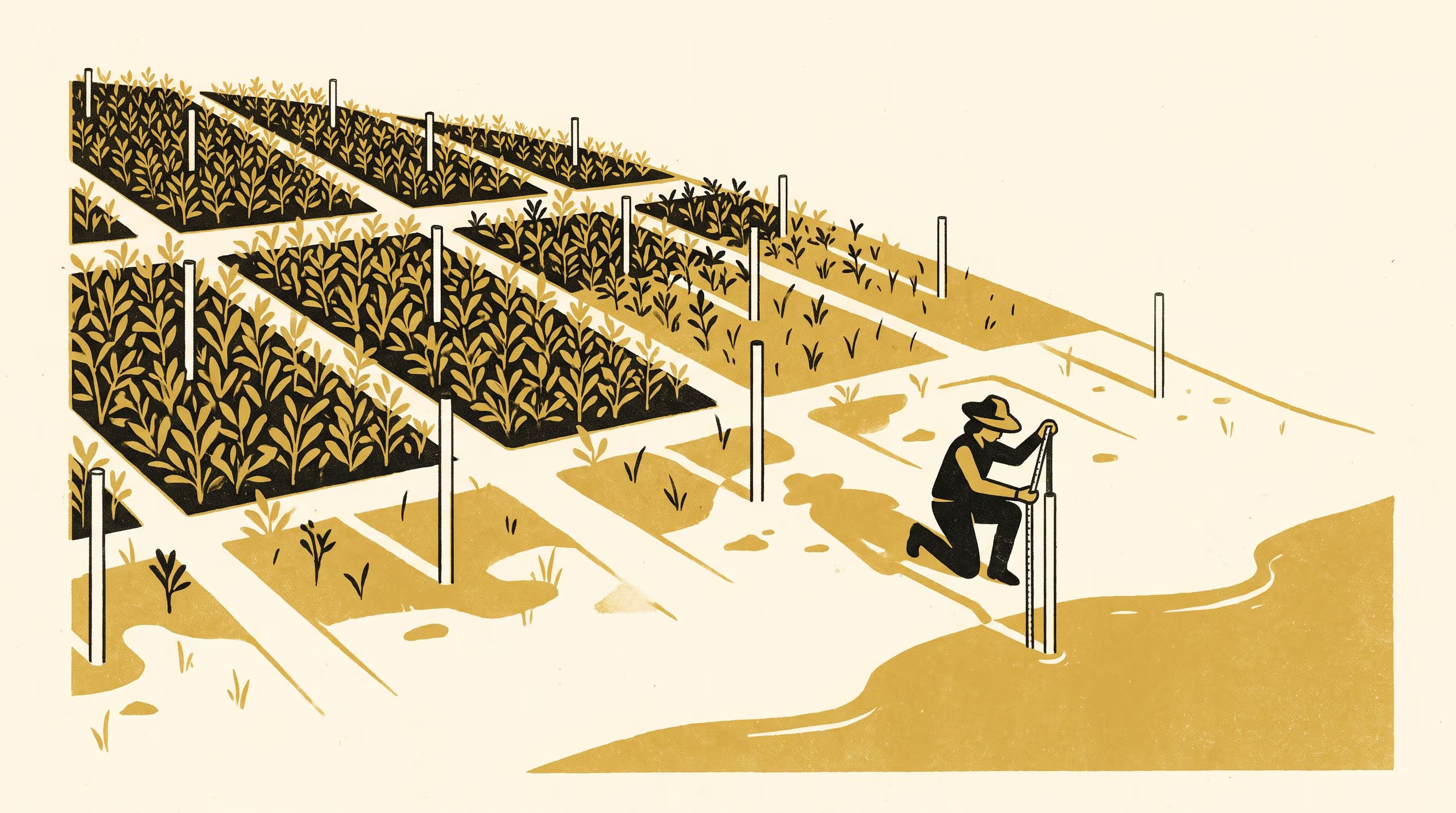
Dr Vigdis Emenike and Dr Brynjar Obiora gauge the perched water table under 132 lucerne plots for two winters and find that where on the slope a line is scored shapes how resistant it appears.
A hillslope trial reads root rot in twenty breeding lines against the water standing beneath each plot
Plant breeding is not, on the face of it, the business of an earth sciences school. Where the Water Stands, a new paper from the School of Underlying Conditions, makes the case that it can be, provided the plants are growing over the right kind of ground.
The paper is by Dr Vigdis Emenike, Senior Lecturer, and Dr Brynjar Obiora, Senior Research Fellow. Its subject is root rot in lucerne, and its instrument is one the School knows well: a pipe in the ground, read once a week.
The School came to this with no opinion about lucerne at all. What it had was a habit of asking how wet the ground is, and it turns out that habit travels further than we expected.
— Dr Vigdis Emenike, Senior Lecturer
The study aligns soil-landscape survey, shallow groundwater observation and disease assessment within a single field design, positioning the hillslope itself as a screening platform for breeding programs working under variable winter conditions. Its findings are expected to inform how resistance is evaluated wherever the water in a paddock cannot be relied upon to stay in one place.
Dr Obiora acknowledged the many early mornings behind the result, and thanked “everyone who ever carried a dip meter down a wet slope without asking what it was for.”
The University welcomes the paper as a sign of its earth scientists finding common ground with the field around them. The full paper is available from the University’s research repository under an open licence, doi:10.5555/slop.qzg9dw.