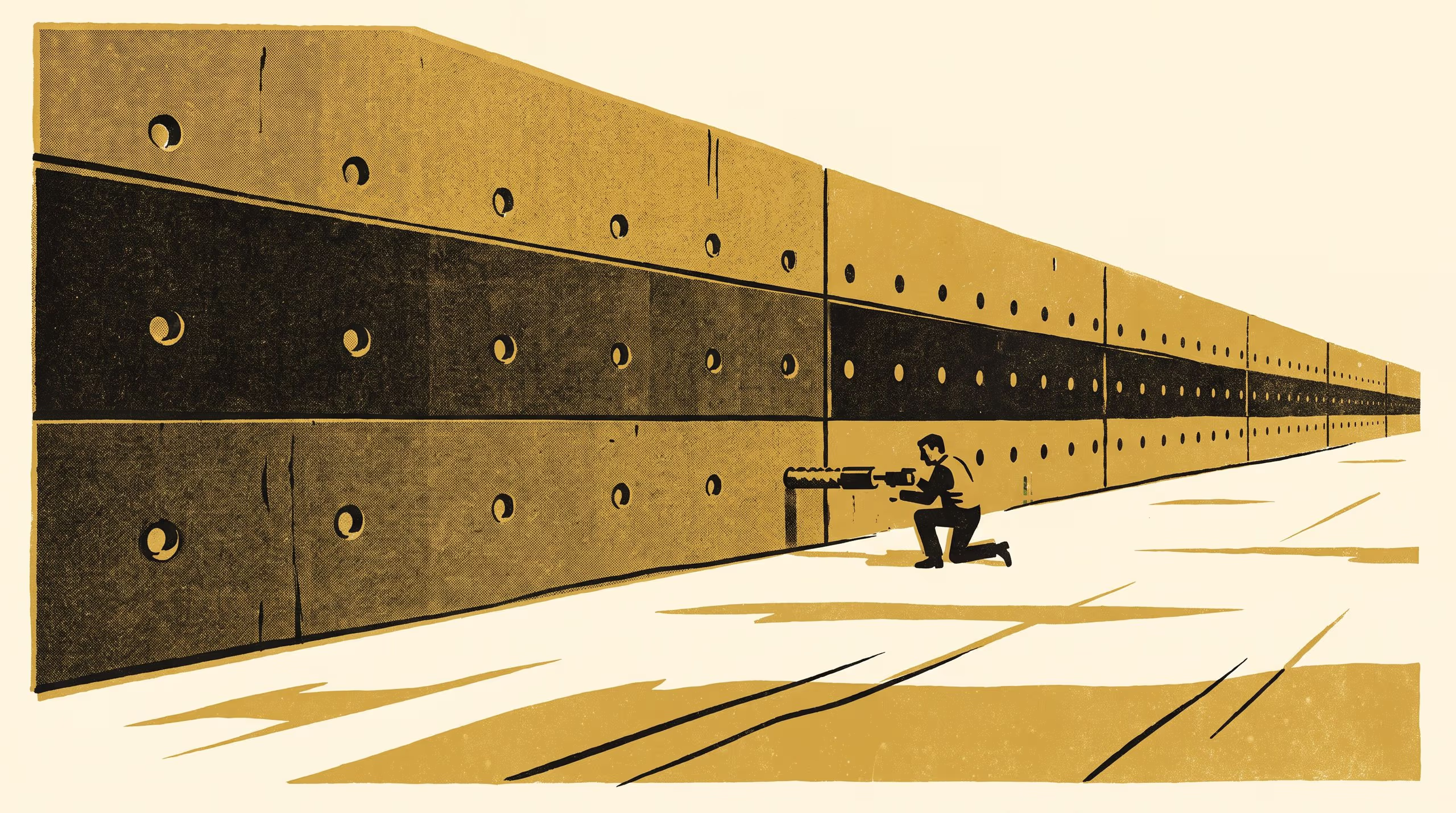
Dr Brynjar Obiora and Associate Professor Ragnhild Uzoma map carbonation depth across a concrete retaining wall and find it changes at the joints between pours rather than across the face.
A core survey of one retaining wall finds carbonation depth follows the pours it was cast in
An ageing concrete retaining wall keeps a record of how it was built, and the depth to which the air has reached into it is where that record can be read. So finds Mapped by Lift, a research poster in which the School of Underlying Conditions brings the methods of soil survey to a structure poured in three stages.
Dr Brynjar Obiora, Senior Research Fellow, and Associate Professor Ragnhild Uzoma, Lead of the Basement Relations Group, cored the wall at 96 points across its face. Rather than varying smoothly from one end to the other, carbonation depth held nearly level within each pour and stepped at both joints, and a map drawn lift by lift proved markedly more accurate than one drawn across the wall as a whole.
I have spent a career drawing lines across the ground and wondering whether they were really there. It was a pleasure to spend a season with a surface that had made up its mind, and I expect the School will be thinking about it for some time.
— Dr Brynjar Obiora, Senior Research Fellow, School of Underlying Conditions
Combining field sampling, spatial modelling and the construction logic of the structure itself, the work extends the School’s long attention to boundaries into the built environment, and positions survey practice to engage more closely with the histories of the things it surveys. The University counts it among the steadier signs of its schools carrying their instruments onto unfamiliar ground.
Associate Professor Uzoma said the project had been “a welcome reminder that the core tray is the same tray, whatever the core came out of”.
The full poster is available from the University’s research repository under an open licence, doi:10.5555/slop.6sxrac.