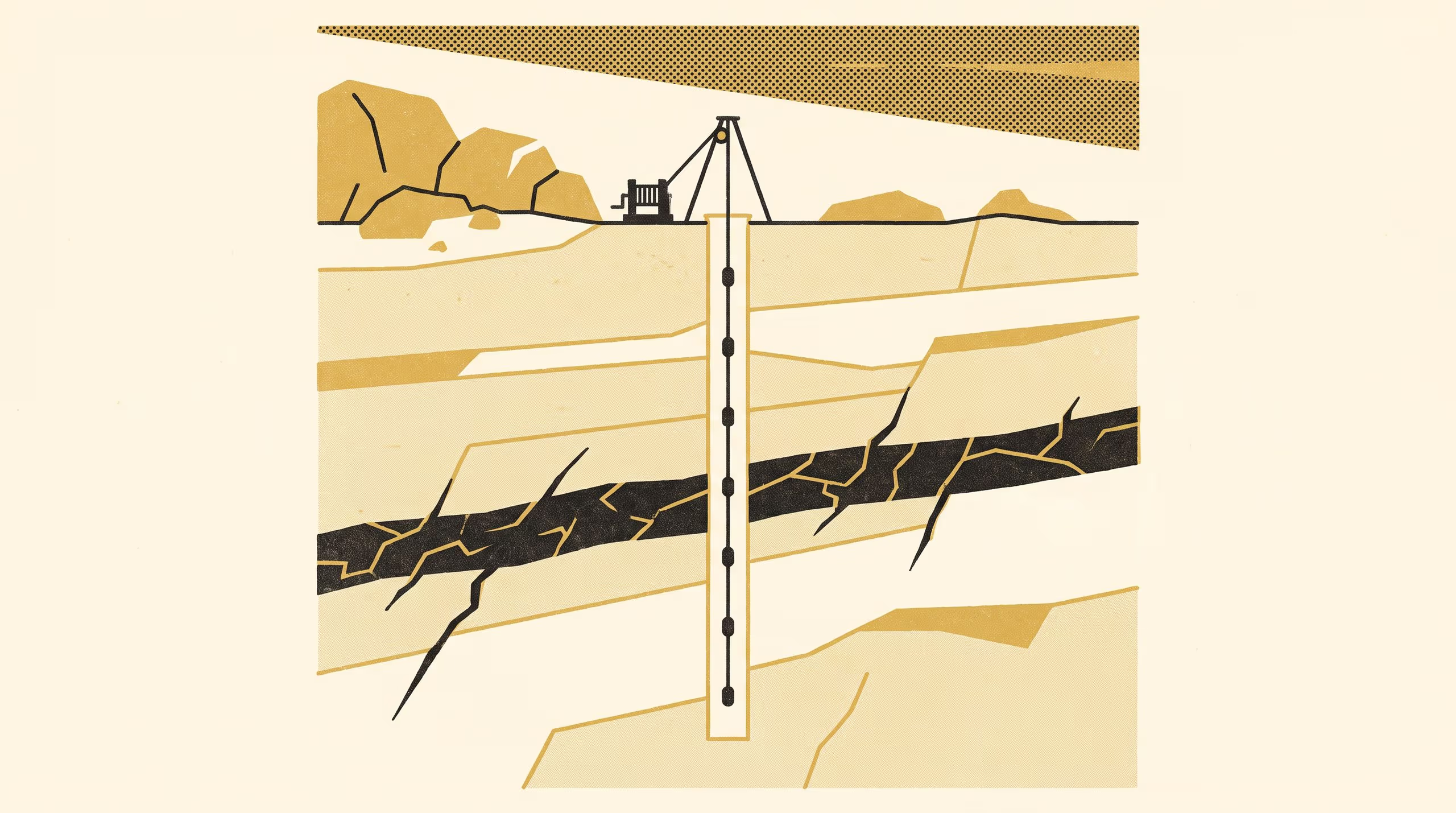
A new research poster finds that a cold spell read from one basement borehole's temperature log belongs to the 19 metres of core the drill failed to recover, once a fast neural surrogate lets that rock's conductivity stay unknown.
A research poster from the School of Underlying Conditions on reading past ground temperatures through rock that never came up
A bend in a temperature log, 118 metres down a borehole in granite, was not a cold century after all. It was rock nobody had seen.
That is the finding of The Kink at 118 Metres, a new research poster from the School of Underlying Conditions by Associate Professor Ragnhild Uzoma and Dr Vigdis Emenike, Senior Lecturer. The pair read a deep borehole’s temperatures back into the history of the ground surface above it, and found that the 19 metres of core the drill never returned had been quietly shaping the answer.
For most of my career the gap in a core tray has been something to apologise for. This work gives it a seat at the table, which turns out to be a more comfortable arrangement for everyone, the rock included.
— Associate Professor Ragnhild Uzoma, Lead of the Basement Relations Group
The approach pairs a fast, learned stand-in for the physics of heat moving through rock with a candid treatment of the metres the core shed cannot show, so that many thousands of possible histories can be weighed in the time a conventional model would spend on a handful. Rather than borrowing a value for the missing interval from its neighbours, the team allowed it to remain an open question, and let the temperatures themselves say how much it mattered.
Dr Emenike said the project had given the School “a reason to be patient with its own uncertainty, and a much quicker way of being patient”.
The poster adds to a body of work in which the University is increasingly at ease with saying what its instruments cannot reach.
The full poster is available from the University’s research repository under an open licence, doi:10.5555/slop.wxeq30.