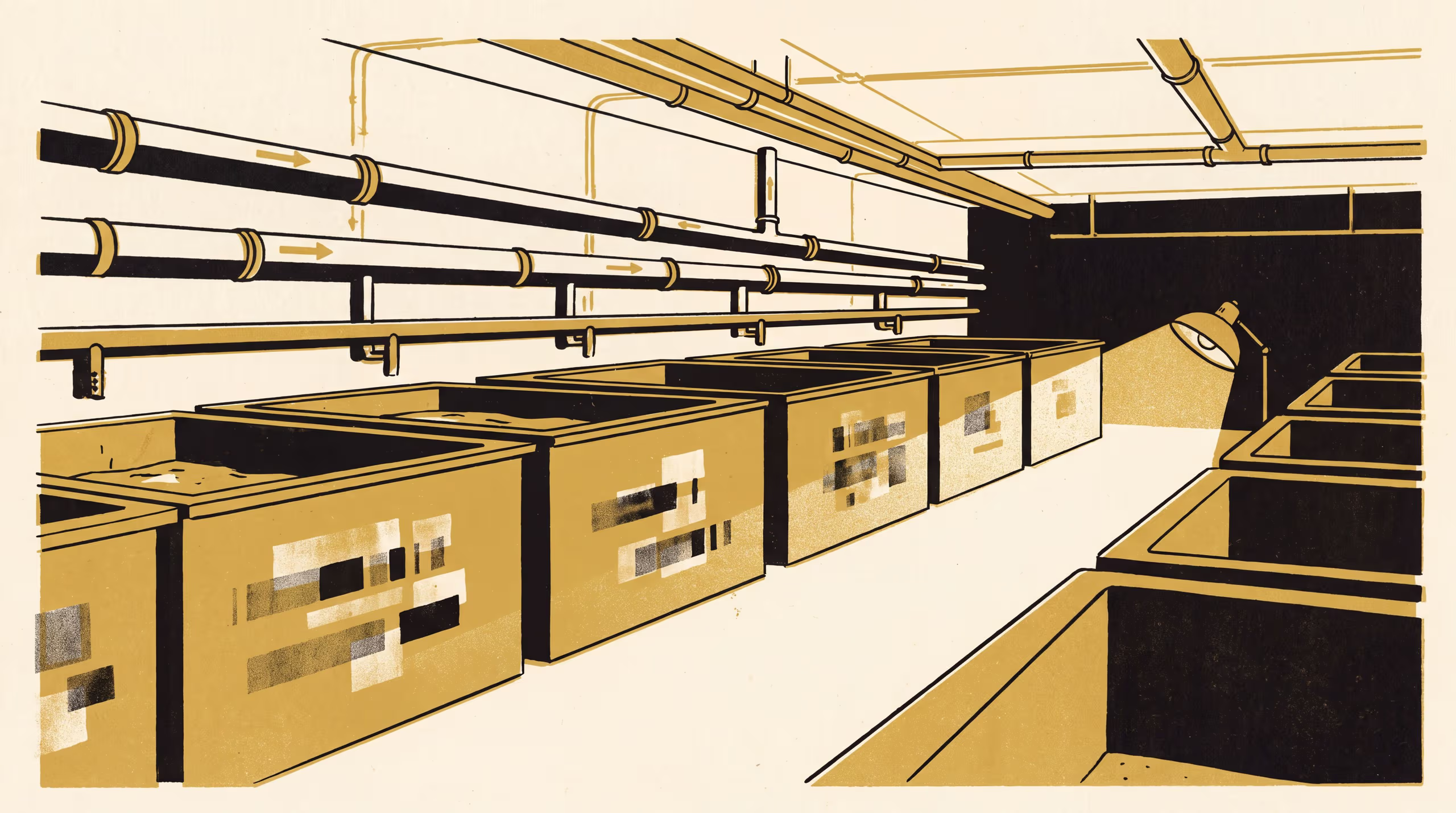
A School of Underlying Conditions team edits the stencilled and overpainted labels of a decommissioned electroplating works as inscriptions, and finds the pipework remembers a layout the vessels have forgotten.
Layered labels on one decommissioned works show its pipes keeping an older plant than its tanks
Before a closed industrial site is cleaned up, someone has to decide where to look first. A new research poster from the School of Underlying Conditions suggests that part of the answer has been on the walls the whole time.
Painted Over is by Associate Professor Ragnhild Uzoma, Lead of the Basement Relations Group, and Dr Vigdis Emenike, Senior Lecturer, both of the School, with Dr Iben Chikere, Lecturer in the School of Emergent Priorities. The team recorded 247 stencilled, cast and painted-over labels on the tanks, valves and pipework of one decommissioned electroplating works, edited every layer as an inscription, and put the layers in order by their lettering. The pipes, they found, keep an older plant than the tanks they feed.
I came to this from handover notes, and I have rarely felt so at home in a building I had never set foot in. It was a pleasure to read alongside colleagues who are used to looking underneath.
— Dr Iben Chikere, Lecturer, School of Emergent Priorities
The poster brings close reading, careful lighting and a long scholarly convention for damaged texts to bear on a working industrial setting, building a joined-up account of how a site keeps the record of its own changes.
Associate Professor Uzoma said the project had left the group with “a new respect for whatever sits under the top coat”, and that she expected the School to come back to it.
The University is pleased to add the poster to a lengthening shelf of work that reads industry with the patience scholars usually reserve for stone.
The full poster is available from the University’s research repository under an open licence, doi:10.5555/slop.k67g30.